Department of Research and Development, Ciro - Centre of Expertise for Chronic Organ Failure, Horn, The Netherlands
Department of Respiratory Medicine, NUTRIM School of Nutrition and Translational Research in Metabolism, Maastricht University Medical Centre+, Maastricht, The Netherlands.
BMJ Open Respir Res. 2021 Oct;8(1). doi: 10.1136/bmjresp-2021-001039.
Bioelectrical impedance analysis (BIA) can be used to estimate Fat-Free Mass Index (FFMI). However, the use of directly measured BIA variables, such as phase angle (PhA), has gained attention. The frequency of low FFMI and PhA and its associations with exercise capacity and health-related quality of life (HRQL) in patients with idiopathic pulmonary fibrosis (IPF) have been scarcely studied.
To investigate the frequency of low FFMI and PhA and their associations with exercise capacity and HRQL in patients with IPF.
Patients underwent assessment of lung function, body composition, exercise capacity by the 6 min walk distance (6MWD), and HRQL by the Medical Outcomes Study Short-Form 36-item Questionnaire (SF-36). Patients were classified as presenting normal or low PhA or FFMI, accordingly to the 10th percentiles of age-sex-body mass index (BMI)-specific reference values.
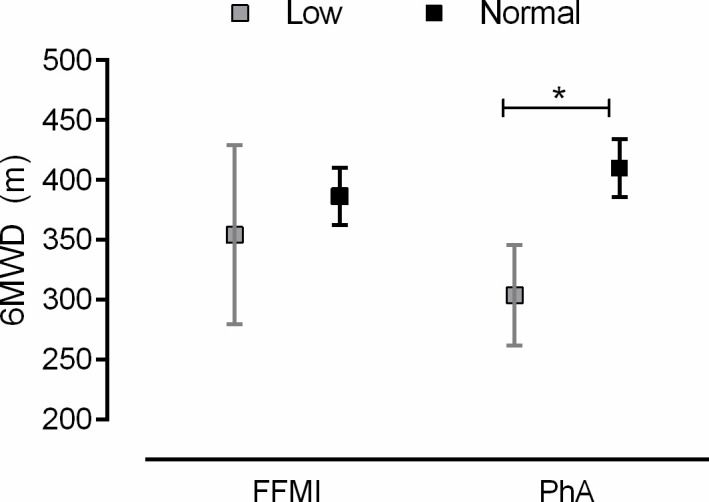
98 patients (84 males, age: 68±8 years, forced vital capacity: 64%±18%predicted) were included. 24 patients presented low PhA. They were characterised by worse lung function, exercise capacity and HRQL compared with patients with normal PhA. 10 patients presented low FFMI, but despite differences in body composition, no differences were found between these patients and patients with normal FFMI. In a single regression analysis, age, lung function and body composition variables (except FFMI) were related to 6MWD and SF-36 Physical Summary Score (R²=0.06-0.36, p<0.05). None of the variables were related to SF-36 Mental Summary Score.
One-fourth of the patients with IPF with normal to obese BMI present abnormally low PhA. Patients classified as low PhA presented worse lung function, exercise capacity and HRQL.
生物电阻抗分析(BIA)可用于估计去脂体重指数(FFMI)。然而,直接测量 BIA 变量,如相位角(PhA),已经引起了关注。特发性肺纤维化(IPF)患者中低 FFMI 和 PhA 的频率及其与运动能力和健康相关生活质量(HRQL)的关系鲜有研究。
探讨 IPF 患者低 FFMI 和 PhA 的频率及其与运动能力和 HRQL 的关系。
患者接受肺功能、身体成分、6 分钟步行距离(6MWD)运动能力评估和健康研究短表单 36 项问卷(SF-36)HRQL 评估。根据年龄、性别、体重指数(BMI)特异性参考值的第 10 百分位数,将患者分为正常或低 PhA 或 FFMI。
共纳入 98 例患者(84 例男性,年龄:68±8 岁,用力肺活量:64%±18%预计值)。24 例患者 PhA 降低。与 PhA 正常的患者相比,这些患者的肺功能、运动能力和 HRQL 更差。10 例患者 FFMI 降低,但尽管身体成分存在差异,这些患者与 FFMI 正常的患者之间没有差异。在单因素回归分析中,年龄、肺功能和身体成分变量(除 FFMI 外)与 6MWD 和 SF-36 生理总评分相关(R²=0.06-0.36,p<0.05)。没有变量与 SF-36 心理总评分相关。
四分之一的 BMI 正常至肥胖的 IPF 患者 PhA 异常降低。PhA 降低的患者肺功能、运动能力和 HRQL 更差。