Flannery Sarah E, Pastorelli Federica, Wood William H J, Hunter C Neil, Dickman Mark J, Jackson Philip J, Johnson Matthew P
Department of Molecular Biology and Biotechnology University of Sheffield Sheffield UK.
Department of Chemical and Biological Engineering University of Sheffield Sheffield UK.
Plant Direct. 2021 Oct 20;5(10):e355. doi: 10.1002/pld3.355. eCollection 2021 Oct.
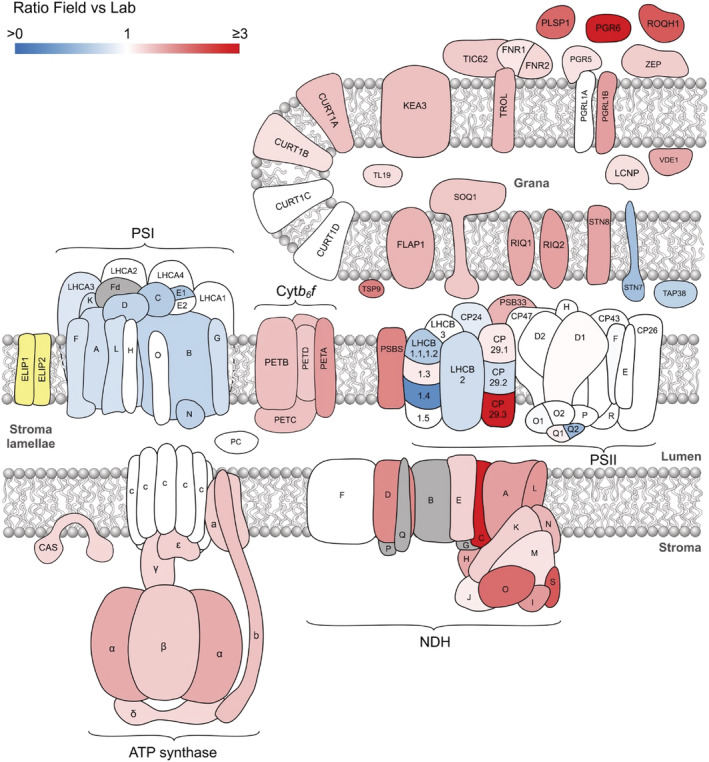
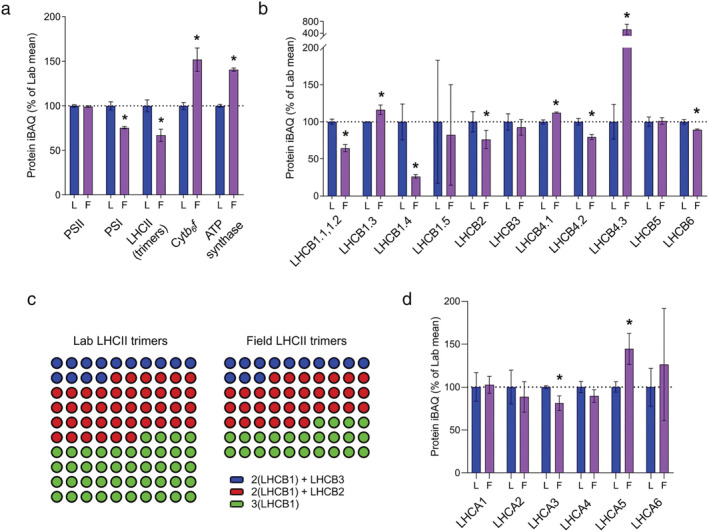
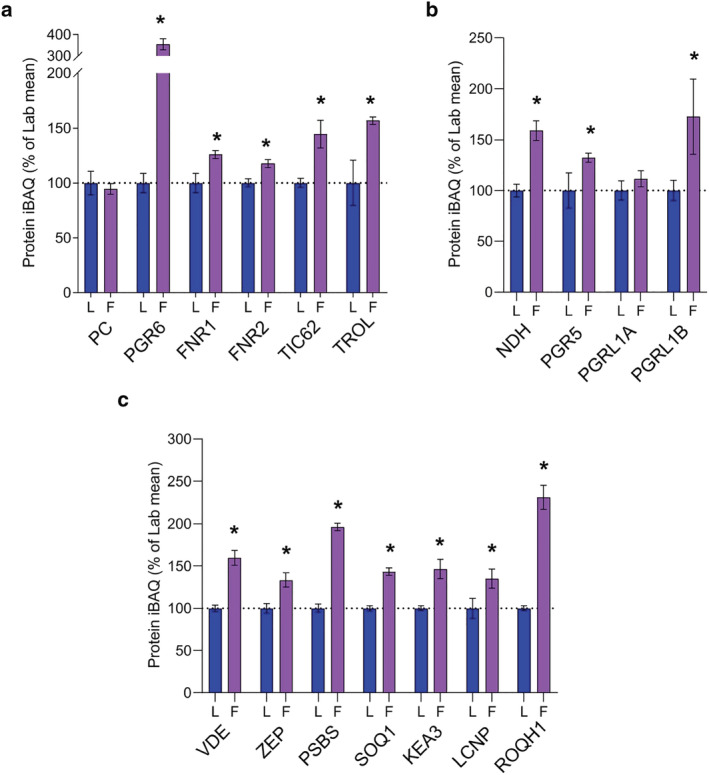
Compared to controlled laboratory conditions, plant growth in the field is rarely optimal since it is frequently challenged by large fluctuations in light and temperature which lower the efficiency of photosynthesis and lead to photo-oxidative stress. Plants grown under natural conditions therefore place an increased onus on the regulatory mechanisms that protect and repair the delicate photosynthetic machinery. Yet, the exact changes in thylakoid proteome composition which allow plants to acclimate to the natural environment remain largely unexplored. Here, we use quantitative label-free proteomics to demonstrate that field-grown Arabidopsis plants incorporate aspects of both the low and high light acclimation strategies previously observed in laboratory-grown plants. Field plants showed increases in the relative abundance of ATP synthase, cytochrome , ferredoxin-NADP reductases (FNR1 and FNR2) and their membrane tethers TIC62 and TROL, thylakoid architecture proteins CURT1A, CURT1B, RIQ1, and RIQ2, the minor monomeric antenna complex CP29.3, rapidly-relaxing non-photochemical quenching (qE)-related proteins PSBS and VDE, the photosystem II (PSII) repair machinery and the cyclic electron transfer complexes NDH, PGRL1B, and PGR5, in addition to decreases in the amounts of LHCII trimers composed of LHCB1.1, LHCB1.2, LHCB1.4, and LHCB2 proteins and CP29.2, all features typical of a laboratory high light acclimation response. Conversely, field plants also showed increases in the abundance of light harvesting proteins LHCB1.3 and CP29.1, zeaxanthin epoxidase (ZEP) and the slowly-relaxing non-photochemical quenching (qI)-related protein LCNP, changes previously associated with a laboratory low light acclimation response. Field plants also showed distinct changes to the proteome including the appearance of stress-related proteins ELIP1 and ELIP2 and changes to proteins that are largely invariant under laboratory conditions such as state transition related proteins STN7 and TAP38. We discuss the significance of these alterations in the thylakoid proteome considering the unique set of challenges faced by plants growing under natural conditions.
与受控的实验室条件相比,田间植物的生长很少处于最佳状态,因为它经常受到光照和温度的大幅波动的挑战,这些波动会降低光合作用的效率并导致光氧化应激。因此,在自然条件下生长的植物对保护和修复脆弱的光合机制的调节机制有更大的依赖。然而,类囊体蛋白质组组成的确切变化,使植物能够适应自然环境,在很大程度上仍未被探索。在这里,我们使用无标记定量蛋白质组学来证明,田间生长的拟南芥植物融合了先前在实验室生长的植物中观察到的低光和高光适应策略的各个方面。田间植物中ATP合酶、细胞色素 、铁氧还蛋白-NADP还原酶(FNR1和FNR2)及其膜连接蛋白TIC62和TROL、类囊体结构蛋白CURT1A、CURT1B、RIQ1和RIQ2、次要单体天线复合物CP29.3、快速弛豫非光化学猝灭(qE)相关蛋白PSBS和VDE、光系统II(PSII)修复机制以及循环电子传递复合物NDH、PGRL1B和PGR5的相对丰度增加,此外,由LHCB1.1、LHCB1.2、LHCB1.4和LHCB2蛋白以及CP29.2组成的LHCII三聚体的数量减少,所有这些特征都是实验室高光适应反应的典型特征。相反,田间植物中光捕获蛋白LHCB1.3和CP29.1、玉米黄质环氧化酶(ZEP)和缓慢弛豫非光化学猝灭(qI)相关蛋白LCNP的丰度也增加,这些变化以前与实验室低光适应反应有关。田间植物的蛋白质组也表现出明显的变化,包括应激相关蛋白ELIP1和ELIP2的出现,以及在实验室条件下基本不变的蛋白质的变化,如状态转换相关蛋白STN7和TAP38。我们考虑到在自然条件下生长的植物面临的独特挑战,讨论了类囊体蛋白质组中这些变化的意义。