Martín-Martín Jaime, Roldán-Jiménez Cristina, De-Torres Irene, Muro-Culebras Antonio, Escriche-Escuder Adrian, Gonzalez-Sanchez Manuel, Ruiz-Muñoz María, Mayoral-Cleries Fermin, Biró Attila, Tang Wen, Nikolova Borjanka, Salvatore Alfredo, Cuesta-Vargas Antonio I
Faculty of Health Sciences, Instituto de Investigación Biomédica de Málaga (IBIMA), Málaga, Spain.
Grupo de Clinimetria (FE-14), Instituto de Investigación Biomédica de Málaga (IBIMA), Málaga, Spain.
Front Digit Health. 2021 Jul 8;3:620383. doi: 10.3389/fdgth.2021.620383. eCollection 2021.
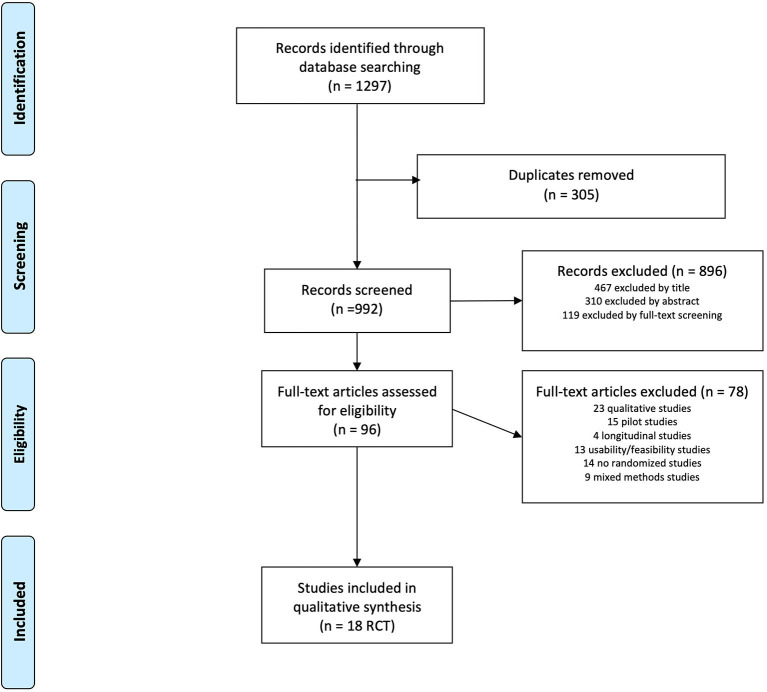
Sedentary behavior (SB) negatively impact health and is highly prevalent in the population. Digital behavior change interventions (DBCIs) have been developed to modify behaviors such as SB by technologies. However, it is unknown which behavior change techniques (BCTs) are most frequently employed in SB as well as the effect associated with DBCIs in this field. The aim of this systematic review was: (a) to evaluate the BCT most frequently employed in digital health including all technologies available and interventions aimed at increasing physical activity (PA), reducing sedentary time, and improving adherence to exercise in the clinical population, and (b) to review the effect associated with DBCIs in this field. The database used was Medline, as well as Scopus, Scielo, and Google Scholar. For the search strategy, we considered versions of behavior/behavioral, mHealth/eHealth/telemedicine/serious game/gamification. The terms related to PA and SB were included, the criteria for inclusion were randomized clinical trials (RCTs), adults, intervention based on digital media, and outcome variable lifestyle modification; a last 5 years filter was included. Michie's Taxonomy was used to identify BCTs. The study was registered under the number PROSPERO CRD42019138681. Eighteen RCTs were included in the present systematic review, 5 of them healthy adults, and 13 of them with some illness. Studies included 2298 sedentary individuals who were followed up for 5 weeks-3 years. The most used BCTs were goal setting, problem solving, review outcomes/goals, feedback on behavior and outcomes of behavior, self-monitoring of behavior, social support, information about health consequences, and behavior practice/rehearsal. The effect associated with DBCIs showed improvements, among several related to PA and physiologic self-reported and anthropometric outcomes. The BCTs most used in digital health to change outcomes related to SB were goals and planning, feedback and monitoring, social support, natural consequences, repetition, and substitution. Besides these findings, DBCIs are influenced by several factors like the type of intervention, patients' preferences and values, or the number of BCTs employed. More research is needed to determine with precision which DBCIs or BCTs are the most effective to reduce SB in the clinical population.
久坐行为(SB)对健康有负面影响,且在人群中非常普遍。数字行为改变干预措施(DBCIs)已被开发出来,通过技术手段来改变诸如久坐行为等行为。然而,尚不清楚在久坐行为中最常采用哪些行为改变技术(BCTs),以及该领域中数字行为改变干预措施的效果如何。本系统评价的目的是:(a)评估数字健康中最常采用的行为改变技术,包括所有可用技术以及旨在增加临床人群身体活动(PA)、减少久坐时间和提高运动依从性的干预措施;(b)综述该领域中数字行为改变干预措施的效果。所使用的数据库是Medline以及Scopus、Scielo和谷歌学术。对于检索策略,我们考虑了行为/行为学的不同版本、移动健康/电子健康/远程医疗/严肃游戏/游戏化。纳入了与身体活动和久坐行为相关的术语,纳入标准为随机临床试验(RCTs)、成年人、基于数字媒体的干预措施以及结果变量为生活方式改变;设置了过去5年的时间筛选条件。采用米基分类法来识别行为改变技术。该研究在PROSPERO注册,注册号为CRD42019138681。本系统评价纳入了18项随机临床试验,其中5项针对健康成年人,13项针对患有某种疾病的人群。研究纳入了2298名久坐个体,随访时间为5周 - 3年。最常用的行为改变技术包括目标设定、问题解决、回顾结果/目标、行为和行为结果反馈、行为自我监测、社会支持、健康后果信息以及行为练习/预演。数字行为改变干预措施的效果显示出改善,涉及与身体活动以及自我报告的生理和人体测量结果相关的多个方面。数字健康中最常用于改变与久坐行为相关结果的行为改变技术是目标与规划、反馈与监测、社会支持、自然结果、重复和替代。除了这些发现外,数字行为改变干预措施还受到多种因素的影响,如干预类型、患者偏好和价值观或所采用的行为改变技术数量。需要更多研究来精确确定哪些数字行为改变干预措施或行为改变技术在临床人群中减少久坐行为最为有效。