Düsseldorf Catholic Hospital Group, West-German Centre of Diabetes and Health, Düsseldorf, Germany.
Faculty of Medicine, Heinrich Heine University Düsseldorf, Düsseldorf, Germany.
BMJ Open. 2019 Apr 11;9(4):e022242. doi: 10.1136/bmjopen-2018-022242.
We examined the effect of a telemedical coaching (TMC) programme accompanied with or without telemonitoring on weight loss in an occupational healthcare setting with a three-armed randomised controlled trial (NCT01837134 'Pre-results').
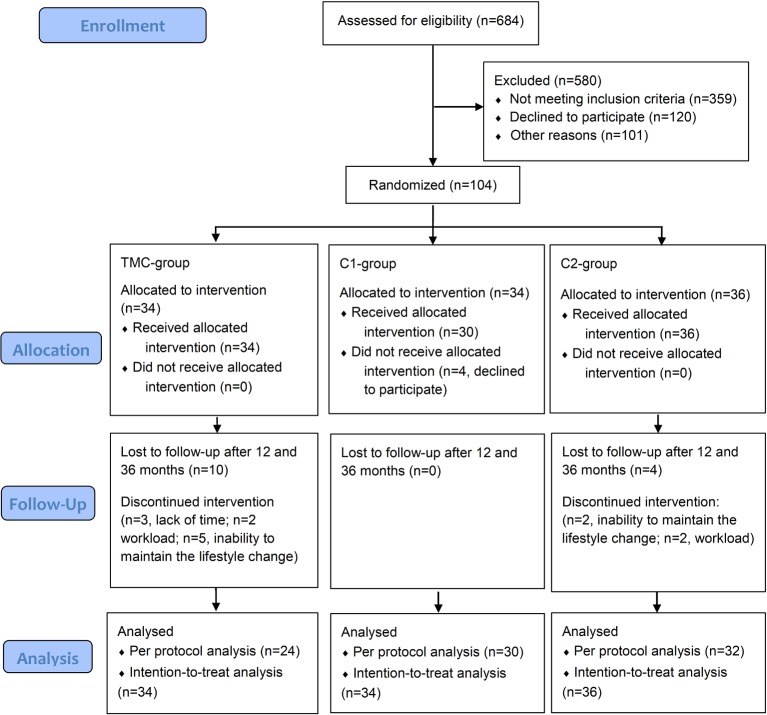
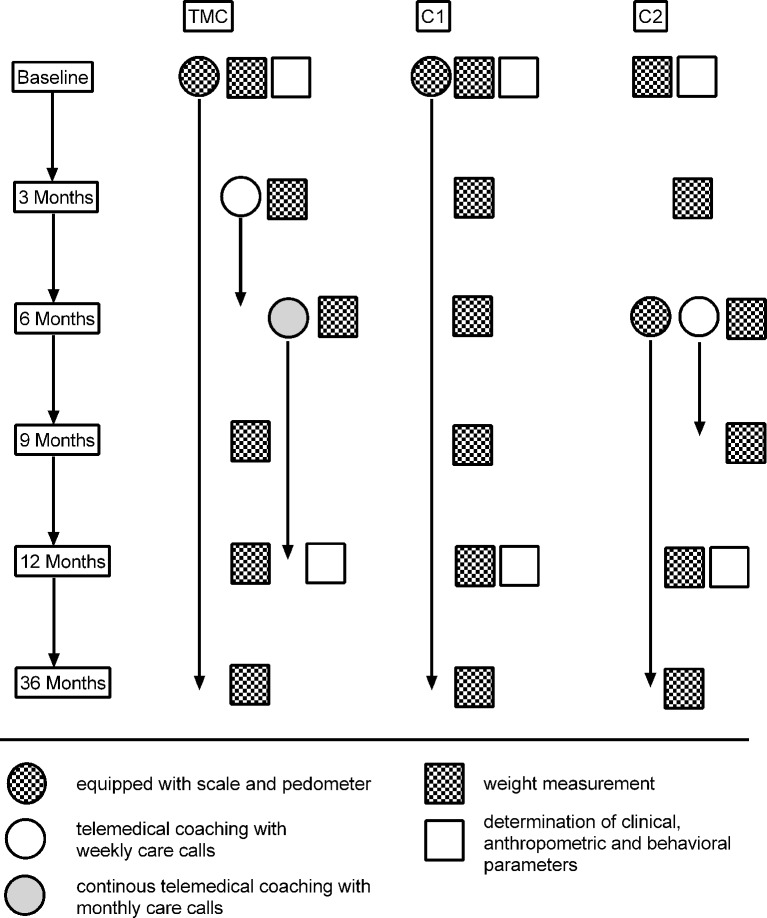
Overweight employees (n=104, body mass index [BMI] ≥25 kg/m) were invited by their medical corporate department and randomised into either a TMC group (n=34) or in one of the two control groups (C1, n=34; C2, n=36). TMC and C1 were equipped with telemonitoring devices (scales and pedometers) at baseline, and C2 after 6 months. Telemonitoring devices automatically transferred data into a personalised online portal. TMC was coached with weekly care calls in months 3-6 and monthly calls from months 7 to 12. C2 had a short coaching phase in months 6-9. C1 received no further support. After the 12-month intervention phase, participants could take advantage of further company health promotion offers. Follow-up data were determined after 12 months of intervention and per-protocol (PP) and intention-to-treat (ITT) analyses were performed. Weight change was followed up after 36 months. Estimated treatment difference (ETD) was calculated for weight reduction.
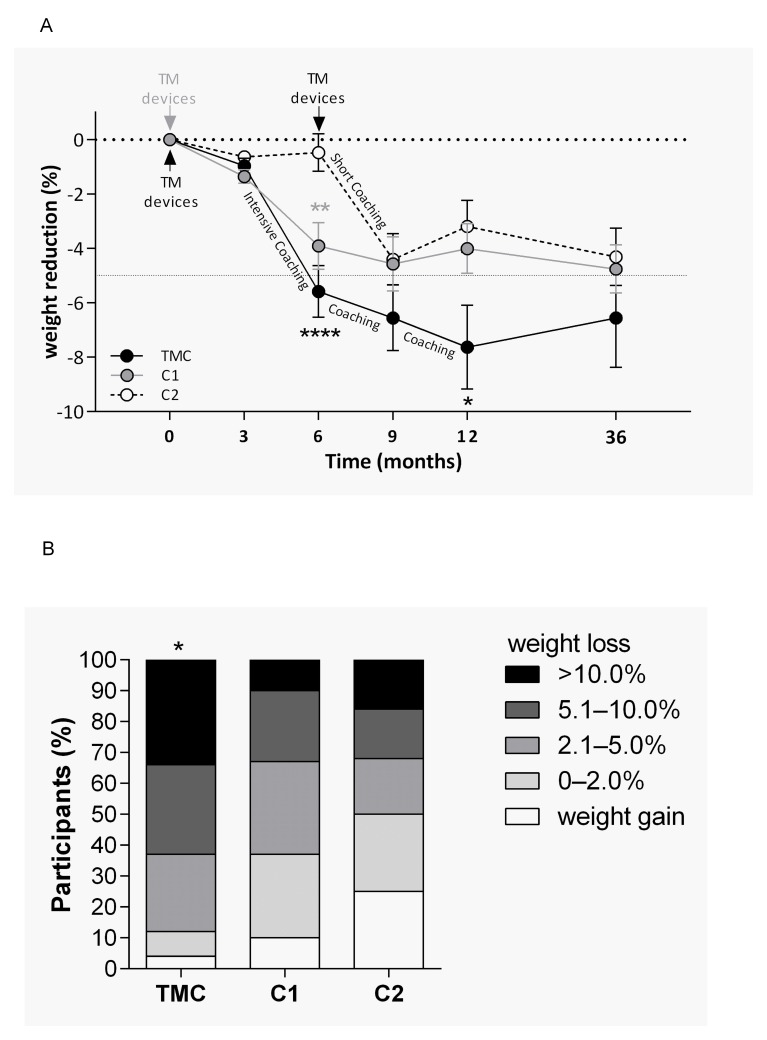
ETD from TMC to C1 (-3.6 kg 95% CI -7.40 to -0.1, p=0.047) and to C2 (-4.2 kg [-7.90 to -0.5], p=0.026) was significantly different at the 12 months follow-up in the PP-analysis, but lost significance in the ITT analysis. All groups reduced weight after 12 months (-3.3 to -8.4 kg [5.5-10.3 kg], all p<0.01) and sustained it during the 36 months follow-up (-4.8 to -7.8 kg [5.6-12.8 kg], all p<0.01). ETD analyses revealed no difference between all groups neither in the PP nor in the ITT analysis at the 3 years follow-up. All groups reduced BMI, systolic and diastolic blood pressure and improved eating behaviour in the PP or ITT analyses.
TMC and/or telemonitoring support long-term weight reduction in overweight employees. The combination of both interventions points towards an additional effect.
NCT01837134.
我们通过一项三臂随机对照试验(NCT01837134“预结果”),研究了在职业健康保健环境中,医疗远程辅导(TMC)计划辅以或不辅以远程监测对体重减轻的影响。
超重员工(n=104,体重指数[BMI]≥25kg/m2)由其医疗部门邀请,并随机分为 TMC 组(n=34)或两个对照组之一(C1,n=34;C2,n=36)。TMC 和 C1 在基线时配备了远程监测设备(秤和计步器),C2 在 6 个月后配备。远程监测设备自动将数据传输到个性化在线门户。TMC 在 3-6 个月期间进行每周一次的护理电话辅导,并在 7-12 个月期间每月进行一次电话辅导。C2 在 6-9 个月期间进行短期辅导阶段。C1 未获得进一步的支持。干预 12 个月后,参与者可以利用公司提供的进一步健康促进服务。在干预后 12 个月确定随访数据,并进行意向治疗(ITT)和符合方案(PP)分析。36 个月后随访体重变化。计算减重的估计治疗差异(ETD)。
在 PP 分析中,TMC 与 C1(-3.6kg,95%CI-7.40 至-0.1,p=0.047)和 C2(-4.2kg[-7.90 至-0.5],p=0.026)的 12 个月随访时的 ETD 差异具有统计学意义,但在 ITT 分析中失去了意义。所有组在 12 个月后体重均减轻(-3.3 至-8.4kg[5.5-10.3kg],均 p<0.01),并且在 36 个月随访期间保持不变(-4.8 至-7.8kg[5.6-12.8kg],均 p<0.01)。在 3 年随访时,在 PP 或 ITT 分析中,ETD 分析未显示各组之间存在差异。在 PP 或 ITT 分析中,所有组均降低了 BMI、收缩压和舒张压,并改善了饮食习惯。
TMC 和/或远程监测支持超重员工的长期减重。两种干预措施的结合表明具有额外的效果。
NCT01837134。