Leibniz Institute for Prevention Research and Epidemiology-BIPS, Bremen, Germany.
Department of Public and Occupational Health, Amsterdam Public Health Research Institute, VU University Medical Center, Amsterdam, Netherlands.
PLoS One. 2019 Jan 30;14(1):e0211546. doi: 10.1371/journal.pone.0211546. eCollection 2019.
Decreasing sedentary behaviour (SB) has emerged as a public health priority since prolonged sitting increases the risk of non-communicable diseases. Mostly, the independent association of factors with SB has been investigated, although lifestyle behaviours are conditioned by interdependent factors. Within the DEDIPAC Knowledge Hub, a system of sedentary behaviours (SOS)-framework was created to take interdependency among multiple factors into account. The SOS framework is based on a system approach and was developed by combining evidence synthesis and expert consensus. The present study conducted a Bayesian network analysis to investigate and map the interdependencies between factors associated with SB through the life-course from large scale empirical data.
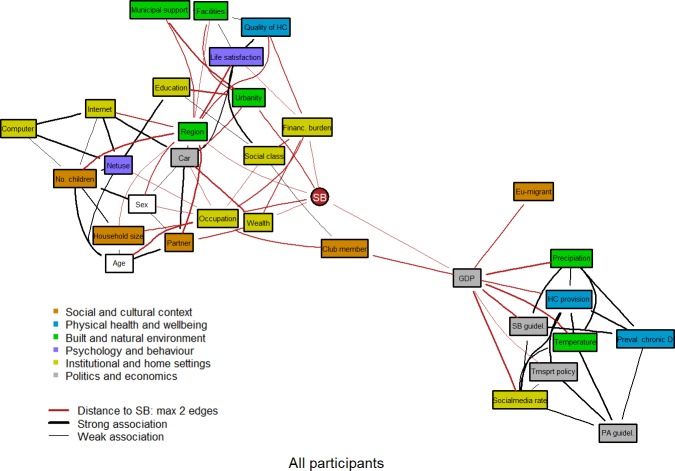
Data from the Eurobarometer survey (80.2, 2013) that included the International physical activity questionnaire (IPAQ) short as well as socio-demographic information and questions on perceived environment, health, and psychosocial information were enriched with macro-level data from the Eurostat database. Overall, 33 factors were identified aligned to the SOS-framework to represent six clusters on the individual or regional level: 1) physical health and wellbeing, 2) social and cultural context, 3) built and natural environment, 4) psychology and behaviour, 5) institutional and home settings, 6) policy and economics. A Bayesian network analysis was conducted to investigate conditional associations among all factors and to determine their importance within these networks. Bayesian networks were estimated for the complete (23,865 EU-citizens with complete data) sample and for sex- and four age-specific subgroups. Distance and centrality were calculated to determine importance of factors within each network around SB.
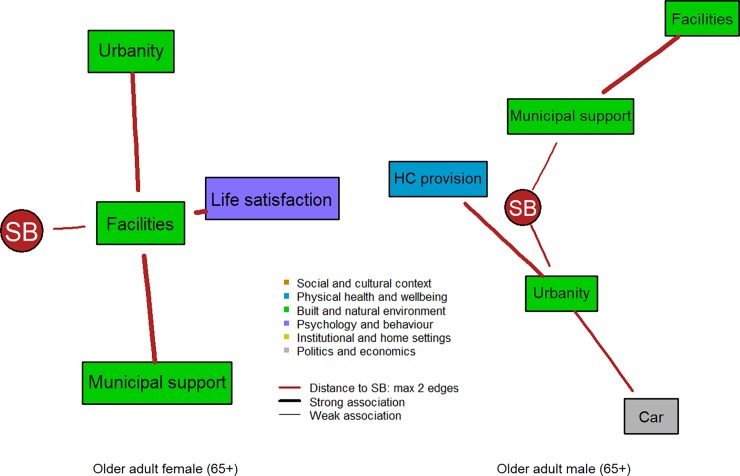
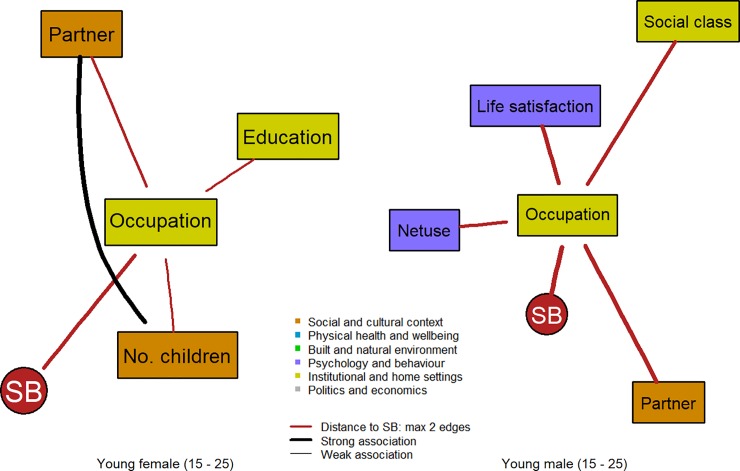
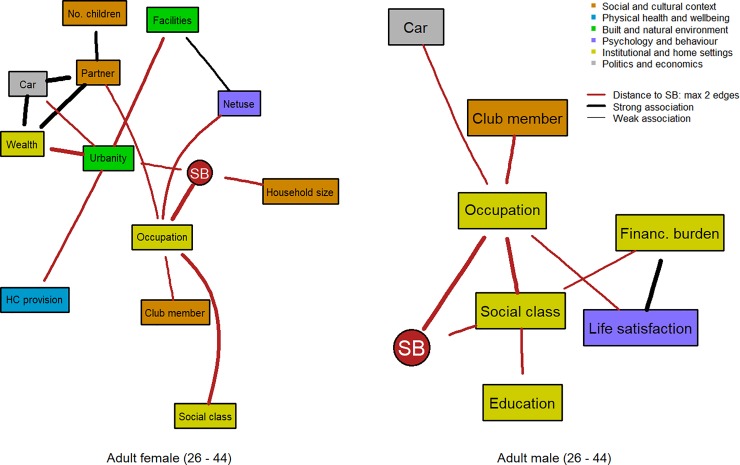
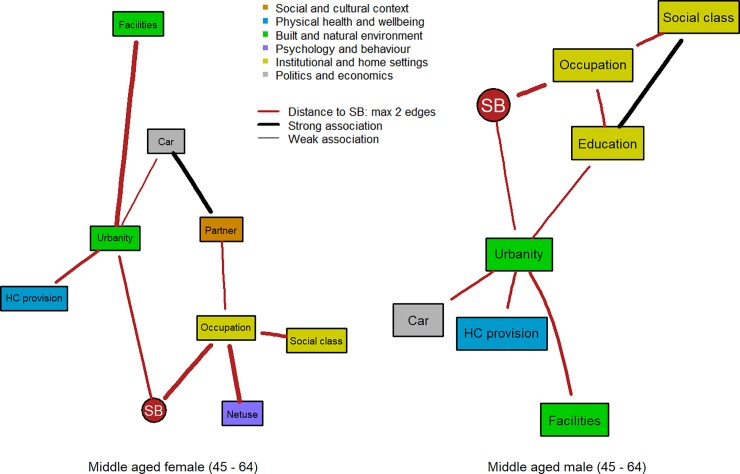
In the young (15-25), adult (26-44), and middle-aged (45-64) groups occupational level was directly associated with SB for both, men and women. Consistently, social class and educational level were indirectly associated within male adult groups, while in women factors of the family context were indirectly associated with SB. Only in older adults, factors of the built environment were relevant with regard to SB, while factors of the home and institutional settings were less important compared to younger age groups.
Factors of the home and institutional settings as well as the social and cultural context were found to be important in the network of associations around SB supporting the priority for future research in these clusters. Particularly, occupational status was found to be the main driver of SB through the life-course. Investigating conditional associations by Bayesian networks gave a better understanding of the complex interplay of factors being associated with SB. This may provide detailed insights in the mechanisms behind the burden of SB to effectively inform policy makers for detailed intervention planning. However, considering the complexity of the issue, there is need for a more comprehensive system of data collection including objective measures of sedentary time.
由于长时间久坐会增加患非传染性疾病的风险,因此减少久坐行为已成为公共卫生的重点。尽管生活方式行为受到相互依存因素的影响,但大多数研究都只关注了各种因素与久坐行为之间的独立关联。在 DEDIPAC 知识中心,创建了一个坐姿行为系统(SOS)框架,以考虑到多个因素之间的相互依存关系。SOS 框架基于系统方法,通过结合证据综合和专家共识进行开发。本研究通过大型实证数据,采用贝叶斯网络分析来研究和绘制与整个生命过程中与 SB 相关的因素之间的相互依赖关系。
该研究的数据来自 Eurobarometer 调查(2013 年 80.2 期),其中包括国际体力活动问卷(IPAQ)短表以及社会人口统计学信息和有关感知环境、健康和心理社会信息的问题,并使用来自 Eurostat 数据库的宏观水平数据进行了丰富。总共确定了 33 个因素,这些因素与 SOS 框架相匹配,代表了个体或区域层面的六个群组:1)身体健康和福利;2)社会和文化背景;3)建筑和自然环境;4)心理和行为;5)机构和家庭环境;6)政策和经济。为了研究所有因素之间的条件关联,并确定它们在这些网络中的重要性,进行了贝叶斯网络分析。为完整(23865 名具有完整数据的欧盟公民)样本和性别及四个年龄特定亚组估计了贝叶斯网络。距离和中心度用于确定围绕 SB 的每个网络中因素的重要性。
在年轻(15-25 岁)、成年(26-44 岁)和中年(45-64 岁)人群中,职业水平与男性和女性的 SB 直接相关。一致的是,在男性成年人群中,社会阶层和教育水平与 SB 间接相关,而在女性中,家庭环境因素与 SB 间接相关。只有在老年人中,建筑环境因素与 SB 相关,而与年轻人群体相比,家庭和机构环境因素的重要性较低。
家庭和机构环境因素以及社会和文化背景被发现是围绕 SB 的关联网络中的重要因素,这支持了未来在这些群组中进行研究的优先级。特别是,职业地位被发现是整个生命过程中 SB 的主要驱动因素。通过贝叶斯网络研究条件关联,使我们更好地理解了与 SB 相关的各种因素之间的复杂相互作用。这可以为政策制定者提供有关 SB 负担背后机制的详细信息,以有效为其提供详细的干预计划。但是,考虑到问题的复杂性,需要建立一个更全面的数据收集系统,包括对久坐时间的客观测量。