Asbjørnsen Rikke Aune, Smedsrød Mirjam Lien, Solberg Nes Lise, Wentzel Jobke, Varsi Cecilie, Hjelmesæth Jøran, van Gemert-Pijnen Julia Ewc
Center for eHealth and Wellbeing Research, Department of Psychology, Health, and Technology, University of Twente, Enschede, Netherlands.
Research and Innovation Department, Vestfold Hospital Trust, Tønsberg, Norway.
J Med Internet Res. 2019 Jun 21;21(6):e14265. doi: 10.2196/14265.
Maintaining weight after weight loss is a major health challenge, and eHealth (electronic health) solutions may be a way to meet this challenge. Application of behavior change techniques (BCTs) and persuasive system design (PSD) principles in eHealth development may contribute to the design of technologies that positively influence behavior and motivation to support the sustainable health behavior change needed.
This review aimed to identify BCTs and PSD principles applied in eHealth interventions to support weight loss and weight loss maintenance, as well as techniques and principles applied to stimulate motivation and adherence for long-term weight loss maintenance.
A systematic literature search was conducted in PsycINFO, Ovid MEDLINE (including PubMed), EMBASE, Scopus, Web of Science, and AMED, from January 1, 2007 to June 30, 2018. Arksey and O'Malley's scoping review methodology was applied. Publications on eHealth interventions were included if focusing on weight loss or weight loss maintenance, in combination with motivation or adherence and behavior change.
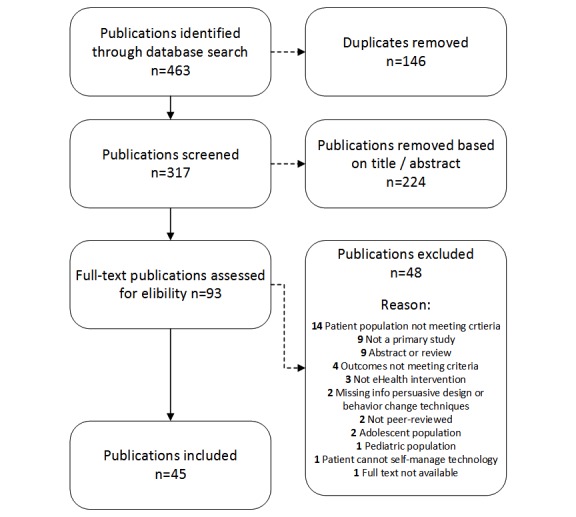
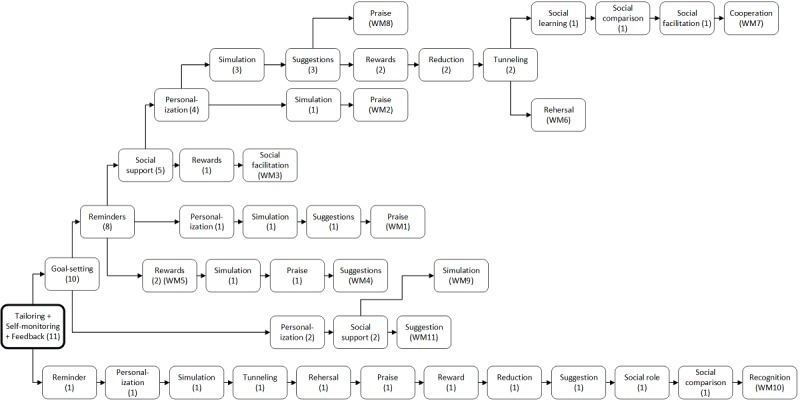
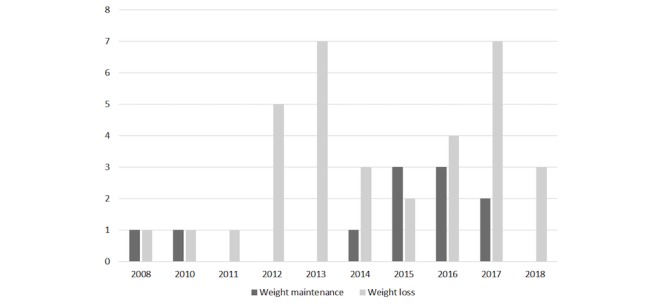
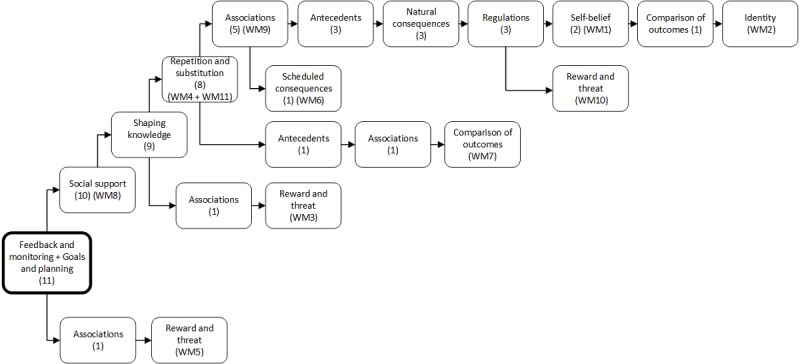
The search identified 317 publications, of which 45 met the inclusion criteria. Of the 45 publications, 11 (24%) focused on weight loss maintenance, and 34 (76%) focused on weight loss. Mobile phones were the most frequently used technology (28/45, 62%). Frequently used wearables were activity trackers (14/45, 31%), as well as other monitoring technologies such as wireless or digital scales (8/45, 18%). All included publications were anchored in behavior change theories. Feedback and monitoring and goals and planning were core behavior change technique clusters applied in the majority of included publications. Social support and associations through prompts and cues to support and maintain new habits were more frequently used in weight loss maintenance than weight loss interventions. In both types of interventions, frequently applied persuasive principles were self-monitoring, goal setting, and feedback. Tailoring, reminders, personalization, and rewards were additional principles frequently applied in weight loss maintenance interventions. Results did not reveal an ideal combination of techniques or principles to stimulate motivation, adherence, and weight loss maintenance. However, the most frequently mentioned individual techniques and principles applied to stimulate motivation were, personalization, simulation, praise, and feedback, whereas associations were frequently mentioned to stimulate adherence. eHealth interventions that found significant effects for weight loss maintenance all applied self-monitoring, feedback, goal setting, and shaping knowledge, combined with a human social support component to support healthy behaviors.
To our knowledge, this is the first review examining key BCTs and PSD principles applied in weight loss maintenance interventions compared with those of weight loss interventions. This review identified several techniques and principles applied to stimulate motivation and adherence. Future research should aim to examine which eHealth design combinations can be the most effective in support of long-term behavior change and weight loss maintenance.
减肥后维持体重是一项重大的健康挑战,电子健康(eHealth)解决方案可能是应对这一挑战的一种方式。在电子健康发展中应用行为改变技术(BCTs)和说服系统设计(PSD)原则,可能有助于设计出对行为和动机产生积极影响的技术,以支持所需的可持续健康行为改变。
本综述旨在确定电子健康干预措施中应用的行为改变技术和说服系统设计原则,以支持减肥和体重维持,以及用于激发长期体重维持的动机和依从性的技术和原则。
于2007年1月1日至2018年6月30日在PsycINFO、Ovid MEDLINE(包括PubMed)、EMBASE、Scopus、Web of Science和AMED中进行了系统的文献检索。采用了Arksey和O'Malley的范围综述方法。如果电子健康干预措施的出版物聚焦于减肥或体重维持,并结合动机、依从性和行为改变,则纳入其中。
检索到317篇出版物,其中45篇符合纳入标准。在这45篇出版物中,11篇(24%)聚焦于体重维持,34篇(76%)聚焦于减肥。手机是最常用的技术(28/45,62%)。常用的可穿戴设备是活动追踪器(14/45,31%),以及其他监测技术,如无线或数字秤(8/45,18%)。所有纳入的出版物均以行为改变理论为基础。反馈与监测以及目标与计划是大多数纳入出版物中应用的核心行为改变技术集群。与减肥干预相比,通过提示和线索提供社会支持和关联以支持和维持新习惯在体重维持中使用得更频繁。在这两种干预类型中,常用的说服原则是自我监测、目标设定和反馈。定制、提醒、个性化和奖励是体重维持干预中经常应用的其他原则。结果未揭示出用于激发动机、依从性和体重维持的理想技术或原则组合。然而,最常提到的用于激发动机的个体技术和原则是个性化、模拟、赞扬和反馈,而关联则经常被提及以激发依从性。对体重维持有显著效果的电子健康干预措施均应用了自我监测、反馈、目标设定和塑造知识,并结合了人类社会支持成分以支持健康行为。
据我们所知,这是第一项比较减肥干预措施与体重维持干预措施中应用的关键行为改变技术和说服系统设计原则的综述。本综述确定了几种用于激发动机和依从性的技术和原则。未来的研究应旨在研究哪种电子健康设计组合在支持长期行为改变和体重维持方面可能最有效。