Santos Mauro D, Roman Cristian, Pimentel Marco A F, Vollam Sarah, Areia Carlos, Young Louise, Watkinson Peter, Tarassenko Lionel
Department of Engineering Science, Institute of Biomedical Engineering, University of Oxford, Oxford, United Kingdom.
Critical Care Research Group, Nuffield Department of Clinical Neurosciences, University of Oxford, Oxford, United Kingdom.
Front Digit Health. 2021 Sep 7;3:630273. doi: 10.3389/fdgth.2021.630273. eCollection 2021.
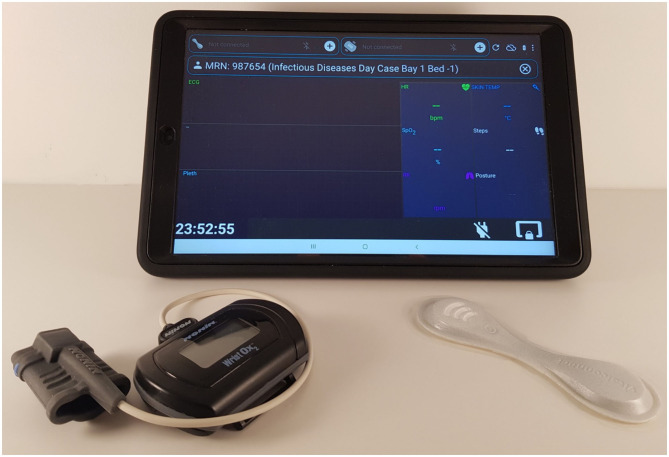
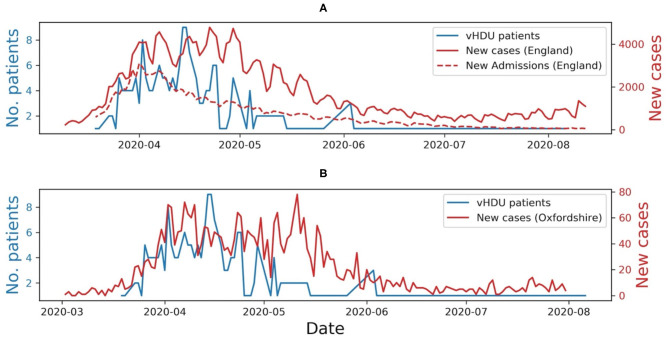
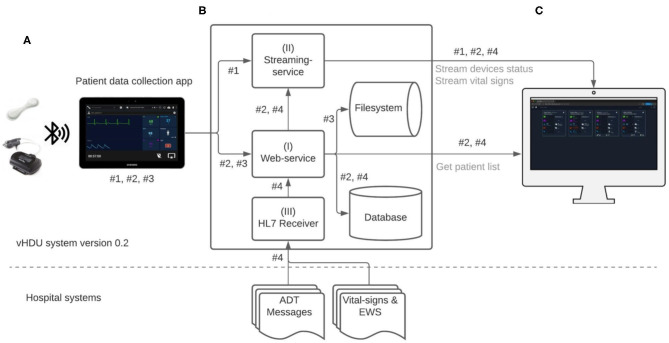
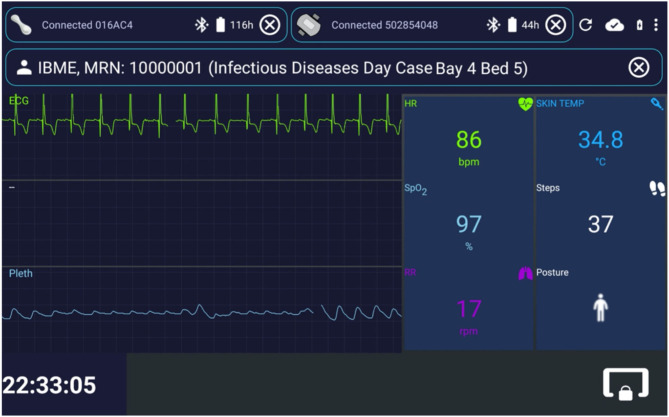
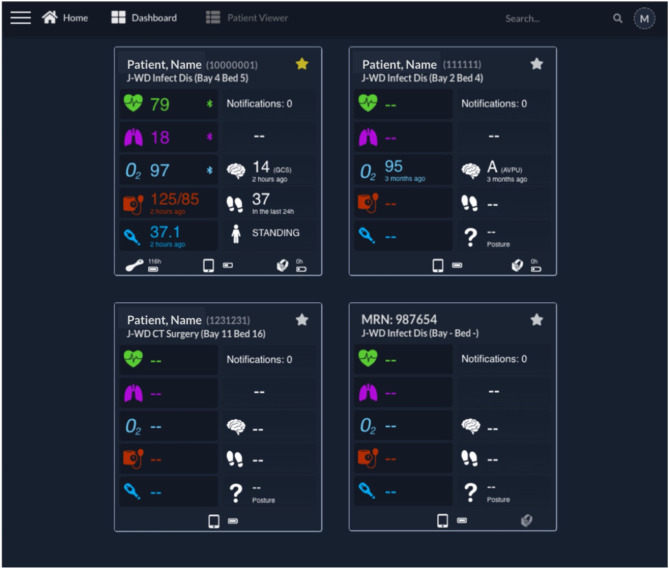
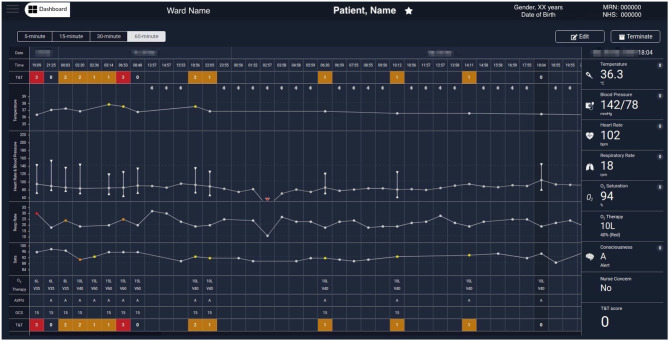
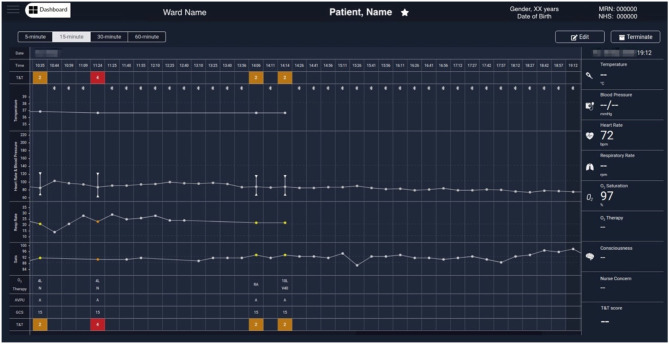
The challenges presented by the Coronavirus disease 2019 (COVID-19) pandemic to the National Health Service (NHS) in the United Kingdom (UK) led to a rapid adaptation of infection disease protocols in-hospital. In this paper we report on the optimisation of our wearable ambulatory monitoring system (AMS) to monitor COVID-19 patients on isolation wards. A wearable chest patch (VitalPatch®, VitalConnect, United States of America, USA) and finger-worn pulse oximeter (WristOx2® 3150, Nonin, USA) were used to estimate and transmit continuous Heart Rate (HR), Respiratory Rate (RR), and peripheral blood Oxygen Saturation (SpO) data from ambulatory patients on these isolation wards to nurse bays remote from these patients, with a view to minimising the risk of infection for nursing staff. Our virtual High-Dependency Unit (vHDU) system used a secure web-based architecture and protocols (HTTPS and encrypted WebSockets) to transmit the vital-sign data in real time from wireless Android tablet devices, operating as patient data collection devices by the bedside in the isolation rooms, into the clinician dashboard interface available remotely any modern web-browser. Fault-tolerant software strategies were used to reconnect the wearables automatically, avoiding the need for nurses to enter the isolation ward to re-set the patient monitoring equipment. The remote dashboard also displayed the vital-sign observations recorded by the nurses, using a separate electronic observation system, allowing them to review both sources of vital-sign data in one integrated chart. System usage was found to follow the trend of the number of local COVID-19 infections during the first wave of the pandemic in the UK (March to June 2020), with almost half of the patients on the isolation ward monitored with wearables during the peak of hospital admissions in the local area. Patients were monitored for a median of 31.5 [8.8, 75.4] hours, representing 88.1 [62.5, 94.5]% of the median time they were registered in the system. This indicates the system was being used in the isolation ward during this period. An updated version of the system has now also been used throughout the second and third waves of the pandemic in the UK.
2019年冠状病毒病(COVID-19)大流行给英国国家医疗服务体系(NHS)带来了诸多挑战,促使医院迅速调整传染病防治方案。在本文中,我们报告了对可穿戴动态监测系统(AMS)进行优化,以用于隔离病房中COVID-19患者的监测情况。使用了一款可穿戴式胸部贴片(VitalPatch®,VitalConnect公司,美国)和一款手指佩戴式脉搏血氧仪(WristOx2® 3150,Nonin公司,美国),用于估算并传输隔离病房中行动自如患者的心率(HR)、呼吸频率(RR)和外周血氧饱和度(SpO)等连续数据,传送到远离这些患者的护士站,目的是将护理人员的感染风险降至最低。我们的虚拟高依赖病房(vHDU)系统采用安全的基于网络的架构和协议(HTTPS和加密WebSocket),将生命体征数据从无线安卓平板电脑设备实时传输,这些平板电脑设备在隔离病房床边作为患者数据收集设备使用,传输到可通过任何现代网络浏览器远程访问的临床医生仪表板界面。采用了容错软件策略来自动重新连接可穿戴设备,无需护士进入隔离病房重新设置患者监测设备。远程仪表板还使用单独的电子观察系统显示护士记录的生命体征观察结果,使他们能够在一个综合图表中查看两种生命体征数据来源。在英国第一波疫情(2020年3月至6月)期间,发现系统使用情况与当地COVID-19感染人数的趋势相符,在当地医院入院高峰期间,隔离病房中近一半的患者使用了可穿戴设备进行监测。患者的监测时间中位数为31.5 [8.8, 75.4]小时,占其在系统中登记时间中位数的88.1 [62.5, 94.5]%。这表明在此期间该系统在隔离病房中得到了应用。该系统的更新版本目前也已在英国第二波和第三波疫情期间得到了全面使用。