Downey Candice, Ng Shu, Jayne David, Wong David
Leeds Institute of Medical Research at St. James's, University of Leeds, Leeds, UK
School of Medicine, University of Leeds, Leeds, UK.
BMJ Open. 2019 Aug 15;9(8):e031150. doi: 10.1136/bmjopen-2019-031150.
To validate whether a wearable remote vital signs monitor could accurately measure heart rate (HR), respiratory rate (RR) and temperature in a postsurgical patient population at high risk of complications.
Manually recorded vital signs data were paired with vital signs data derived from the remote monitor set in patients participating in the Trial of Remote versus Continuous INtermittent monitoring (TRaCINg) study: a trial of continuous remote vital signs monitoring.
St James's University Hospital, UK.
51 patients who had undergone major elective general surgery.
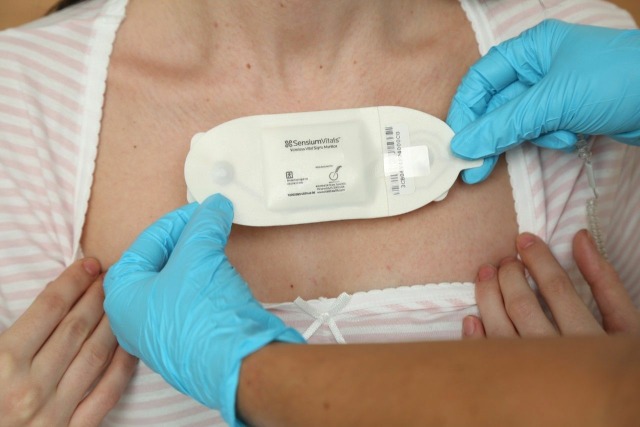
The intervention was the SensiumVitals monitoring system. This is a wireless patch worn on the patient's chest that measures HR, RR and temperature continuously. The reference standard was nurse-measured manually recorded vital signs.
The primary outcomes were the 95% limits of agreement between manually recorded and wearable patch vital sign recordings of HR, RR and temperature. The secondary outcomes were the percentage completeness of vital sign patch data for each vital sign.
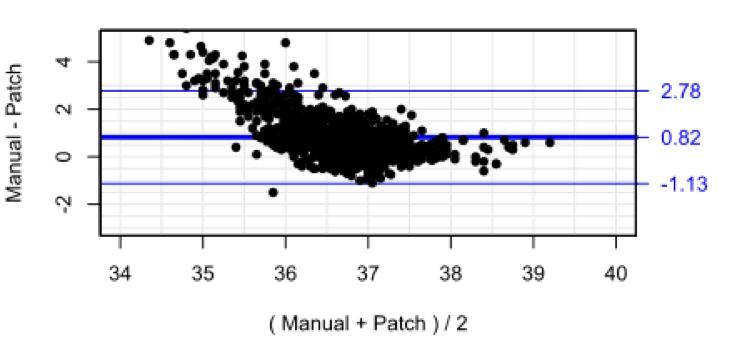
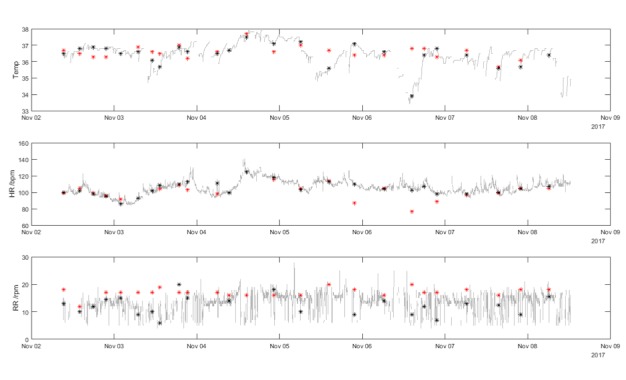
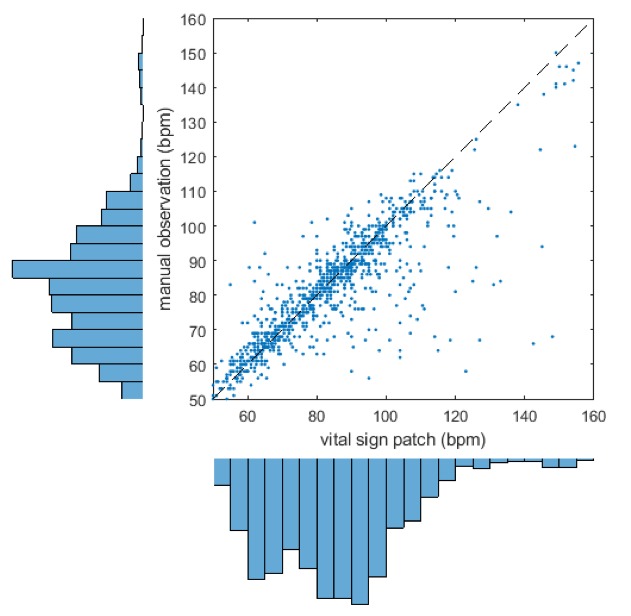
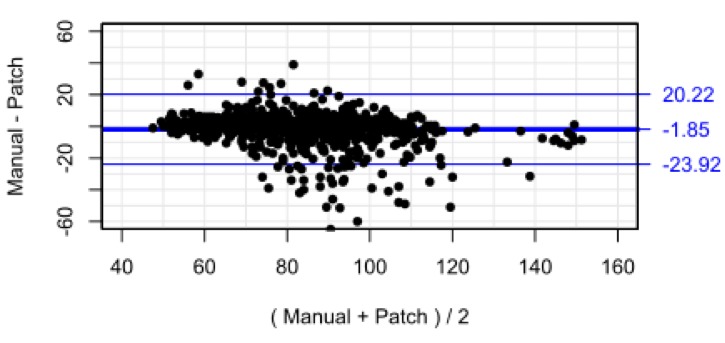
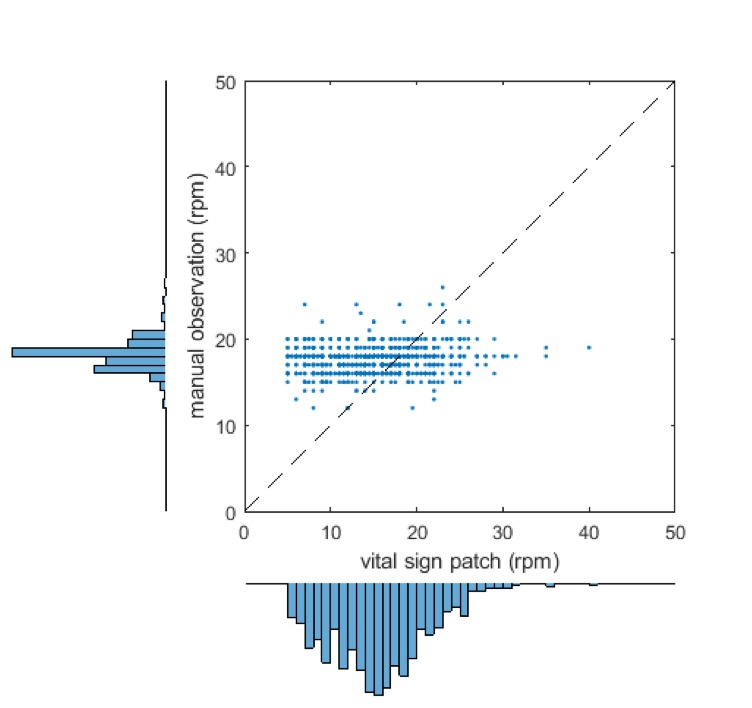
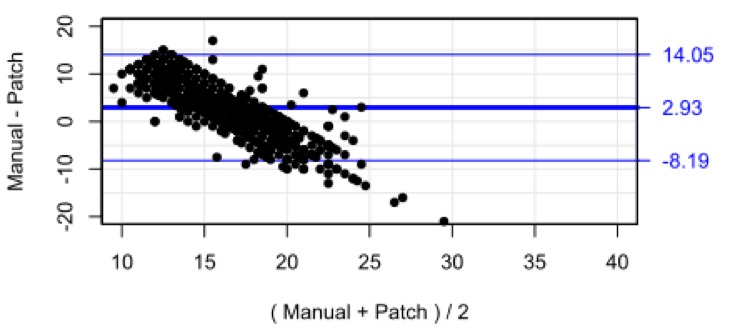
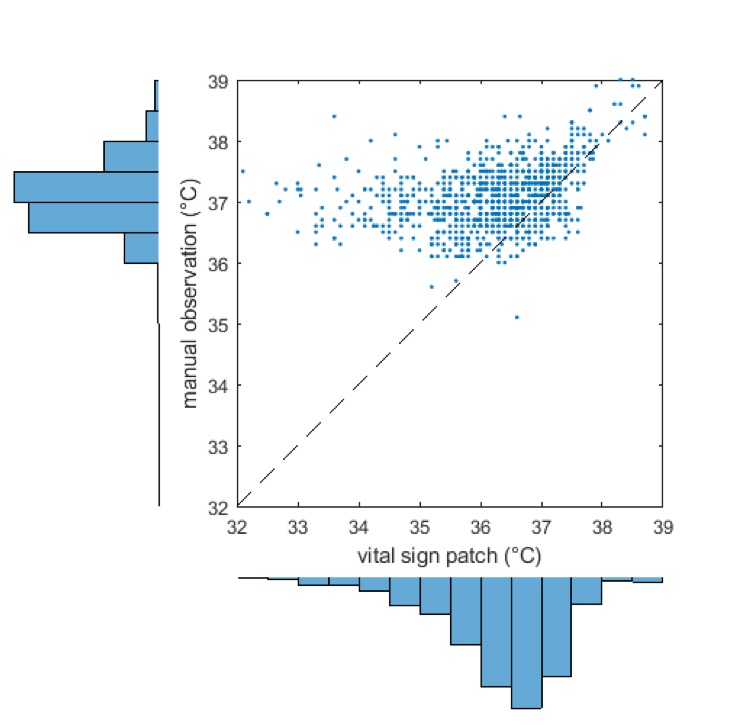
1135 nurse observations were available for analysis. There was no clinically meaningful bias in HR (1.85 bpm), but precision was poor (95% limits of agreement -23.92 to 20.22 bpm). Agreement was poor for RR (bias 2.93 breaths per minute, 95% limits of agreement -8.19 to 14.05 breaths per minute) and temperature (bias 0.82C, 95% limits of agreement -1.13C to 2.78C). Vital sign patch data completeness was 72.8% for temperature, 59.2% for HR and 34.1% for RR. Distributions of RR in manually recorded measurements were clinically implausible.
The continuous monitoring system did not reliably provide HR consistent with nurse measurements. The accuracy of RR and temperature was outside of acceptable limits. Limitations of the system could potentially be overcome through better signal processing. While acknowledging the time pressures placed on nursing staff, inaccuracies in the manually recorded data present an opportunity to increase awareness about the importance of manual observations, particularly with regard to methods of manual HR and RR measurements.
验证一款可穿戴远程生命体征监测仪能否准确测量并发症高风险的术后患者群体的心率(HR)、呼吸频率(RR)和体温。
在参与远程与连续间歇监测试验(TRaCINg)研究(一项连续远程生命体征监测试验)的患者中,将手动记录的生命体征数据与远程监测仪获取的生命体征数据进行配对。
英国圣詹姆斯大学医院。
51例接受了大型择期普通外科手术的患者。
干预措施为SensiumVitals监测系统。这是一种佩戴在患者胸部的无线贴片,可连续测量HR、RR和体温。参考标准是护士手动记录测量的生命体征。
主要结局是手动记录与可穿戴贴片记录的HR、RR和体温之间的95%一致性界限。次要结局是每个生命体征的生命体征贴片数据的完整率。
有1135次护士观察结果可供分析。HR方面无临床意义的偏差(1.85次/分钟),但精密度较差(95%一致性界限为-23.92至20.22次/分钟)。RR(偏差2.93次/分钟,95%一致性界限为-8.19至14.05次/分钟)和体温(偏差0.82℃,95%一致性界限为-1.13℃至2.78℃)的一致性较差。生命体征贴片数据的完整率体温为72.8%,HR为59.2%,RR为34.1%。手动记录测量中RR的分布在临床上不合理。
连续监测系统不能可靠地提供与护士测量一致的HR。RR和体温的准确性超出了可接受的限度。通过更好的信号处理可能会克服该系统的局限性。在认识到护理人员面临的时间压力的同时,手动记录数据中的不准确之处提供了一个提高对手动观察重要性认识的机会,特别是在手动HR和RR测量方法方面。