Department of Cell and Molecular Pharmacology and Experimental Therapeutics, Medical University of South Carolina, Charleston, South Carolina 29425, United States.
Division of Cardiac Surgery, University of Ottawa Heart Institute, Ottawa, Ontario K1Y 4W7, Canada.
J Am Soc Mass Spectrom. 2021 Dec 1;32(12):2746-2754. doi: 10.1021/jasms.1c00189. Epub 2021 Oct 29.
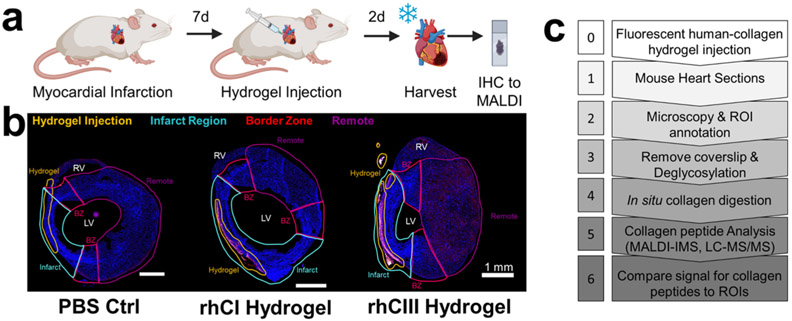
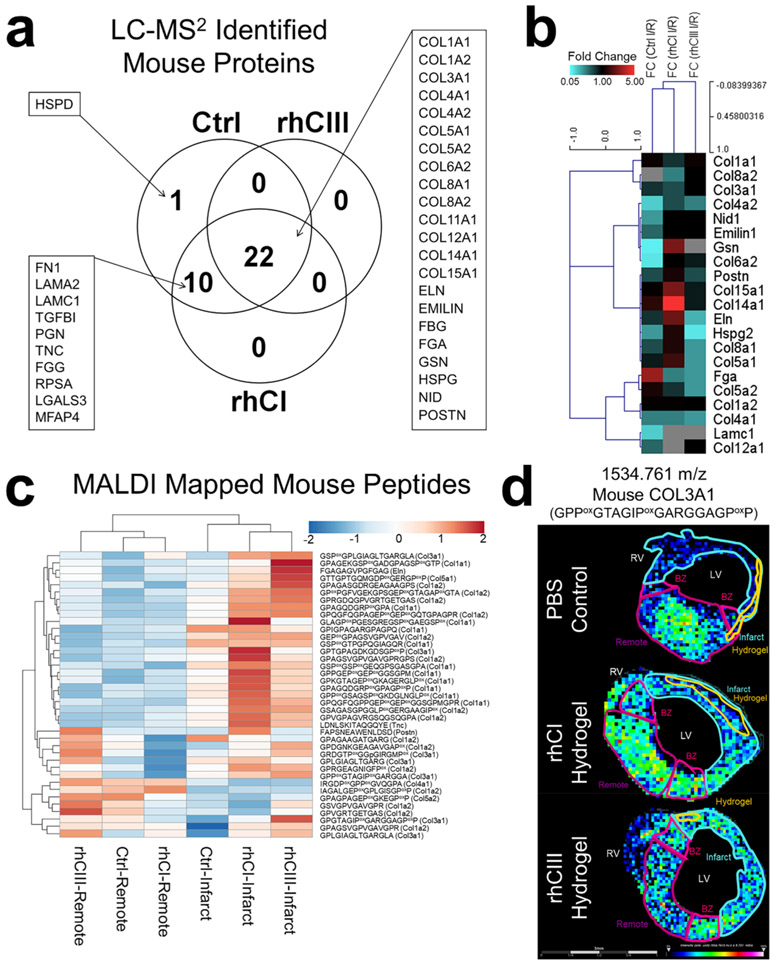
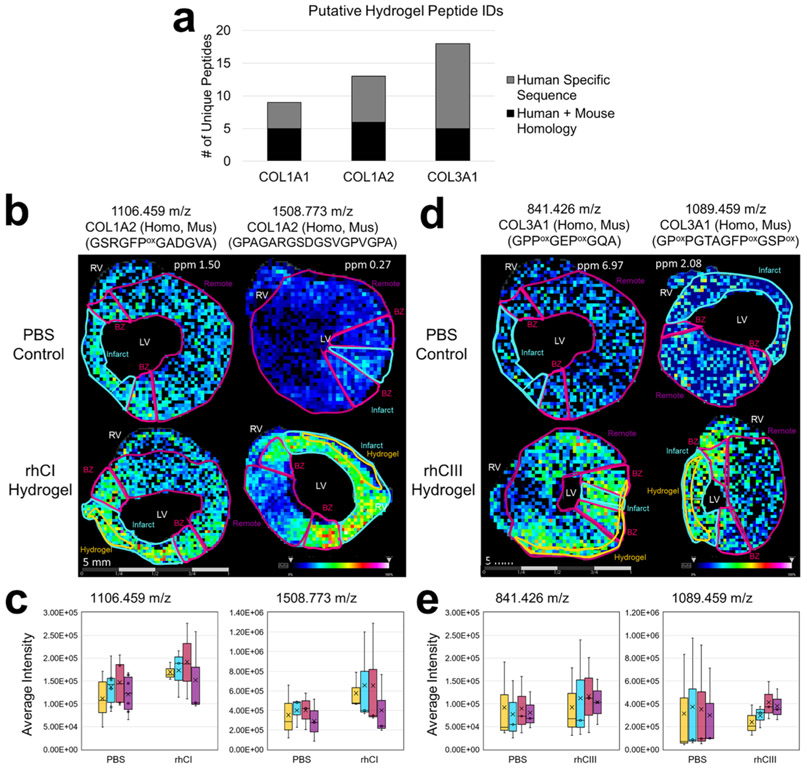
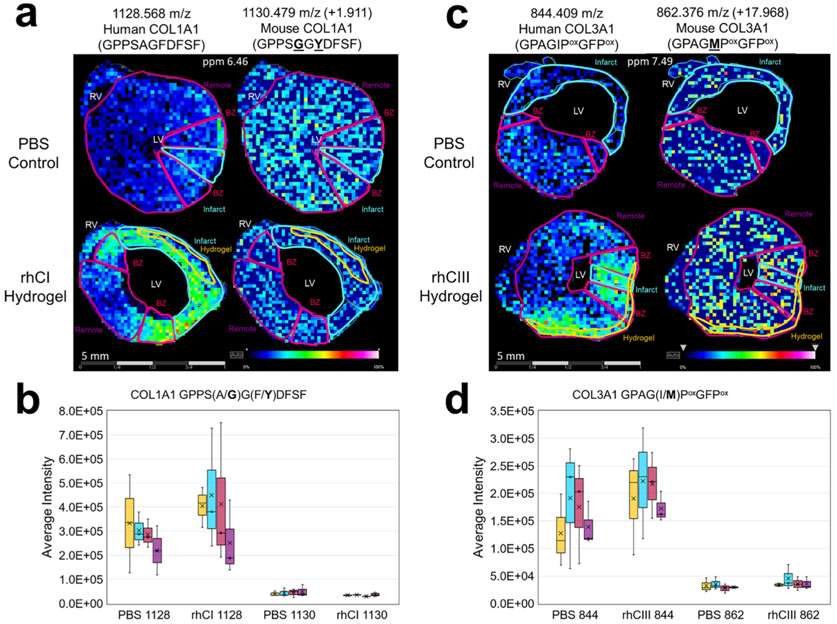
The goal of this study was to develop strategies to localize human collagen-based hydrogels within an infarcted mouse heart, as well as analyze its impact on endogenous extracellular matrix (ECM) remodeling. Collagen is a natural polymer that is abundantly used in bioengineered hydrogels because of its biocompatibility, cell permeability, and biodegradability. However, without the use of tagging techniques, collagen peptides derived from hydrogels can be difficult to differentiate from the endogenous ECM within tissues. Imaging mass spectrometry is a robust tool capable of visualizing synthetic and natural polymeric molecular structures yet is largely underutilized in the field of biomaterials outside of surface characterization. In this study, our group leveraged a recently developed matrix-assisted laser desorption/ionization imaging mass spectrometry (MALDI IMS) technique to enzymatically target collagen and other ECM peptides within the tissue microenvironment that are both endogenous and hydrogel-derived. Using a multimodal approach of fluorescence microscopy and ECM-IMS techniques, we were able to visualize and relatively quantify significantly abundant collagen peptides in an infarcted mouse heart that were localized to regions of therapeutic hydrogel injection sites. On-tissue MALDI MS/MS was used to putatively identify sites of collagen peptide hydroxyproline site occupancy, a post-translational modification that is critical in collagen triple helical stability. Additionally, the technique could putatively identify over 35 endogenously expressed ECM peptides that were expressed in hydrogel-injected mouse hearts. Our findings show evidence for the use of MALDI-IMS in assessing the therapeutic application of collagen-based biomaterials.
本研究旨在提出策略,将基于人胶原蛋白的水凝胶定位于梗死小鼠心脏内,并分析其对内源性细胞外基质(ECM)重塑的影响。胶原蛋白是一种天然聚合物,由于其生物相容性、细胞通透性和生物降解性,被广泛应用于生物工程水凝胶中。然而,如果不使用标记技术,水凝胶衍生的胶原蛋白肽很难与组织内的内源性 ECM 区分开来。成像质谱是一种强大的工具,能够可视化合成和天然聚合物的分子结构,但在生物材料领域除了表面特性外,其应用还远远不够。在本研究中,我们的研究小组利用最近开发的基质辅助激光解吸/电离成像质谱(MALDI IMS)技术,在组织微环境中酶切靶向胶原蛋白和其他 ECM 肽,这些肽既来自内源性,也来自水凝胶。我们采用荧光显微镜和 ECM-IMS 技术的多模态方法,能够可视化并相对定量在梗死小鼠心脏中定位到治疗性水凝胶注射部位的大量丰富的胶原蛋白肽。在组织上进行 MALDI MS/MS 分析,推测鉴定胶原蛋白肽羟脯氨酸位点占有率的位点,该翻译后修饰对于胶原三螺旋稳定性至关重要。此外,该技术还可以推测鉴定出 35 种以上在注射水凝胶的小鼠心脏中表达的内源性 ECM 肽。我们的研究结果表明 MALDI-IMS 可用于评估基于胶原蛋白的生物材料的治疗应用。