Department of Infectious Disease Epidemiology, Robert Koch Institute, Berlin, Germany.
European Programme for Intervention Epidemiology Training (EPIET), European Centre for Disease Prevention and Control (ECDC), Stockholm, Sweden.
Euro Surveill. 2021 Oct;26(43). doi: 10.2807/1560-7917.ES.2021.26.43.2001757.
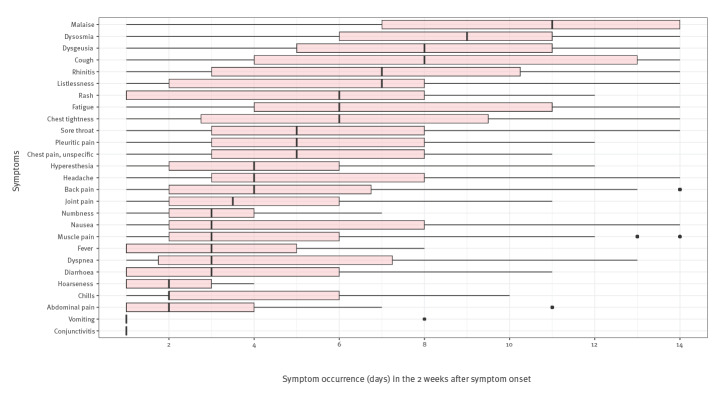
BackgroundDetailed information on symptom duration and temporal course of patients with mild COVID-19 was scarce at the beginning of the COVID-19 pandemic.AimWe aimed to determine the longitudinal course of clinical symptoms in non-hospitalised COVID-19 patients in Berlin, Germany.MethodsBetween March and May 2020, 102 confirmed COVID-19 cases in home isolation notified in Berlin, Germany, were sampled using total population sampling. Data on 25 symptoms were collected during telephone consultations (a maximum of four consultations) with each patient. We collected information on prevalence and duration of symptoms for each day of the first 2 weeks after symptom onset and for day 30 and 60 after symptom onset.ResultsMedian age was 35 years (range 18-74), 57% (58/102) were female, and 37% (38/102) reported having comorbidities. During the first 2 weeks, most common symptoms were malaise (94%, 92/98), headache (71%, 70/98), and rhinitis (69%, 68/98). Malaise was present for a median of 11 days (IQR 7-14 days) with 35% (34/98) of cases still reporting malaise on day 14. Headache and muscle pain mostly occurred during the first week, whereas dysosmia and dysgeusia mostly occurred during the second week. Symptoms persisted in 41% (39/95) and 20% (18/88) of patients on day 30 and 60, respectively.ConclusionOur study shows that a significant proportion of non-hospitalised COVID-19 cases endured symptoms for at least 2 months. Further research is needed to assess the frequency of long-term adverse health effects in non-hospitalised COVID-19 patients.
背景
在 COVID-19 大流行初期,有关轻症 COVID-19 患者症状持续时间和时间进程的详细信息很少。
目的
我们旨在确定德国柏林非住院 COVID-19 患者的临床症状的纵向过程。
方法
2020 年 3 月至 5 月期间,德国柏林使用全人群抽样对 102 例在家隔离的确诊 COVID-19 病例进行采样。对每位患者进行了最多四次电话咨询,收集了 25 种症状的数据。我们收集了发病后前两周每天以及发病后 30 天和 60 天症状的患病率和持续时间信息。
结果
中位年龄为 35 岁(范围 18-74 岁),57%(58/102)为女性,37%(38/102)报告有合并症。在最初的两周内,最常见的症状是不适(94%,92/98)、头痛(71%,70/98)和鼻炎(69%,68/98)。不适中位持续 11 天(7-14 天),35%(34/98)的病例在第 14 天仍有不适。头痛和肌肉疼痛主要发生在第一周,而嗅觉和味觉障碍主要发生在第二周。在第 30 天和第 60 天,分别有 41%(39/95)和 20%(18/88)的患者症状持续存在。
结论
我们的研究表明,相当一部分非住院 COVID-19 病例的症状持续时间至少为 2 个月。需要进一步研究来评估非住院 COVID-19 患者长期不良健康影响的频率。