Department of Computer Science, Helsinki Institute for Information Technology HIIT, Aalto University, Helsinki, Finland.
Faculty of Medicine, Obesity Research Unit, Research Program for Clinical and Molecular Metabolism, University of Helsinki, Helsinki, Finland.
Ann Med. 2021 Dec;53(1):1885-1895. doi: 10.1080/07853890.2021.1964035.
Our aim was to investigate in a real-life setting the use of machine learning for modelling the postprandial glucose concentrations in morbidly obese patients undergoing Roux-en-Y gastric bypass (RYGB) or one-anastomosis gastric bypass (OAGB).
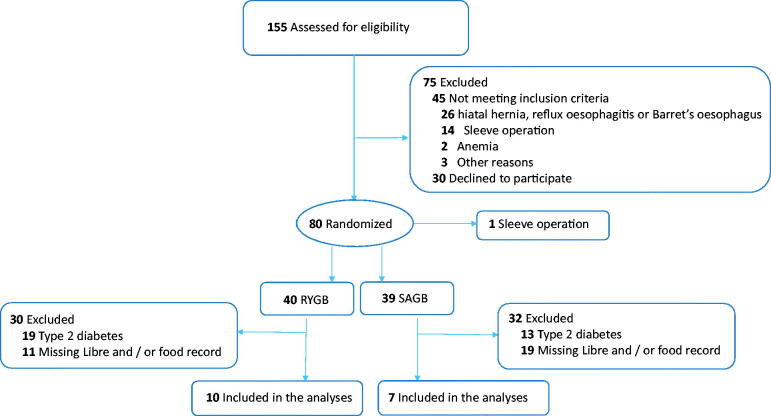
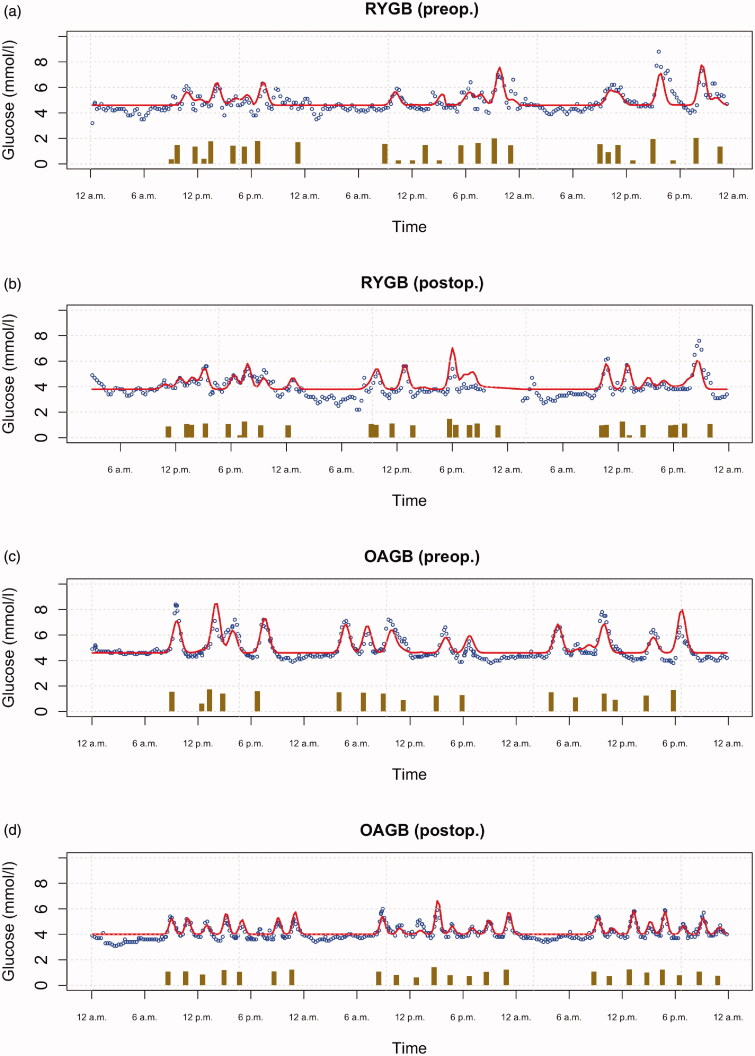
As part of the prospective randomized open-label trial (RYSA), data from obese (BMI ≥35 kg/m) non-diabetic adult participants were included. Glucose concentrations, measured with FreeStyle Libre, were recorded over 14 preoperative and 14 postoperative days. During these periods, 3-day food intake was self-reported. A machine learning model was applied to estimate glycaemic responses to the reported carbohydrate intakes before and after the bariatric surgeries.
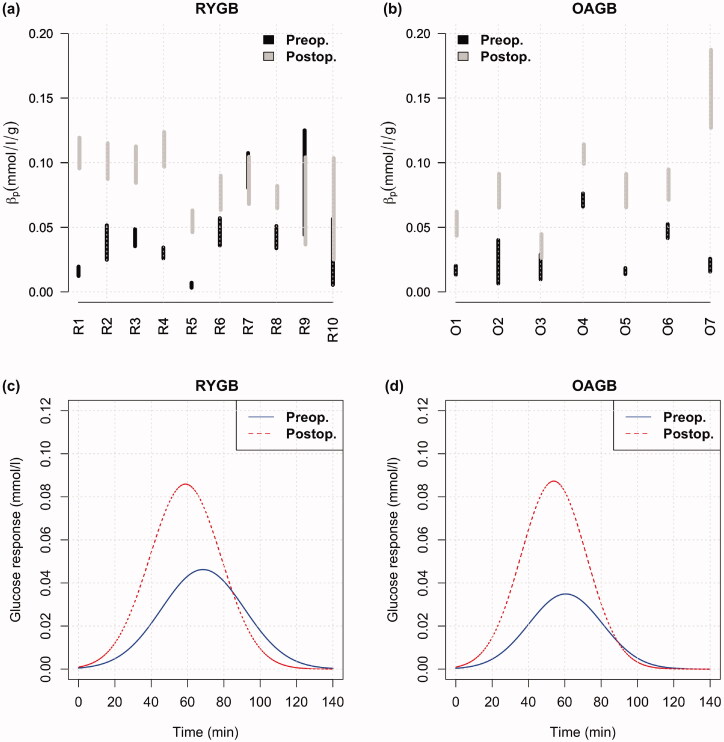
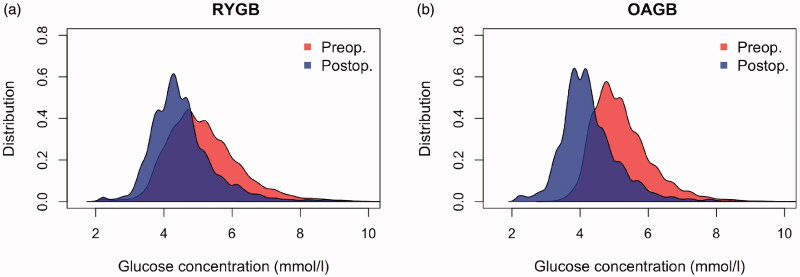
Altogether, 10 participants underwent RYGB and 7 participants OAGB surgeries. The glucose concentrations and carbohydrate intakes were reduced postoperatively in both groups. The relative time spent in hypoglycaemia increased regardless of the operation (RYGB, from 9.2 to 28.2%; OAGB, from 1.8 to 37.7%). Postoperatively, we observed an increase in the height of the fitted response curve and a reduction in its width, suggesting that the same amount of carbohydrates caused a larger increase in the postprandial glucose response and that the clearance of the meal-derived blood glucose was faster, with no clinically meaningful differences between the surgeries.
A detailed analysis of the glycaemic responses using food diaries has previously been difficult because of the noisy meal data. The utilized machine learning model resolved this by modelling the uncertainty in meal times. Such an approach is likely also applicable in other applications involving dietary data. A marked reduction in overall glycaemia, increase in postprandial glucose response, and rapid glucose clearance from the circulation immediately after surgery are evident after both RYGB and OAGB. Whether nondiabetic individuals would benefit from monitoring the post-surgery hypoglycaemias and the potential to prevent them by dietary means should be investigated.KEY MESSAGESThe use of a novel machine learning model was applicable for combining patient-reported data and time-series data in this clinical study.Marked increase in postprandial glucose concentrations and rapid glucose clearance were observed after both Roux-en-Y gastric bypass and one-anastomosis gastric bypass surgeries.Whether nondiabetic individuals would benefit from monitoring the post-surgery hypoglycaemias and the potential to prevent them by dietary means should be investigated.
本研究旨在真实环境下,利用机器学习模型对病态肥胖患者在行 Roux-en-Y 胃旁路术(RYGB)或单吻合胃旁路术(OAGB)后进行建模,以研究其餐后血糖浓度。
作为前瞻性随机开放标签试验(RYSA)的一部分,纳入了肥胖(BMI≥35kg/m²)非糖尿病成年参与者的数据。使用 FreeStyle Libre 测量的血糖浓度在术前 14 天和术后 14 天进行记录。在此期间,参与者自我报告了 3 天的饮食摄入。应用机器学习模型估计报告的碳水化合物摄入量对手术前后的血糖反应。
共 10 名参与者接受了 RYGB 手术,7 名参与者接受了 OAGB 手术。两组术后血糖浓度和碳水化合物摄入量均降低。无论手术类型如何,低血糖时间的相对比例均增加(RYGB 组从 9.2%增加到 28.2%,OAGB 组从 1.8%增加到 37.7%)。术后,我们观察到拟合反应曲线的高度增加,宽度减小,表明相同量的碳水化合物引起餐后血糖反应更大,餐后血糖清除更快,但两种手术之间没有临床意义上的差异。
由于膳食数据的不准确性,使用饮食日记对血糖反应进行详细分析以前较为困难。本研究使用的机器学习模型通过对膳食时间的不确定性进行建模解决了这个问题。这种方法可能也适用于涉及饮食数据的其他应用。在 RYGB 和 OAGB 手术后,明显降低了总体血糖,增加了餐后血糖反应,并迅速从循环中清除了血糖。应该研究非糖尿病个体是否会受益于监测手术后的低血糖以及通过饮食手段预防低血糖的可能性。
在这项临床研究中,使用一种新的机器学习模型,将患者报告的数据和时间序列数据相结合是可行的。在接受 Roux-en-Y 胃旁路术和单吻合胃旁路术治疗后,都观察到餐后血糖浓度明显增加,且血糖清除速度加快。应该研究非糖尿病个体是否会受益于监测手术后的低血糖以及通过饮食手段预防低血糖的可能性。