Buetti Niccolò, Ruckly Stéphane, Lucet Jean-Christophe, Mageau Arthur, Dupuis Claire, Souweine Bertrand, Mimoz Olivier, Timsit Jean-François
University of Paris, INSERM, IAME, 75006, Paris, France.
Infection Control Program and WHO Collaborating Centre On Patient Safety, University of Geneva Hospitals and Faculty of Medicine, Geneva, Switzerland.
Ann Intensive Care. 2021 Oct 29;11(1):153. doi: 10.1186/s13613-021-00940-3.
The potential relationship between intravascular catheter infections with their insertion during weekend or night-time (i.e., off-hours or not regular business hours) remains an open issue. Our primary aim was to describe differences between patients and catheters inserted during on- versus off-hours. Our secondary aim was to investigate whether insertions during off-hours influenced the intravascular catheter infectious risks.
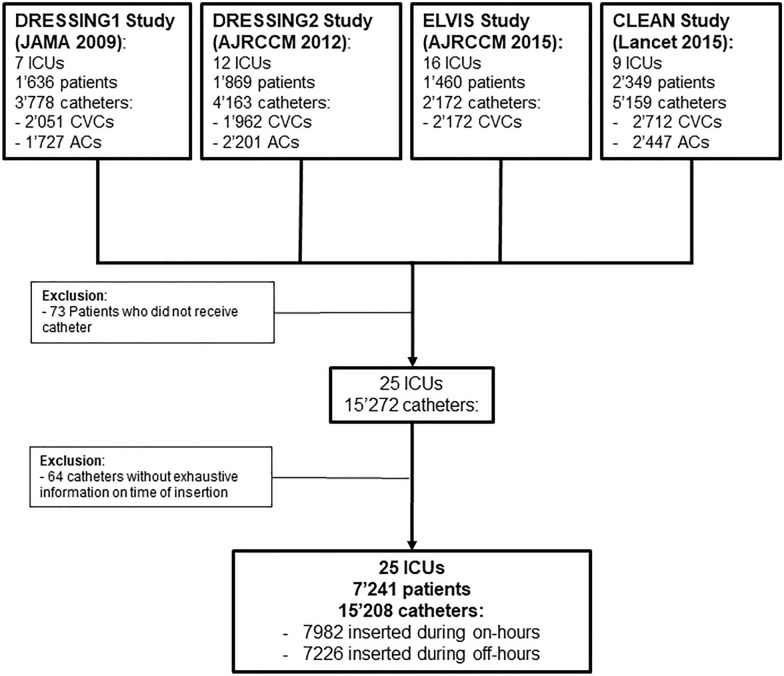
We performed a post hoc analysis using the databases from four large randomized-controlled trials. Adult patients were recruited in French ICUs as soon as they required central venous catheters or peripheral arterial (AC) catheter insertion. Off-hours started at 6 P.M. until 8:30 A.M. during the week; at weekend, we defined off-hours from 1 P.M. on Saturday to 8.30 A.M. on Monday. We performed multivariable marginal Cox models to estimate the effect of off-hours (versus on-hours) on major catheter-related infections (MCRI) and catheter-related bloodstream infections (CRBSIs).
We included 7241 patients in 25 different ICUs, and 15,208 catheters, including 7226 and 7982 catheters inserted during off- and on-hours, respectively. Catheters inserted during off-hours were removed after 4 days (IQR 2, 9) in median, whereas catheters inserted during on-hours remained in place for 6 days (IQR 3,10; p < 0.01) in median. Femoral insertion was more frequent during off-hours. Among central venous catheters and after adjusting for well-known risk factors for intravascular catheter infection, we found a similar risk between off- and on-hours for MCRI (HR 0.91, 95% CI 0.61-1.37, p = 0.65) and CRBSI (HR 1.05, 95% CI 0.65-1.68, p = 0.85). Among central venous catheters with a dwell-time > 4 or > 6 days, we found a similar risk for MCRI and CRBSI between off- and on-hours. Similar results were observed for ACs.
Off-hours did not increase the risk of intravascular catheter infections compared to on-hours. Off-hours insertion is not a sufficient reason for early catheter removal, even if femoral route has been selected.
血管内导管感染与其在周末或夜间(即非工作时间或非正常营业时间)插入之间的潜在关系仍是一个悬而未决的问题。我们的主要目的是描述在工作时间与非工作时间插入导管的患者和导管之间的差异。我们的次要目的是调查非工作时间插入导管是否会影响血管内导管感染风险。
我们使用来自四项大型随机对照试验的数据库进行了事后分析。法国重症监护病房(ICU)一旦有成年患者需要插入中心静脉导管或外周动脉(AC)导管,就会招募他们。非工作时间从周一至周五下午6点开始至次日上午8点30分;在周末,我们将非工作时间定义为从周六下午1点至周一上午8点30分。我们使用多变量边际Cox模型来估计非工作时间(与工作时间相比)对主要导管相关感染(MCRI)和导管相关血流感染(CRBSI)的影响。
我们纳入了25个不同ICU中的7241例患者和15208根导管,其中分别有7226根和7982根导管在非工作时间和工作时间插入。非工作时间插入的导管中位留置4天(四分位间距2,9)后被拔除,而工作时间插入的导管中位留置6天(四分位间距3,10;p<0.01)。非工作时间股静脉插入更为频繁。在中心静脉导管中,在调整了血管内导管感染的已知危险因素后,我们发现非工作时间与工作时间相比,MCRI(风险比[HR]0.91,95%置信区间[CI]0.61 - 1.37,p = 0.65)和CRBSI(HR 1.05,95% CI 0.65 - 1.68,p = 0.85)的风险相似。在留置时间>4天或>6天的中心静脉导管中,我们发现非工作时间与工作时间相比,MCRI和CRBSI的风险相似。AC导管也观察到类似结果。
与工作时间相比,非工作时间并未增加血管内导管感染的风险。即使选择了股静脉途径,非工作时间插入也不是早期拔除导管的充分理由。