Teixeira Simão P B, Reis Rui L, Peppas Nicholas A, Gomes Manuela E, Domingues Rui M A
3B's Research Group, I3Bs-Research Institute on Biomaterials, Biodegradables and Biomimetics, University of Minho, Headquarters of the European Institute of Excellence on Tissue Engineering and Regenerative Medicine, AvePark-Parque de Ciência e Tecnologia, Zona Industrial da Gandra, 4805-017 Barco, Guimarães, Portugal.
ICVS/3B's-PT Government Associate Laboratory, Braga, Guimarães, Portugal.
Sci Adv. 2021 Oct 29;7(44):eabi9884. doi: 10.1126/sciadv.abi9884.
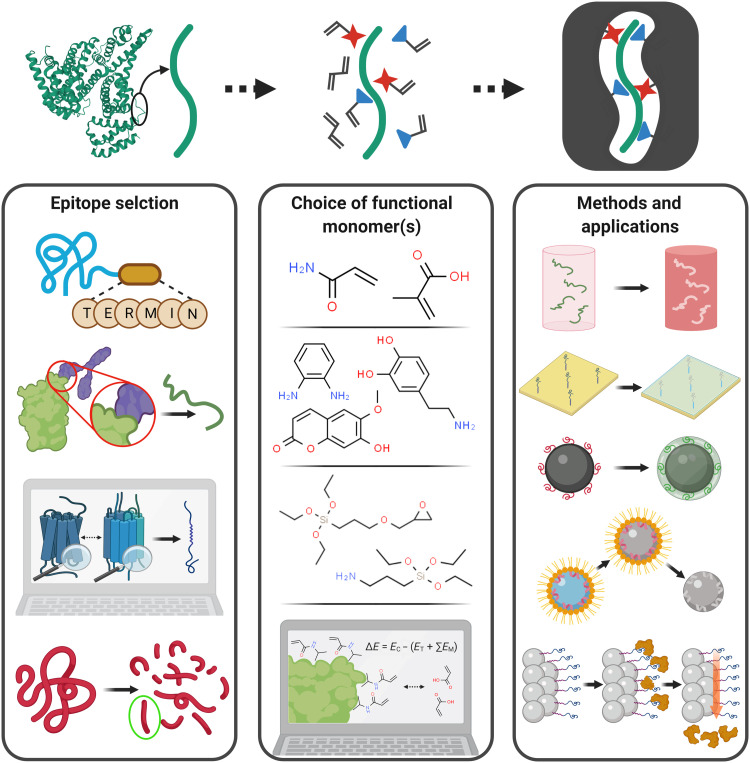
Molecular imprinting (MI) has been explored as an increasingly viable tool for molecular recognition in various fields. However, imprinting of biologically relevant molecules like proteins is severely hampered by several problems. Inspired by natural antibodies, the use of epitopes as imprinting templates has been explored to circumvent those limitations, offering lower costs and greater versatility. Here, we review the latest innovations in this technology, as well as different applications where MI polymers (MIPs) have been used to target biomolecules of interest. We discuss the several steps in MI, from the choice of epitope and functional monomers to the different production methods and possible applications. We also critically explore how MIP performance can be assessed by various parameters. Last, we present perspectives on future breakthroughs and advances, offering insights into how MI techniques can be expanded to new fields such as tissue engineering.
分子印迹(MI)已被视作一种在各个领域中越来越可行的分子识别工具。然而,诸如蛋白质等生物相关分子的印迹受到若干问题的严重阻碍。受天然抗体启发,人们探索了使用表位作为印迹模板来规避这些限制,这具有成本更低和通用性更强的优势。在此,我们综述了该技术的最新创新成果,以及使用分子印迹聚合物(MIP)靶向感兴趣生物分子的不同应用。我们讨论了分子印迹中的几个步骤,从表位和功能单体的选择到不同的制备方法及可能的应用。我们还批判性地探讨了如何通过各种参数评估MIP的性能。最后,我们展示了对未来突破和进展的展望,深入探讨了分子印迹技术如何能够扩展到组织工程等新领域。