Helmholtz Centre for Environmental Research-UFZ, Leipzig, Germany.
Office of Research and Development, Great Lakes Ecology and Toxicology Division, US Environmental Protection Agency, Duluth, Minnesota.
Environ Toxicol Chem. 2022 Jan;41(1):30-45. doi: 10.1002/etc.5242.
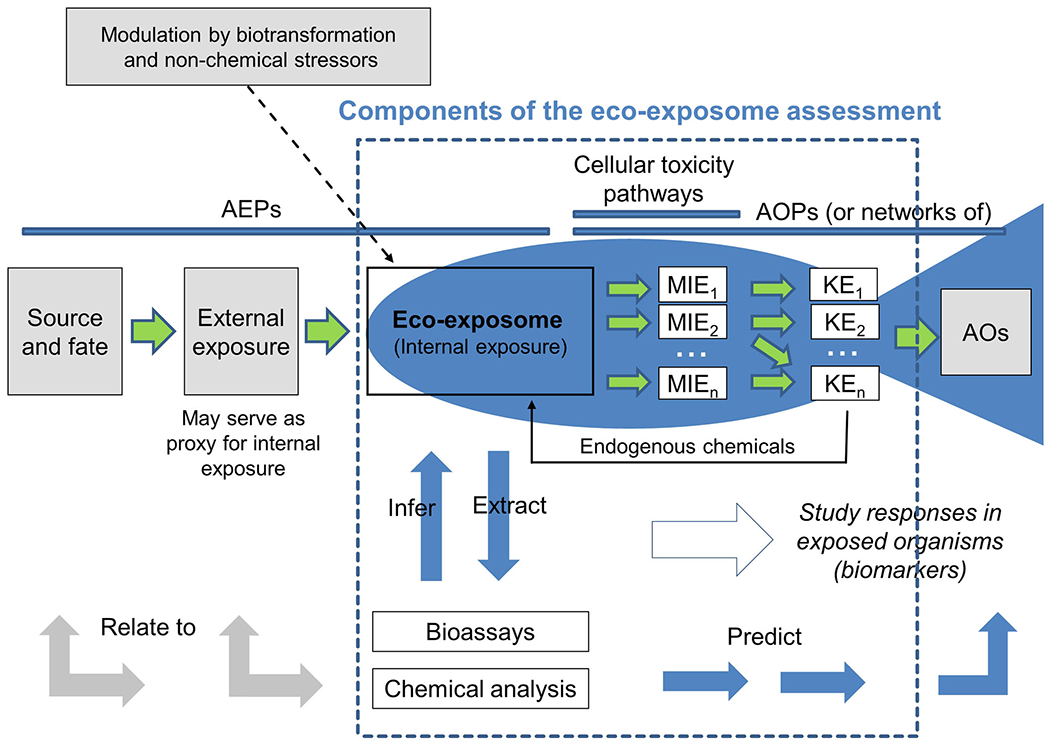
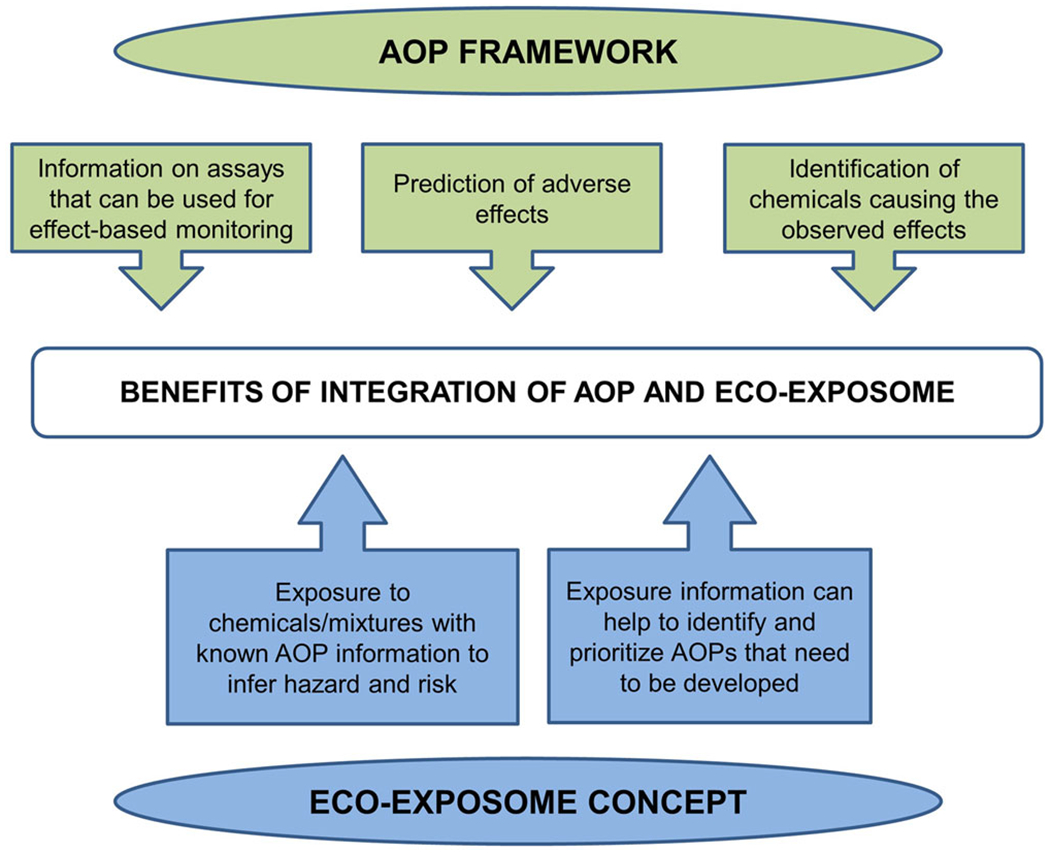
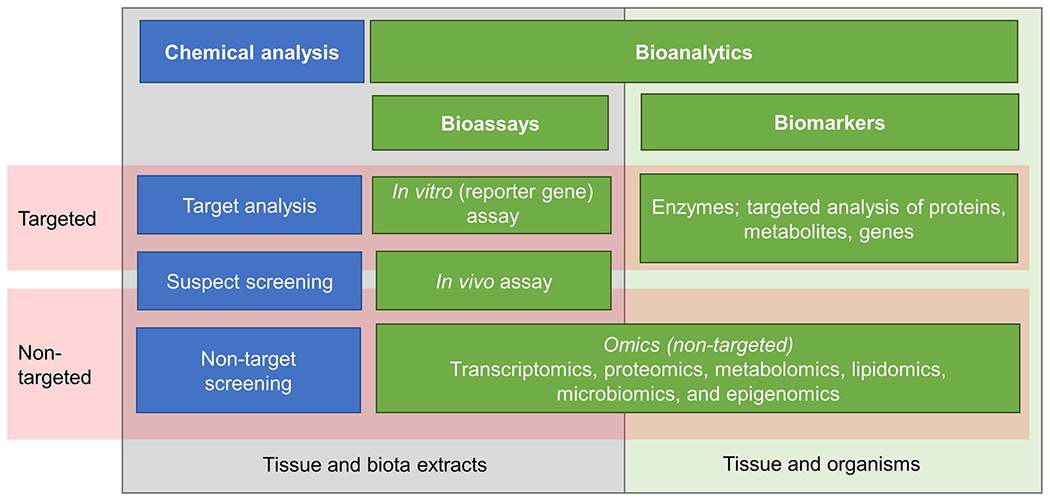
Organisms are exposed to ever-changing complex mixtures of chemicals over the course of their lifetime. The need to more comprehensively describe this exposure and relate it to adverse health effects has led to formulation of the exposome concept in human toxicology. Whether this concept has utility in the context of environmental hazard and risk assessment has not been discussed in detail. In this Critical Perspective, we propose-by analogy to the human exposome-to define the eco-exposome as the totality of the internal exposure (anthropogenic and natural chemicals, their biotransformation products or adducts, and endogenous signaling molecules that may be sensitive to an anthropogenic chemical exposure) over the lifetime of an ecologically relevant organism. We describe how targeted and nontargeted chemical analyses and bioassays can be employed to characterize this exposure and discuss how the adverse outcome pathway concept could be used to link this exposure to adverse effects. Available methods, their limitations, and/or requirement for improvements for practical application of the eco-exposome concept are discussed. Even though analysis of the eco-exposome can be resource-intensive and challenging, new approaches and technologies make this assessment increasingly feasible. Furthermore, an improved understanding of mechanistic relationships between external chemical exposure(s), internal chemical exposure(s), and biological effects could result in the development of proxies, that is, relatively simple chemical and biological measurements that could be used to complement internal exposure assessment or infer the internal exposure when it is difficult to measure. Environ Toxicol Chem 2022;41:30-45. © 2021 The Authors. Environmental Toxicology and Chemistry published by Wiley Periodicals LLC on behalf of SETAC.
生物体在其一生中会不断暴露于不断变化的复杂化学物质混合物中。为了更全面地描述这种暴露,并将其与不良健康影响联系起来,人类毒理学中提出了暴露组学的概念。然而,这一概念在环境危害和风险评估方面的应用尚未得到详细讨论。在这篇批判性观点文章中,我们通过类比人类暴露组学,提出将生态暴露组学定义为生态相关生物体一生中的内部暴露(人为和天然化学物质、它们的生物转化产物或加合物以及可能对人为化学暴露敏感的内源性信号分子)的总和。我们描述了如何利用靶向和非靶向化学分析和生物测定来描述这种暴露,并讨论了如何使用不良结局途径概念将这种暴露与不良影响联系起来。讨论了可用方法的优缺点、局限性,以及将生态暴露组学概念应用于实际的改进要求。尽管分析生态暴露组学可能需要大量资源且具有挑战性,但新的方法和技术使这种评估变得越来越可行。此外,对外部化学暴露、内部化学暴露和生物效应之间的机制关系的深入了解,可能会开发出替代物,即相对简单的化学和生物学测量方法,可用于补充内部暴露评估或在难以测量内部暴露时推断内部暴露。环境毒理学与化学 2022;41:30-45。