Reiter Eva B, Jahnke Annika, König Maria, Siebert Ursula, Escher Beate I
Department Cell Toxicology, Helmholtz Centre for Environmental Research-UFZ, Permoserstraße 15, 04318 Leipzig, Germany.
Institute for Terrestrial and Aquatic Wildlife Research, University of Veterinary Medicine Hannover, Foundation, Werftstr. 6, 25761 Büsum, Germany.
Environ Sci Technol. 2020 Apr 7;54(7):4240-4247. doi: 10.1021/acs.est.9b07850. Epub 2020 Mar 16.
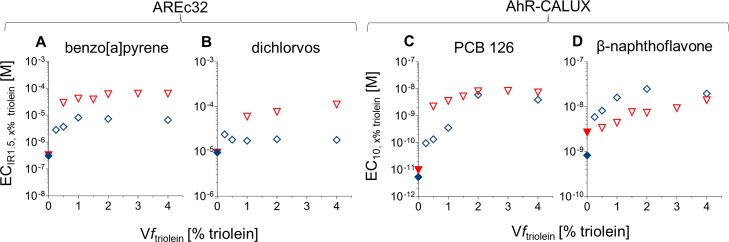
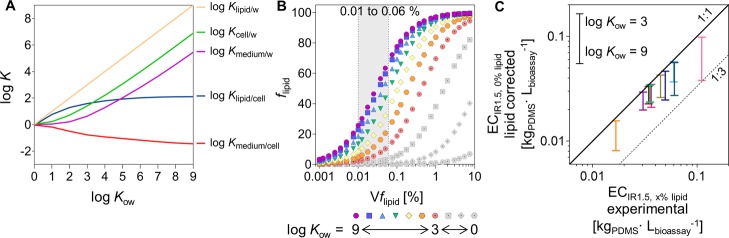
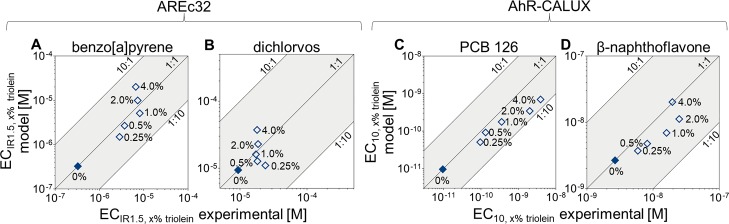
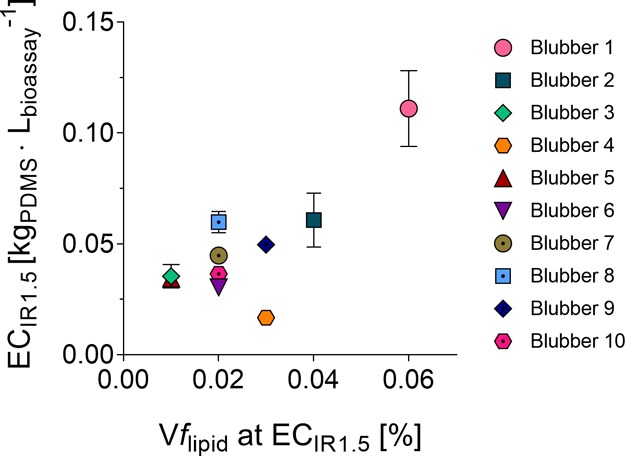
Extraction of chemicals from biota leads to co-extraction of lipids. When dosing such extracts into in vitro bioassays, co-dosed lipids act as an additional phase that can reduce the bioavailability of the chemicals and the apparent sensitivity of the assay. Equilibrium partitioning between medium, cells, and co-dosed lipids was described with an existing equilibrium partitioning model for cell-based bioassays extended by an additional lipid phase. We experimentally investigated the influence of co-dosed lipids on the effects elicited by four test chemicals of different hydrophobicity in two bioassays, indicative of the aryl hydrocarbon receptor and oxidative stress response (AREc32). The partitioning model explained the effect of the test chemicals in the presence of spiked triolein within a factor of 0.33-5.83 between the measured and predicted effect concentration (EC). We applied the model to marine mammal blubber extracted with silicone. Extracts dosed in the AREc32 bioassay showed a linear increase of apparent EC with increasing lipid fraction. The partitioning model was used to interpret the role of the co-extracted lipid. A quantitative lipid correction of bioassay results in the presence of co-dosed lipids was possible for known compounds and defined mixtures, while we could only estimate a range for mixtures of unknown chemicals.
从生物群中提取化学物质会导致脂质的共提取。当将此类提取物加入体外生物测定中时,共加入的脂质会作为一个额外的相,降低化学物质的生物利用度以及测定的表观灵敏度。利用一个现有的基于细胞的生物测定平衡分配模型,并增加一个脂质相,来描述介质、细胞和共加入脂质之间的平衡分配。我们通过实验研究了在两种生物测定中,共加入的脂质对四种不同疏水性测试化学物质所引发效应的影响,这两种生物测定分别指示芳烃受体和氧化应激反应(AREc32)。分配模型解释了在加入三油酸甘油酯的情况下,测试化学物质的效应,实测和预测效应浓度(EC)之间的差异在0.33至5.83倍之间。我们将该模型应用于用硅胶提取的海洋哺乳动物脂肪。在AREc32生物测定中加入提取物后,表观EC随着脂质分数的增加呈线性增加。分配模型用于解释共提取脂质的作用。对于已知化合物和特定混合物,在存在共加入脂质的情况下对生物测定结果进行定量脂质校正成为可能,而对于未知化学物质的混合物,我们只能估计一个范围。