
构建和验证基于缺氧-干性的基因特征用于食管癌风险分层。
Construction and Verification of a Hypoxia-Stemness-Based Gene Signature for Risk Stratification in Esophageal Cancer.
机构信息
Department of Frontier Surgery, Chiba University Graduate School of Medicine, Chiba, Japan.
Department of Gastrointestinal Surgery, The First Affiliated Hospital of Chongqing Medical University, Chongqing, China (mainland).
出版信息
Med Sci Monit. 2021 Oct 30;27:e934359. doi: 10.12659/MSM.934359.
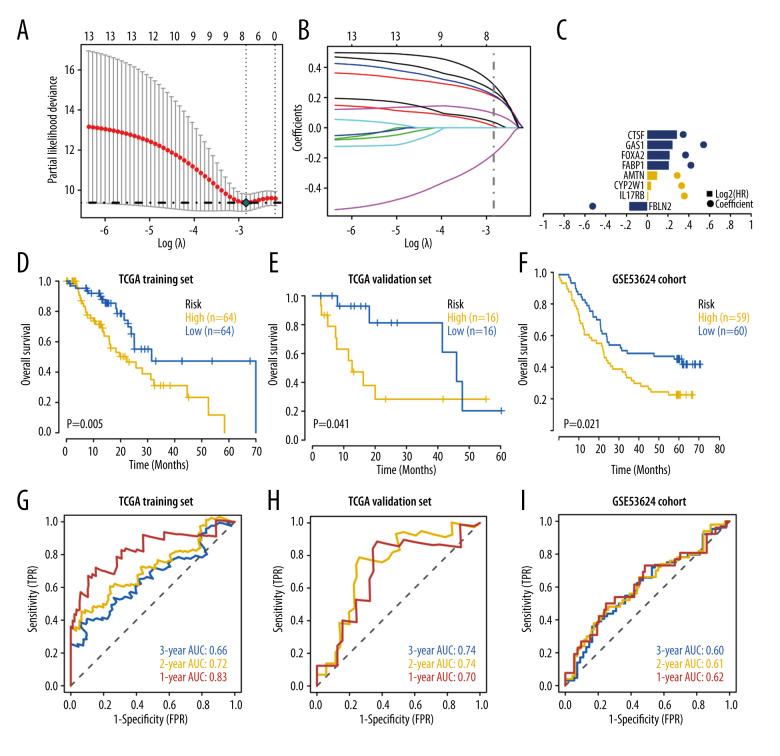
BACKGROUND Numerous studies have shown that esophageal cancer (ESCA) contains areas of intertumoral hypoxia. It is widely accepted that the association of hypoxia with cancer stemness in the tumor microenvironment of ESCA is of profound clinical significance. However, reliable prognostic signatures based on hypoxia and cancer stemness are still lacking in ESCA. MATERIAL AND METHODS The t-SNE algorithm was used to estimate the hypoxia status based on the transcriptome profiles of the discovery cohort in the TCGA database. Median values of the stemness index were used to group and identify stemness-associated differentially expressed genes (DEGs). The LASSO method and Cox regression model were combined to screen for prognostic genes and to establish a genetic signature based on hypoxia-stemness. The robustness of the prognostic model was then tested in an external independent validation cohort of the GEO database. RESULTS A total of 8 genes - FBLN2, IL17RB, CYP2W1, AMTN, FABP1, FOXA2, GAS1, and CTSF - were identified to construct a gene signature for ESCA risk stratification. Overall survival was significantly lower in the high-risk group than in the low-risk group in both the internal discovery set and the external validation set. The risk score was found to be an independent prognostic factor for ESCA patients. In addition, a higher risk score was significantly associated with the sensitivity of ESCA patients to gefitinib, bexarotene, dasatinib, and imatinib. CONCLUSIONS The hypoxia-stemness-based genetic signature established for the first time in our study could be a promising tool for ESCA cancer risk stratification.
背景
大量研究表明,食管癌(ESCA)包含间质缺氧区域。广泛接受的是,肿瘤微环境中的缺氧与 ESCA 中的癌症干样性之间的关联具有深远的临床意义。然而,基于缺氧和癌症干样性的可靠预后标志物在 ESCA 中仍然缺乏。
材料和方法
使用 t-SNE 算法根据 TCGA 数据库中发现队列的转录组谱来估计缺氧状态。使用干细胞指数的中位数将其分组并鉴定与干细胞相关的差异表达基因(DEGs)。LASSO 方法和 Cox 回归模型相结合筛选预后基因,并建立基于缺氧-干细胞的遗传特征。然后在 GEO 数据库的外部独立验证队列中测试预后模型的稳健性。
结果
共鉴定出 8 个基因 - FBLN2、IL17RB、CYP2W1、AMTN、FABP1、FOXA2、GAS1 和 CTSF - 用于构建 ESCA 风险分层的基因特征。在内部发现集和外部验证集中,高风险组的总生存率均明显低于低风险组。风险评分被发现是 ESCA 患者的独立预后因素。此外,较高的风险评分与 ESCA 患者对吉非替尼、贝沙罗汀、达沙替尼和伊马替尼的敏感性显著相关。
结论
我们首次建立的基于缺氧-干细胞的遗传特征可作为 ESCA 癌症风险分层的有前途的工具。




 Zotero 插件