Department of Cardiology, The Second Affiliated Hospital of Chongqing Medical University, No. 76, Linjiang Road, Chongqing, 400010, China.
Department of Gastroenterology, The Chongqing Traditional Chinese Medicine Hospital, Chongqing Academy of Traditional Chinese Medicine, Chongqing, China.
ESC Heart Fail. 2021 Dec;8(6):4852-4862. doi: 10.1002/ehf2.13677. Epub 2021 Oct 30.
We aimed to investigate whether sacubitril-valsartan could further improve the prognosis, cardiac function, and left ventricular (LV) remodelling in patients following acute myocardial infarction (AMI).
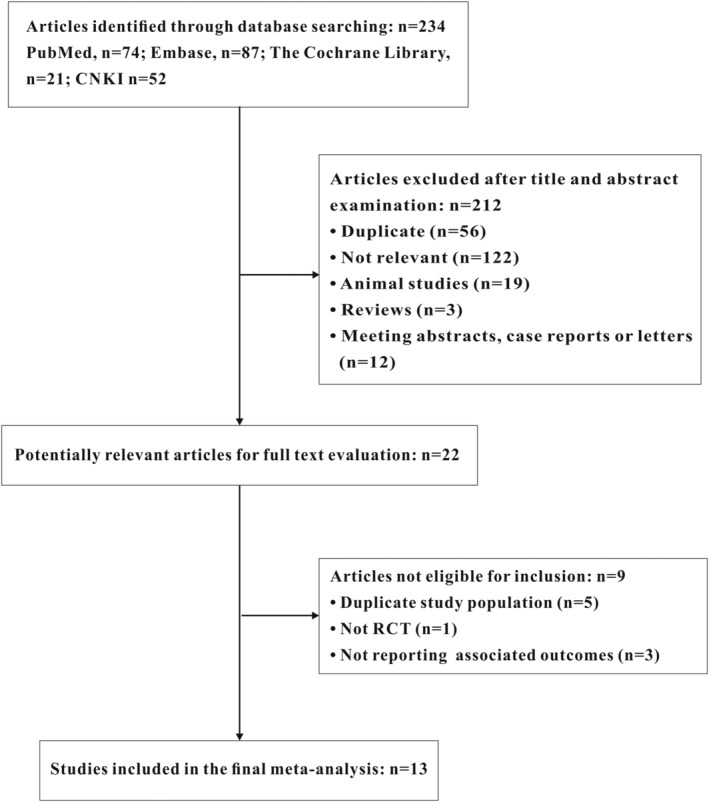
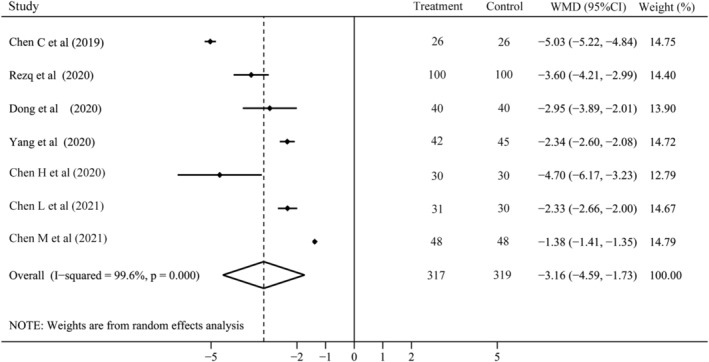
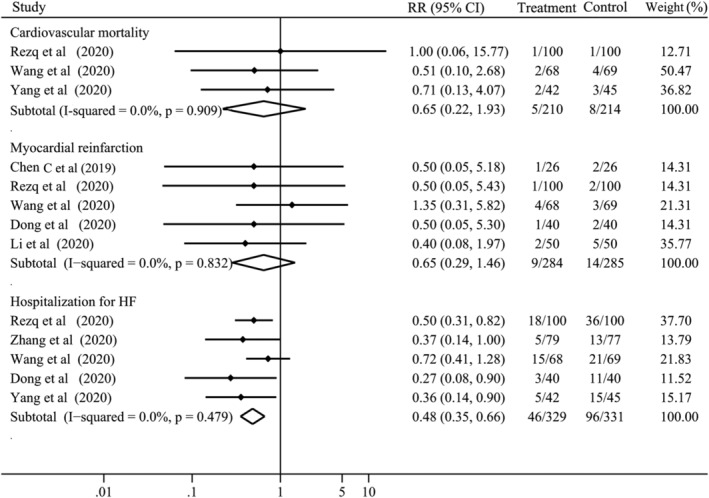
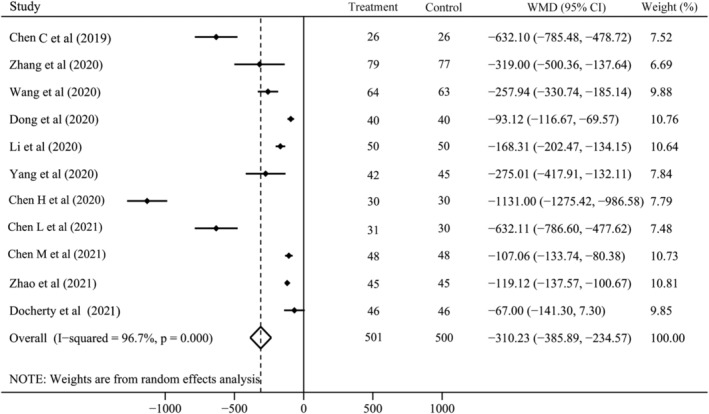
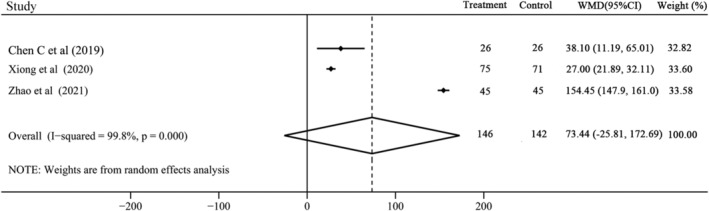
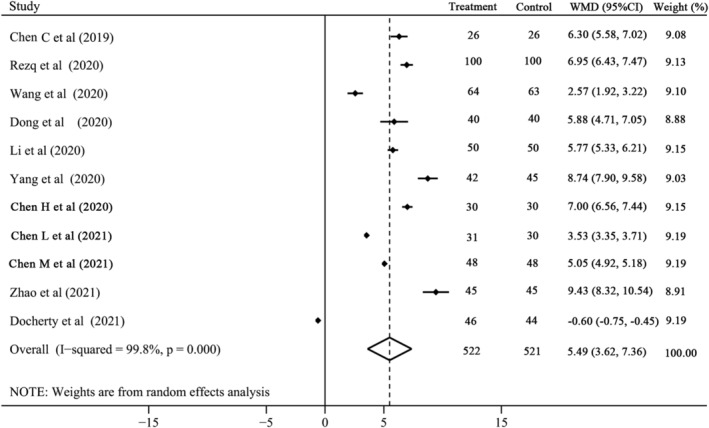
We searched the PubMed, Embase, Cochrane Library, and China National Knowledge Infrastructure (CNKI) from inception to 10 May 2021 to identify potential articles. Randomized controlled trials (RCTs) meeting the inclusion criteria were included and analysed. Thirteen RCTs, covering 1358 patients, were analysed. Compared with angiotensin-converting enzyme inhibitors (ACEI)/angiotensin receptor blockers (ARB), sacubitril-valsartan did not significantly reduced the cardiovascular mortality [risk ratio (RR) 0.65, 95% confidence interval (CI) 0.22 to 1.93, P = 0.434] and the rate of myocardial reinfarction (RR 0.65, 95% CI 0.29 to 1.46, P = 0.295) of patients following AMI, but the rate of hospitalization for heart failure (HF) (RR 0.48, 95% CI 0.35 to 0.66, P < 0.001) and the change of LV ejection fraction (LVEF) [weighted mean difference (WMD) 5.49, 95% CI 3.62 to 7.36, P < 0.001] were obviously improved. The N-terminal pro-brain natriuretic peptide (NT-ProBNP) level (WMD -310.23, 95% CI -385.89 to -234.57, P < 0.001) and the LV end-diastolic dimension (LVEDD) (WMD -3.16, 95% CI -4.59 to -1.73, P < 0.001) were also significantly lower in sacubitril-valsartan group than in ACEI/ARB group. Regarding safety, sacubitril-valsartan did not increase the risk of hypotension, hyperkalaemia, angioedema, and cough.
This meta-analysis suggests that early administration of sacubitril-valsartan may be superior to conventional ACEI/ARB to decrease the risk of hospitalization for HF, improve the cardiac function, and reverse the LV remodelling in patients following AMI.
我们旨在研究沙库巴曲缬沙坦是否可以进一步改善急性心肌梗死(AMI)患者的预后、心功能和左心室(LV)重构。
我们从建库至 2021 年 5 月 10 日在 PubMed、Embase、Cochrane 图书馆和中国知网(CNKI)中搜索潜在的文章。纳入符合纳入标准的随机对照试验(RCT)并进行分析。分析了 13 项 RCT,共纳入 1358 例患者。与血管紧张素转换酶抑制剂(ACEI)/血管紧张素受体阻滞剂(ARB)相比,沙库巴曲缬沙坦并未显著降低 AMI 后患者的心血管死亡率[风险比(RR)0.65,95%置信区间(CI)0.22 至 1.93,P=0.434]和心肌再梗死率(RR 0.65,95%CI 0.29 至 1.46,P=0.295),但心力衰竭(HF)住院率(RR 0.48,95%CI 0.35 至 0.66,P<0.001)和左心室射血分数(LVEF)变化[加权均数差(WMD)5.49,95%CI 3.62 至 7.36,P<0.001]明显改善。N 端脑利钠肽前体(NT-ProBNP)水平(WMD -310.23,95%CI -385.89 至 -234.57,P<0.001)和左心室舒张末期内径(LVEDD)(WMD -3.16,95%CI -4.59 至 -1.73,P<0.001)也明显低于 ACEI/ARB 组。关于安全性,沙库巴曲缬沙坦并未增加低血压、高钾血症、血管性水肿和咳嗽的风险。
这项荟萃分析表明,早期使用沙库巴曲缬沙坦可能优于常规 ACEI/ARB,可降低 AMI 后 HF 住院风险,改善心功能,逆转 LV 重构。