School of Sport, Exercise and Nutrition, College of Health, Massey University, Albany Highway, Auckland, New Zealand.
Sports Med. 2022 Feb;52(2):349-375. doi: 10.1007/s40279-021-01558-y. Epub 2021 Oct 30.
Body-fluid loss during prolonged continuous exercise can impair cardiovascular function, harming performance. Delta percent plasma volume (dPV) represents the change in central and circulatory body-water volume and therefore hydration during exercise; however, the effect of carbohydrate-electrolyte drinks and water on the dPV response is unclear.
To determine by meta-analysis the effects of ingested hypertonic (> 300 mOsmol kg), isotonic (275-300 mOsmol kg) and hypotonic (< 275 mOsmol kg) drinks containing carbohydrate and electrolyte ([Na] < 50 mmol L), and non-carbohydrate drinks/water (< 40 mOsmol kg) on dPV during continuous exercise.
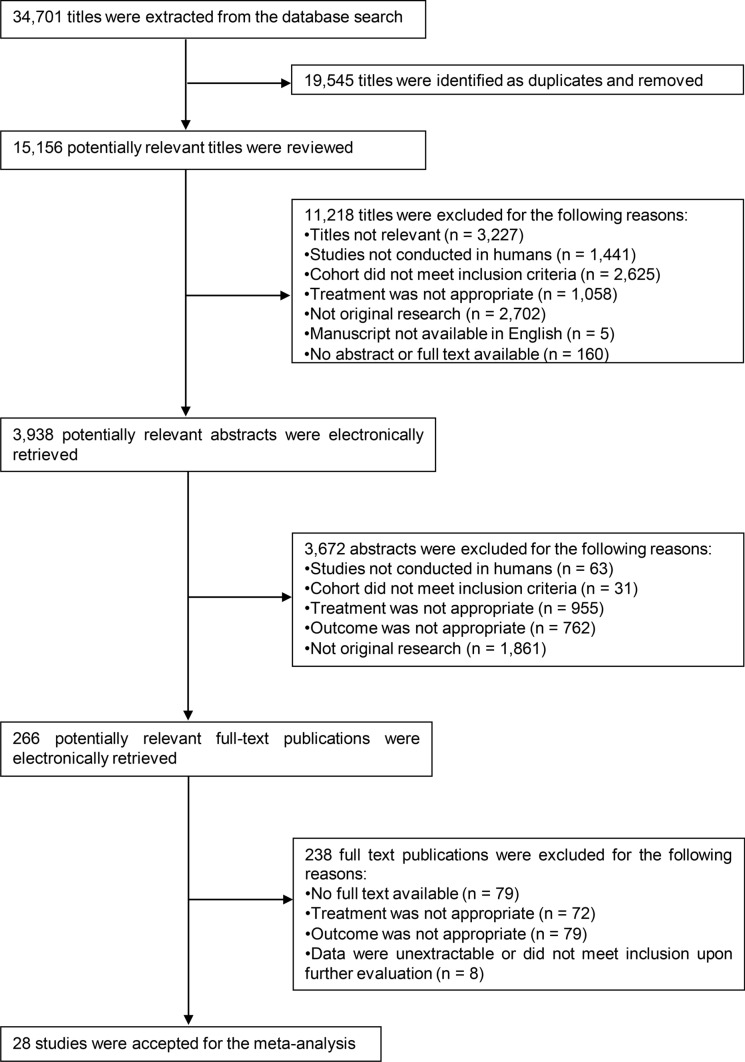
A systematic review produced 28 qualifying studies and 68 drink treatment effects. Random-effects meta-analyses with repeated measures provided estimates of effects and probability of superiority (p) during 0-180 min of exercise, adjusted for drink osmolality, ingestion rate, metabolic rate and a weakly informative Bayesian prior.
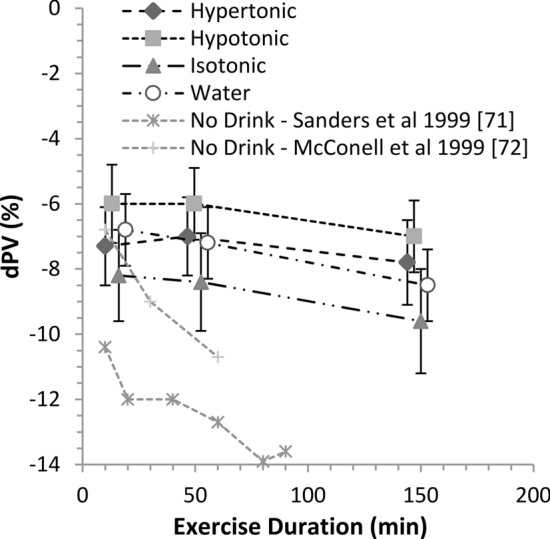
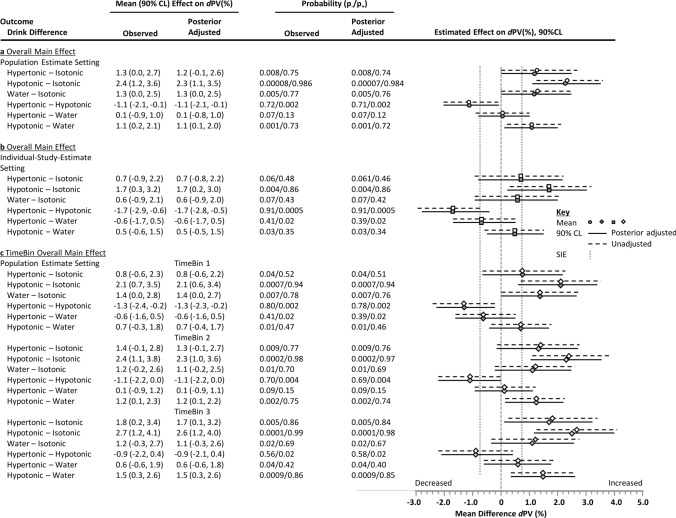
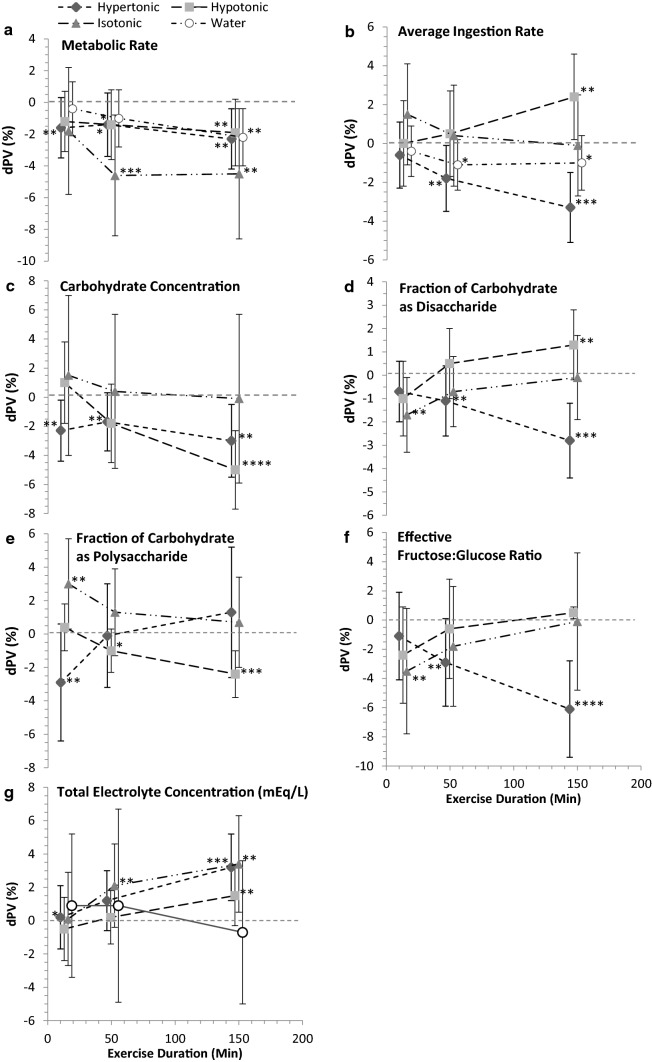
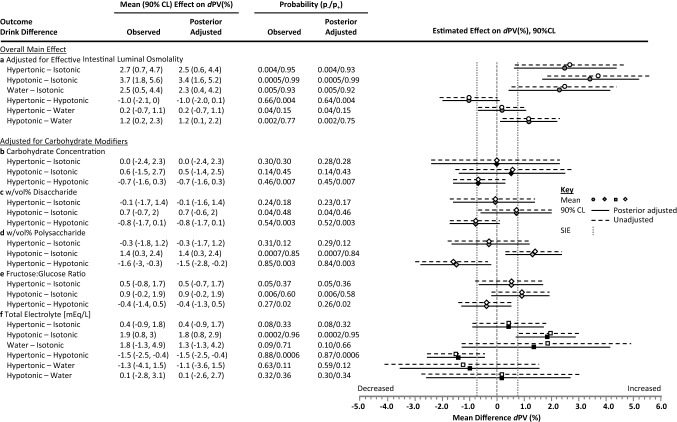
Mean drink effects on dPV were: hypertonic - 7.4% [90% compatibility limits (CL) - 8.5, - 6.3], isotonic - 8.7% (90% CL - 10.1, - 7.4), hypotonic - 6.3% (90% CL - 7.4, - 5.3) and water - 7.5% (90% CL - 8.5, - 6.4). Posterior contrast estimates relative to the smallest important effect (dPV = 0.75%) were: hypertonic-isotonic 1.2% (90% CL - 0.1, 2.6; p = 0.74), hypotonic-isotonic 2.3% (90% CL 1.1, 3.5; p = 0.984), water-isotonic 1.3% (90% CL 0.0, 2.5; p = 0.76), hypotonic-hypertonic 1.1% (90% CL 0.1, 2.1; p = 0.71), hypertonic-water 0.1% (90% CL - 0.8, 1.0; p = 0.12) and hypotonic-water 1.1% (90% CL 0.1, 2.0; p = 0.72). Thus, hypotonic drinks were very likely superior to isotonic and likely superior to hypertonic and water. Metabolic rate, ingestion rate, carbohydrate characteristics and electrolyte concentration were generally substantial modifiers of dPV.
Hypotonic carbohydrate-electrolyte drinks ingested continuously during exercise provide the greatest benefit to hydration.
长时间持续运动导致体液流失会损害心血管功能,影响运动表现。血浆容量变化百分比(dPV)代表运动期间中心和循环体水容量以及水合状态的变化;然而,尚不清楚碳水化合物-电解质饮料和水对 dPV 反应的影响。
通过荟萃分析确定摄入高渗(>300 mOsmol kg)、等渗(275-300 mOsmol kg)和低渗(<275 mOsmol kg)含碳水化合物和电解质[Na] < 50 mmol L 的饮料以及非碳水化合物饮料/水(<40 mOsmol kg)对持续运动期间 dPV 的影响。
系统评价产生了 28 项合格研究和 68 项饮料处理效果。使用重复测量的随机效应荟萃分析,根据饮料渗透压、摄入率、代谢率和弱信息贝叶斯先验值,提供了运动 0-180 分钟时效应和优势概率(p)的估计值。
dPV 的平均饮料效应为:高渗-7.4%[90%置信区间(CL)-8.5,-6.3]、等渗-8.7%(90%CL-10.1,-7.4)、低渗-6.3%(90%CL-7.4,-5.3)和水-7.5%(90%CL-8.5,-6.4)。相对于最小重要效应(dPV=0.75%)的后验对比估计值为:高渗-等渗 1.2%(90%CL-0.1,2.6;p=0.74)、低渗-等渗 2.3%(90%CL 1.1,3.5;p=0.984)、水-等渗 1.3%(90%CL 0.0,2.5;p=0.76)、低渗-高渗 1.1%(90%CL 0.1,2.1;p=0.71)、高渗-水 0.1%(90%CL-0.8,1.0;p=0.12)和低渗-水 1.1%(90%CL 0.1,2.0;p=0.72)。因此,低渗饮料很可能优于等渗饮料,而且可能优于高渗饮料和水。代谢率、摄入率、碳水化合物特性和电解质浓度通常是 dPV 的重要调节因素。
在运动期间持续摄入低渗碳水化合物-电解质饮料对水合作用最有益。