University of Minnesota, School of Public Health, Division of Epidemiology and Community Health, Minneapolis, MN 55454, USA; University of Houston, Department of Health and Human Performance, Houston, TX 77204, USA.
University of Minnesota, School of Public Health, Division of Epidemiology and Community Health, Minneapolis, MN 55454, USA; University of Minnesota Medical School, Duluth Campus, Department of Family Medicine and Biobehavioral Health, Duluth, MN 55812, USA.
Eat Behav. 2021 Dec;43:101577. doi: 10.1016/j.eatbeh.2021.101577. Epub 2021 Oct 23.
Sexual and physical abuse are risk factors for binge eating and overeating, but few studies have examined association of the identity of the perpetrator with survivors' risk of binge eating and overeating.
To examine the risk of binge eating and overeating by (1) type of abuse and identity of the perpetrators and (2) cumulative abuse experiences/perpetrators.
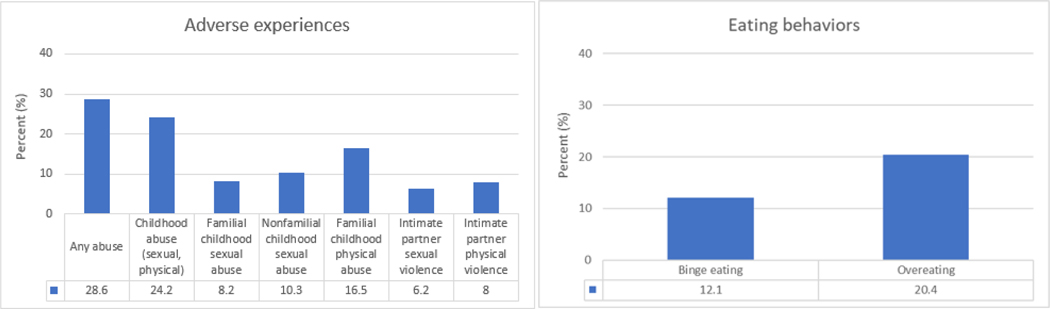
Data came from Eating and Activity over Time (N = 1407; ages 18-30 during 2017-2018). Sexual abuse perpetrators included family members, non-family members, and intimate partners. Physical abuse perpetrators included family members and intimate partners. Cumulative abuse experiences were defined as the number of types of abuse experienced. Modified Poisson regressions were used to examine the risk of binge eating (overeating with loss of control) and overeating (without loss of control), by (1) abuse type and perpetrator and (2) cumulative abuse experiences.
Abuse was more strongly associated with binge eating than overeating. For binge eating, risk factors included familial and intimate partner sexual abuse (RR = 1.48 [95% CI = 1.01-2.17] and 2.41, [95% CI = 1.70-3.41], respectively) and physical abuse (RR = 1.84, [95% CI = 1.33-2.53] and 1.95, [95% CI = 1.35-2.81], respectively), after adjustment for sociodemographic variables. For overeating, associations with physical abuse were close to the null, and those with sexual abuse were modest, with wide CIs that overlapped the null. Abuse experiences were cumulatively associated with binge eating, but not overeating.
Assessment of identity of the perpetrator, and cumulative abuse experiences/perpetrators may assist in identifying people at the greatest risk of binge eating.
性虐待和身体虐待是暴食和过度进食的风险因素,但很少有研究调查施虐者的身份与幸存者暴食和过度进食风险之间的关系。
通过(1)虐待类型和施虐者身份,以及(2)累积虐待经历/施虐者,来研究暴食和过度进食的风险。
数据来自 Eating and Activity over Time(2017-2018 年期间年龄在 18-30 岁的 1407 人)。性虐待的施虐者包括家庭成员、非家庭成员和亲密伴侣。身体虐待的施虐者包括家庭成员和亲密伴侣。累积虐待经历定义为经历的虐待类型的数量。使用修正泊松回归来检查暴食(失控性暴食)和过度进食(无失控性暴食)的风险,通过(1)虐待类型和施虐者,以及(2)累积虐待经历。
虐待与暴食的相关性强于与过度进食的相关性。对于暴食,危险因素包括家庭和亲密伴侣的性虐待(RR=1.48 [95%CI=1.01-2.17] 和 2.41 [95%CI=1.70-3.41])和身体虐待(RR=1.84 [95%CI=1.33-2.53] 和 1.95 [95%CI=1.35-2.81]),调整社会人口统计学变量后。对于过度进食,与身体虐待的关联接近零,与性虐待的关联适度,置信区间较宽,与零重叠。虐待经历与暴食累积相关,但与过度进食无关。
评估施虐者的身份以及累积的虐待经历/施虐者可能有助于识别暴食风险最大的人群。