College of Public Health, Zhengzhou University, 100, Science Avenue, Gaoxin District, Zhengzhou, 450001, Henan, China.
Department of Health Management, Sanquan College of Xinxiang Medical University, Xinxiang, 453000, Henan, China.
Int J Equity Health. 2021 Oct 30;20(1):236. doi: 10.1186/s12939-021-01572-6.
Primary medical and health care facilities are the first lines of defense for the health of population. This study aims to evaluate the current state and trend of equity and coupling coordination degree (CCD) of staff in primary medical and health care institutions (SPMHCI) based on the quantity and living standards of citizens in China 2013-2019. The research findings are expected to serve as a guideline for the allocation of SPMHCI.
The data used in this study including the quantity and living standards of citizens, as well as the number of SPMHCI in 31 provincial administrative regions of China, were obtained from the China Statistical Yearbook and the China Health Statistics Yearbook. The equity and CCD for SPMHCI were analyzed by using the Gini coefficient and the CCD model, and the Grey forecasting model GM (1, 1) (GM) was used to predict the equity and CCD from 2020 to 2022.
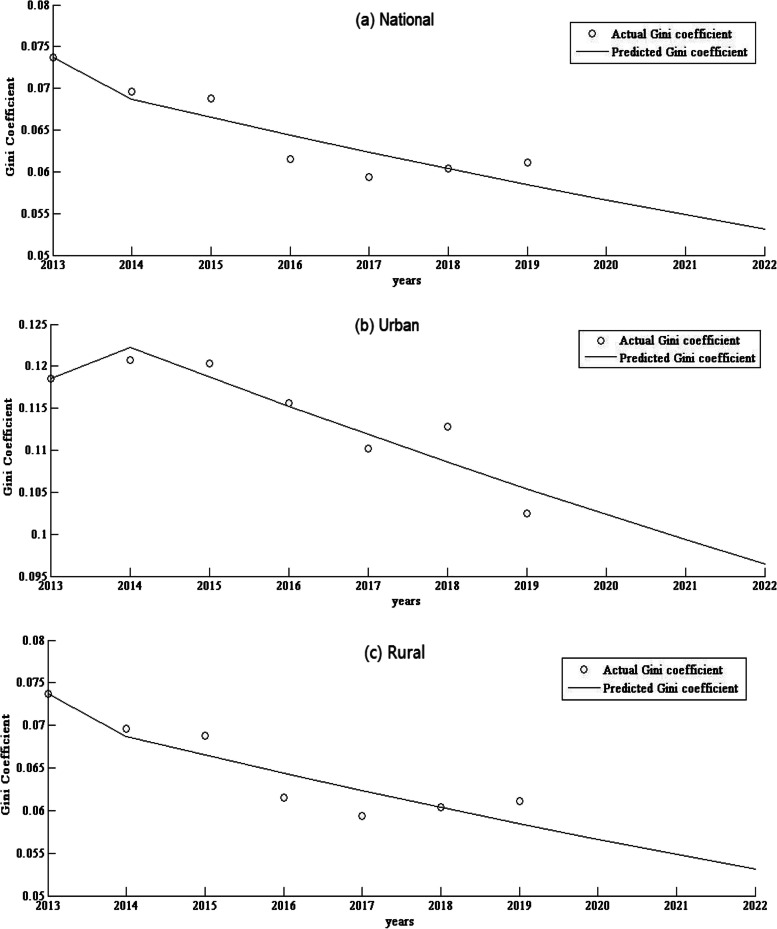
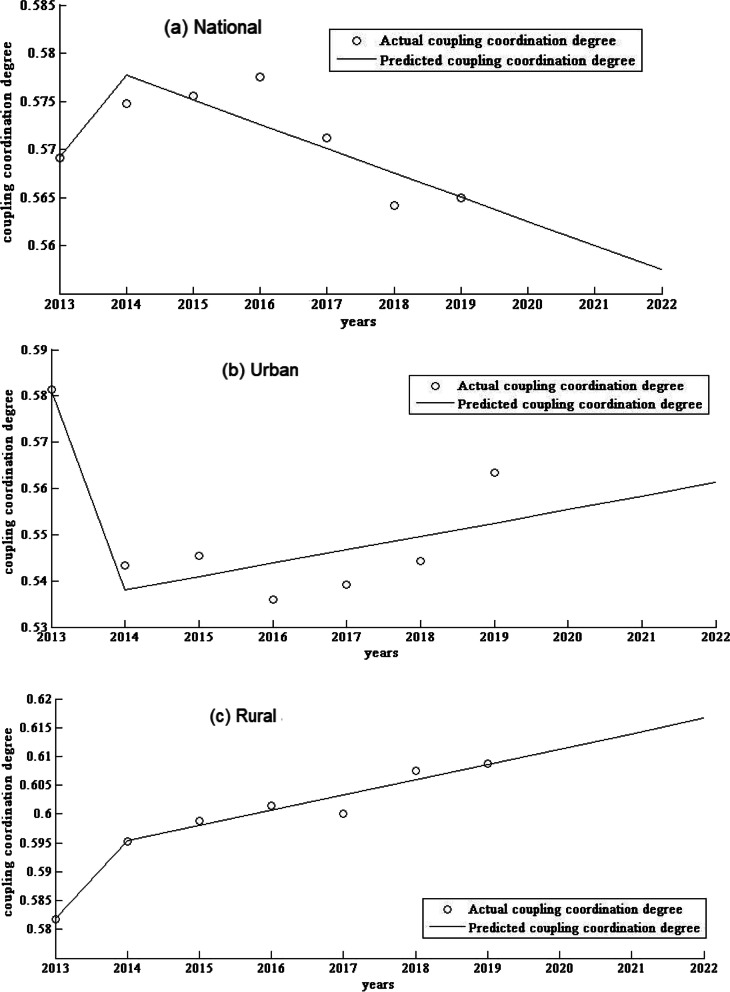
Between 2013 and 2019, the number of SPMHCI increased from 3.17 million to 3.50 million, and the population-based Gini coefficient declined from 0.0704 to 0.0513. In urban and rural areas, the Gini coefficients decreased from 0.1185 and 0.0737 to 0.1025 and 0.0611, respectively. The CCD between SPMHCI and citizens' living standards (CLS) changed from 0.5691, 0.5813, 0.5818 to 0.5650, 0.5634, 0.6088 at national, urban, and rural levels, respectively. The forecasting results of GM revealed that at the national, urban and rural levels from 2020 to 2022, the Gini coefficient would rise at a rate of - 13.53, - 5.77%, and - 6.10%, respectively, while the CCD would grow at a rate of - 0.89, 1.06, and 0.87%, respectively.
In China, the number of SPMHCI has increased significantly, with an equitable allocation based on the population. The interaction between SPMHCI and CLS is sufficient, but the degree of mutual promotion is moderate. The government could optimize SPMHCI and improve the chronic disease management services to improve CLS and to ensure the continued operation of primary medical and health care institutions in urban areas.
基层医疗卫生机构是居民健康的第一道防线。本研究旨在基于中国 2013-2019 年公民数量和生活水平,评估基层医疗卫生机构(SPMHCI)人员的现状和公平性以及耦合协调度(CCD)。研究结果有望为 SPMHCI 的配置提供指导。
本研究使用的数据包括中国 31 个省级行政区的公民数量和生活水平以及 SPMHCI 的数量,均来自《中国统计年鉴》和《中国卫生统计年鉴》。利用基尼系数和 CCD 模型分析 SPMHCI 的公平性和 CCD,采用灰色预测模型 GM(1,1)(GM)预测 2020-2022 年的公平性和 CCD。
2013 年至 2019 年间,SPMHCI 数量从 317 万增加到 350 万,人口基尼系数从 0.0704 下降到 0.0513。城乡基尼系数分别从 0.1185 和 0.0737 下降到 0.1025 和 0.0611。SPMHCI 与居民生活水平(CLS)之间的 CCD 分别从全国、城镇和农村的 0.5691、0.5813 和 0.5818 变为 0.5650、0.5634 和 0.6088。GM 的预测结果表明,2020 年至 2022 年,全国、城镇和农村地区的基尼系数将分别以-13.53%、-5.77%和-6.10%的速度上升,而 CCD 将分别以-0.89%、1.06%和 0.87%的速度增长。
在中国,SPMHCI 的数量显著增加,人口分布公平合理。SPMHCI 与 CLS 的相互作用充分,但相互促进程度适中。政府可以优化 SPMHCI,提高慢性病管理服务水平,提高 CLS,确保城镇基层医疗卫生机构的持续运行。