Chu Qingfei, Gu Xinyu, Zheng Qiuxian, Guo Zixuan, Shan Dandan, Wang Jing, Zhu Haihong
State Key Laboratory for Diagnosis and Treatment of Infectious Diseases, National Clinical Research Center for Infectious Diseases, Collaborative Innovation Center for Diagnosis and Treatment of Infectious Diseases, The First Affiliated Hospital, College of Medicine, Zhejiang University, NO. 79 Qingchun Road, Hangzhou, 310003, Zhejiang, China.
Cancer Cell Int. 2021 Oct 30;21(1):583. doi: 10.1186/s12935-021-02292-1.
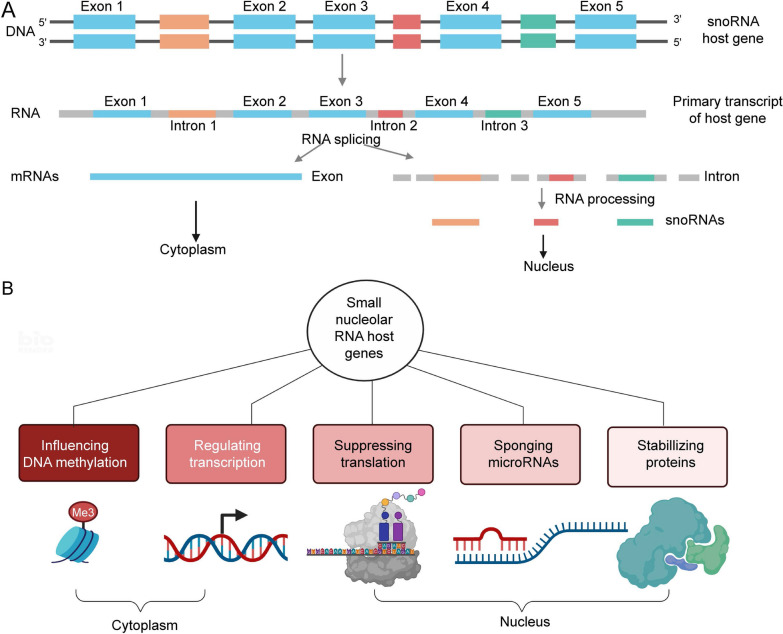
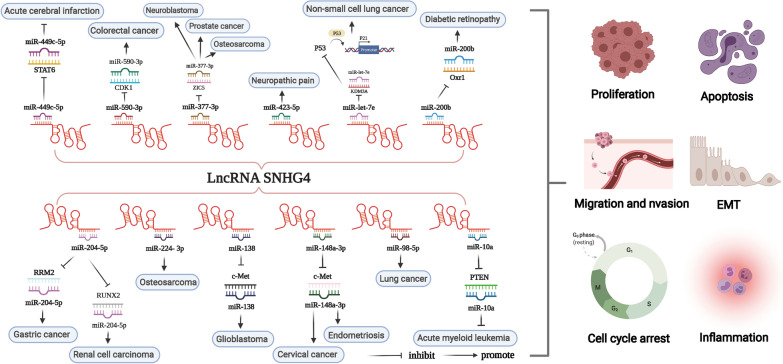
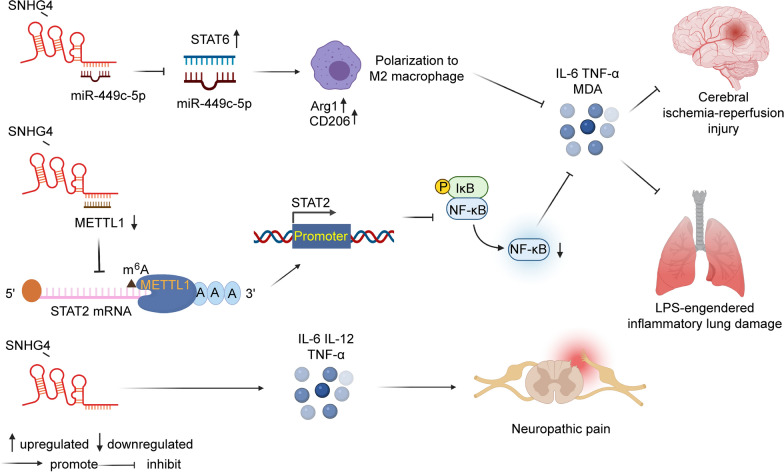
Recently, long noncoding RNAs (lncRNAs) have attracted great attention from researchers. LncRNAs are non-protein-coding RNAs of more than 200 nucleotides in length. Multiple studies have been published on the relationship between lncRNA expression and the progression of human diseases. LncRNA small nucleolar RNA host gene 4 (SNHG4), a member of the lncRNA SNHG family, is abnormally expressed in a variety of human diseases, including gastric cancer, renal cell carcinoma, glioblastoma, neuroblastoma, prostate cancer, colorectal cancer, osteosarcoma, cervical cancer, liver cancer, lung cancer, non-small-cell lung cancer, neonatal pneumonia, diabetic retinopathy, neuropathic pain, acute cerebral infarction, acute myeloid leukaemia, and endometriosis. In this paper, the structure of SNHG4 is first introduced, and then studies in humans, animal models and cells are summarized to highlight the expression and function of SNHG4 in the above diseases. In addition, the specific mechanism of SNHG4 as a competing endogenous RNA (ceRNA) is discussed. The findings indicate that SNHG4 can be used as a biomarker for disease prognosis evaluation and as a potential target for disease diagnosis and treatment.
最近,长链非编码RNA(lncRNAs)引起了研究人员的极大关注。lncRNAs是长度超过200个核苷酸的非蛋白质编码RNA。关于lncRNA表达与人类疾病进展之间的关系,已经发表了多项研究。lncRNA小核仁RNA宿主基因4(SNHG4)是lncRNA SNHG家族的成员之一,在多种人类疾病中异常表达,包括胃癌、肾细胞癌、胶质母细胞瘤、神经母细胞瘤、前列腺癌、结直肠癌、骨肉瘤、宫颈癌、肝癌、肺癌、非小细胞肺癌、新生儿肺炎、糖尿病视网膜病变、神经性疼痛、急性脑梗死、急性髓系白血病和子宫内膜异位症。本文首先介绍了SNHG4的结构,然后总结了在人类、动物模型和细胞中的研究,以突出SNHG4在上述疾病中的表达和功能。此外,还讨论了SNHG4作为竞争性内源RNA(ceRNA)的具体机制。研究结果表明,SNHG4可作为疾病预后评估的生物标志物,以及疾病诊断和治疗的潜在靶点。