Division of Cardiology, Department of Internal Medicine, Taipei Veterans General Hospital, Taipei, Taiwan.
Department of Medicine, National Yang Ming Chiao Tung University, School of Medicine, Taipei, Taiwan.
Syst Rev. 2021 Oct 30;10(1):284. doi: 10.1186/s13643-021-01816-0.
Hemodynamic assessment in patients with pulmonary arterial hypertension (PAH) is essential for risk stratification and pharmacological management. However, the prognostic value of the hemodynamic changes after treatment is less well established.
We investigated the prognostic impacts of the changes in hemodynamic indices, including mean pulmonary artery pressure (mPAP), pulmonary vascular resistance (PVR), right atrial pressure (RAP), and cardiac output index (CI). We conducted this systematic review with meta-regression analysis on existing clinical trials.
We searched and identified all relevant randomized controlled trials from multiple databases. An analogous R index was used to quantify the proportion of variance explained by each predictor in the association with PAH patients' prognosis. A total of 21 trials and 3306 individuals were enrolled.
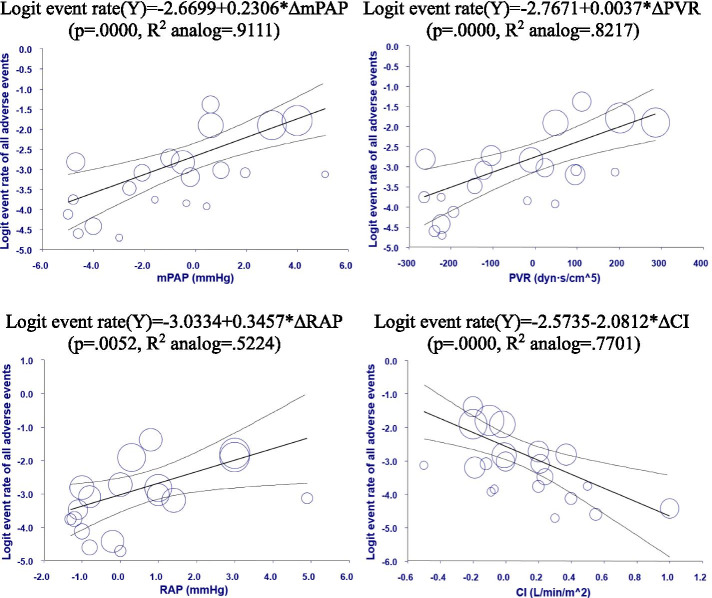
The changes in mPAP, PVR, RAP, and CI were all significantly associated with the change in 6MWD (∆6MWD). The change in mPAP was with the highest explanatory power for ∆6MWD (R analog = 0.740). Additionally, the changes in mPAP, PVR, and CI were independently predictive of adverse clinical events. The change in mPAP had the highest explanatory power for the clinical events (R analog = 0.911). Furthermore, the change in PVR was with the highest explanatory power for total mortality of PAH patients (R analog = 0.612).
Hemodynamic changes after treatment, including mPAP, PVR, CI, and RAP, were significantly associated with adverse clinical events or mortality in treated PAH patients. It is recommended that further studies be conducted to evaluate the changes in hemodynamic indices to guide drug titration.
PROSPERO CRD42019125157.
肺动脉高压(PAH)患者的血流动力学评估对于风险分层和药物管理至关重要。然而,治疗后血流动力学变化的预后价值尚未得到充分证实。
我们研究了血流动力学指标变化(包括平均肺动脉压(mPAP)、肺血管阻力(PVR)、右心房压(RAP)和心输出量指数(CI))对预后的影响。我们对现有的临床试验进行了系统评价和荟萃回归分析。
我们从多个数据库中搜索并确定了所有相关的随机对照试验。使用类似的 R 指数来量化每个预测因子与 PAH 患者预后的关联中解释的方差比例。共纳入 21 项试验和 3306 例患者。
mPAP、PVR、RAP 和 CI 的变化均与 6MWD 的变化(△6MWD)显著相关。mPAP 的变化对△6MWD 的解释能力最强(R 模拟值=0.740)。此外,mPAP、PVR 和 CI 的变化均独立预测不良临床事件。mPAP 的变化对临床事件的解释能力最强(R 模拟值=0.911)。此外,PVR 的变化对 PAH 患者的总死亡率具有最高的解释能力(R 模拟值=0.612)。
治疗后血流动力学的变化,包括 mPAP、PVR、CI 和 RAP,与治疗后的 PAH 患者不良临床事件或死亡率显著相关。建议进一步研究评估血流动力学指标的变化,以指导药物滴定。
PROSPERO CRD42019125157。