Department of Medicine, Beth Israel Deaconess Medical Center, Harvard Medical School, Boston, Massachusetts, USA.
Hinda and Arthur Marcus Institute for Aging Research, Hebrew SeniorLife, Roslindale, Massachusetts, USA.
Am J Hypertens. 2022 Apr 2;35(4):337-346. doi: 10.1093/ajh/hpab171.
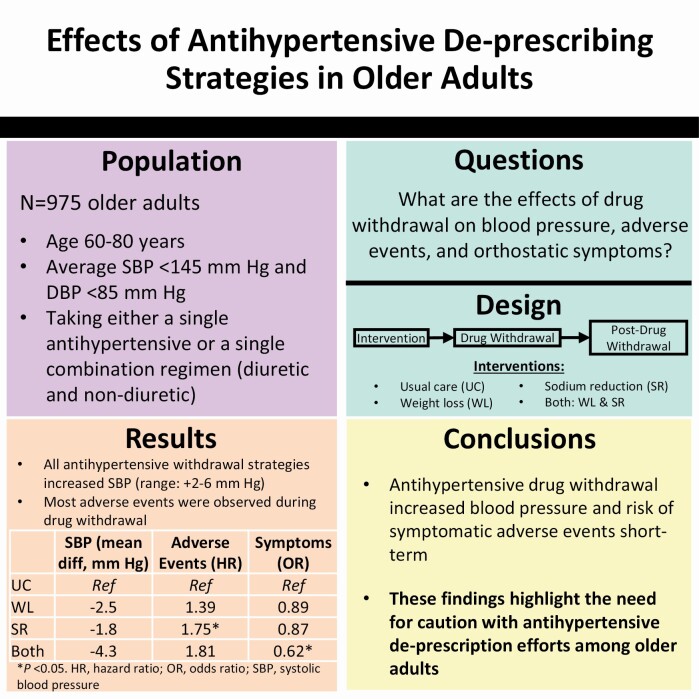
The Trial of Nonpharmacologic Interventions in the Elderly (TONE) demonstrated the efficacy of weight loss and sodium reduction to reduce hypertension medication use in older adults. However, the longer-term effects of drug withdrawal (DW) on blood pressure (BP), adverse events, and orthostatic symptoms were not reported.
TONE enrolled adults, ages 60-80 years, receiving treatment with a single antihypertensive and systolic BP (SBP)/diastolic BP <145/<85 mm Hg. Participants were randomized to weight loss, sodium reduction, both, or neither (usual care) and followed up to 36 months; ~3 months postrandomization, the antihypertensive was withdrawn and only restored if needed for uncontrolled hypertension. BP and orthostatic symptoms (lightheadedness, feeling faint, imbalance) were assessed at randomization and throughout the study. Two physicians independently adjudicated adverse events, masked to intervention, classifying symptomatic (lightheadedness, dizziness, vertigo), or clinical events (fall, fracture, syncope).
Among the 975 participants (mean age 66 years, 48% women, 24% black), mean (±SD) BP was 128 ± 9/71 ± 7 mm Hg. Independent of assignment, DW increased SBP by 4.59 mm Hg (95% confidence interval [CI]: 3.89, 5.28) compared with baseline. There were 113 adverse events (84 symptomatic, 29 clinical), primarily during DW. Compared with usual care, combined weight loss and sodium reduction mitigated the effects of DW on BP (β = -4.33 mm Hg; 95% CI: -6.48, -2.17) and reduced orthostatic symptoms long term (odds ratio = 0.62; 95% CI: 0.41, 0.92), without affecting adverse events (hazard ratio = 1.81; 95% CI: 0.90, 3.65). In contrast, sodium reduction alone increased risk of adverse events (hazard ratio = 1.75; 95% CI: 1.04, 2.95), mainly during DW.
In older adults, antihypertensive DW may increase risk of symptomatic adverse events, highlighting the need for caution in withdrawing their antihypertensive medications.
Trial Number NCT00000535.
老年人非药物干预试验(TONE)表明,减轻体重和减少钠的摄入可有效降低老年人高血压药物的使用量。然而,药物停药(DW)对血压(BP)、不良事件和直立性症状的长期影响尚未报道。
TONE 纳入了年龄在 60-80 岁之间、接受单一抗高血压药物治疗且收缩压(SBP)/舒张压(DBP)<145/<85mmHg 的成年人。参与者被随机分为减肥、减少钠摄入、两者都做或都不做(常规护理),并随访 36 个月;随机分组后约 3 个月,停用降压药,仅在血压控制不佳时恢复使用。在随机分组和整个研究过程中,评估血压和直立性症状(头晕、晕厥、眩晕)。两名医生独立评估不良事件,对干预措施进行盲法评估,将其分类为症状性(头晕、头晕、眩晕)或临床事件(跌倒、骨折、晕厥)。
在 975 名参与者(平均年龄 66 岁,48%为女性,24%为黑人)中,平均(±SD)血压为 128 ± 9/71 ± 7mmHg。无论分配如何,DW 使 SBP 升高 4.59mmHg(95%置信区间:3.89,5.28),与基线相比。共发生 113 例不良事件(84 例为症状性,29 例为临床性),主要发生在 DW 期间。与常规护理相比,联合减肥和减少钠摄入可减轻 DW 对 BP 的影响(β=-4.33mmHg;95%CI:-6.48,-2.17),并长期减轻直立性症状(比值比=0.62;95%CI:0.41,0.92),而不影响不良事件(风险比=1.81;95%CI:0.90,3.65)。相反,单独减少钠摄入增加了不良事件的风险(风险比=1.75;95%CI:1.04,2.95),主要发生在 DW 期间。
在老年人中,降压药 DW 可能会增加症状性不良事件的风险,这突出表明在停用降压药物时需要谨慎。
试验编号 NCT00000535。