Medical Department, The Affiliated Anqing Hospital of Anhui Medical University, Anqing, Anhui, China.
Department of Epidemiology and Biostatistics, School of Public Health, Anhui Medical University, Hefei, 230032, Anhui, China.
Int J Biometeorol. 2022 Jan;66(1):201-211. doi: 10.1007/s00484-021-02207-9. Epub 2021 Oct 31.
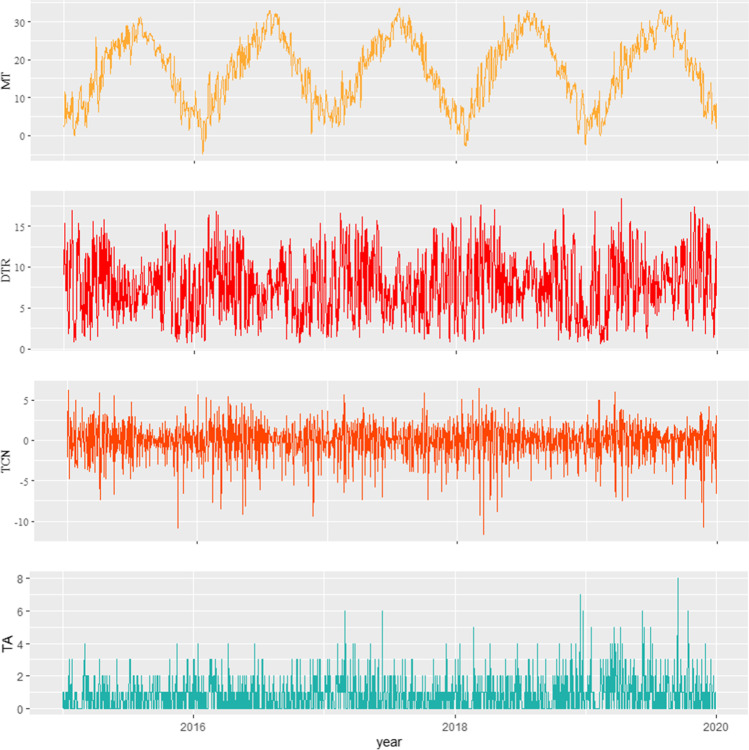
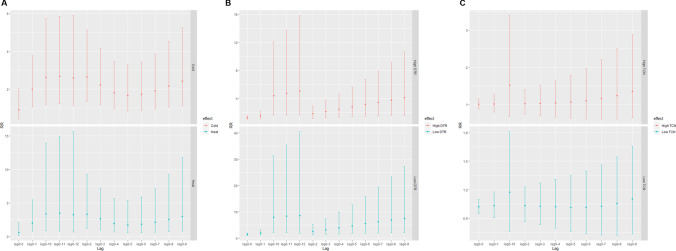
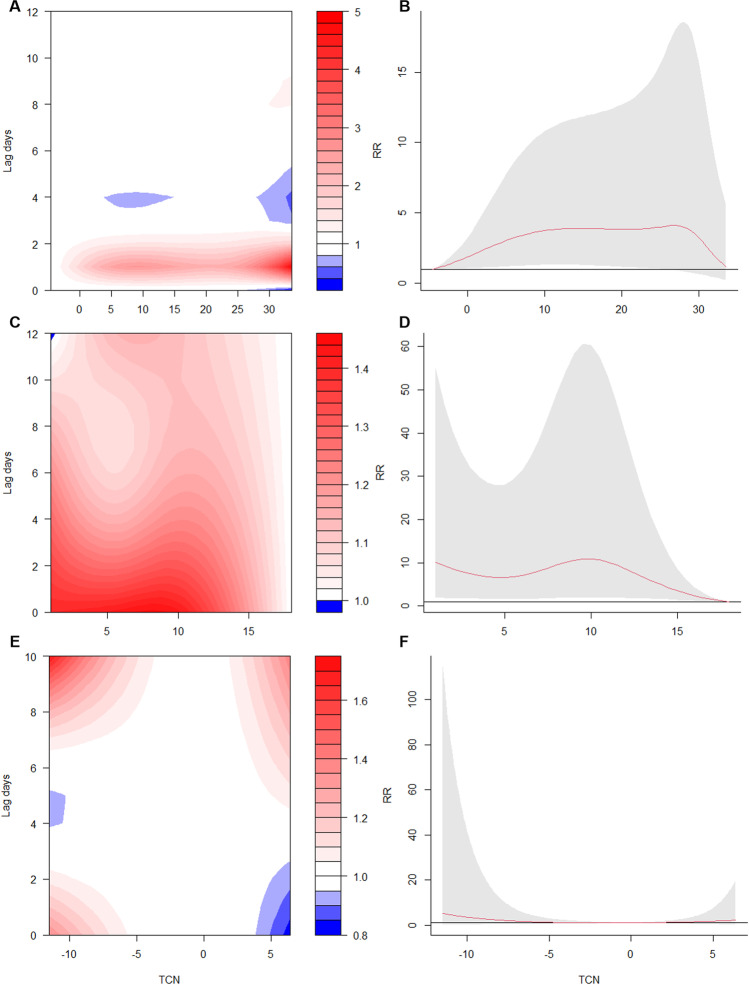
Temperature has been studied in relation to many health outcomes. However, few studies have explored its effect on the risk of hospital admission for rheumatoid arthritis (RA). A distributed lag non-linear model (DLNM) was used to analyze associations between mean temperature, diurnal temperature range (DTR), temperature change between neighboring days (TCN), and daily admissions for RA from 2015 to 2019 in Anqing, China. Subgroup analyses based on age, gender, rheumatoid factors, and admission route were performed. In total, 1456 patients with RA were hospitalized. Regarding the cumulative-lag effects of extreme cold temperature (5th percentile = 3℃), the risks of admissions for RA were increased and highest at lag 0-11 (RR = 2.68, 95% CI: 1.23-5.86). Exposing to low (5th percentile = 1.9℃) and high (95th percentile = 14.2℃) DTRs both had increased risks of RA admission, with highest RRs of 1.40 (95% CI: 1.03-1.91) and 1.24 (95% CI: 1.0-1.53) at lag 0 day, respectively. As for TCN, the marginal risk of admission in RA patients was found when exposed to high TCN (95th percentile = 2.9℃) with the largest single-day effect at lag 10 (RR = 1.11, 95% CI: 1.01-1.23). In subgroup analyses, females were more susceptible to extreme cold temperature, low and high DTRs, and high TCN. In regard to extreme cold temperature, significant risk of hospital admission in females only appeared at lag 2 (RR = 1.48, 95% CI: 1.02-2.15) and lag 0-2 (RR = 2.35, 95% CI: 1.11-4.95). It is clear that RA patients exposed to changing temperature may increase risks of admission.
已有研究探讨了温度与多种健康结果之间的关系。然而,很少有研究探究温度对类风湿关节炎(RA)住院风险的影响。本研究采用分布滞后非线性模型(DLNM)分析了 2015 年至 2019 年中国安庆市平均温度、日较差(DTR)、相邻日温度变化(TCN)与 RA 每日住院人数之间的关系,并进行了基于年龄、性别、类风湿因子和入院途径的亚组分析。共有 1456 例 RA 患者住院。对于极低温(第 5 百分位数=3℃)的累积滞后效应,RA 住院的风险增加,在滞后 0-11 时最高(RR=2.68,95%CI:1.23-5.86)。暴露于低(第 5 百分位数=1.9℃)和高(第 95 百分位数=14.2℃)DTR 均增加 RA 住院的风险,最高 RR 分别为 1.40(95%CI:1.03-1.91)和 1.24(95%CI:1.0-1.53),均在滞后 0 天。对于 TCN,RA 患者在暴露于高 TCN(第 95 百分位数=2.9℃)时发现入院的边际风险最大,在滞后 10 天的单日效应最大(RR=1.11,95%CI:1.01-1.23)。在亚组分析中,女性对极低温、低和高 DTR 以及高 TCN 更敏感。对于极低温,女性仅在滞后 2 天(RR=1.48,95%CI:1.02-2.15)和滞后 0-2 天(RR=2.35,95%CI:1.11-4.95)出现住院风险显著增加。RA 患者暴露于变化的温度可能会增加住院风险。