Keller Sebastian Mathias, Samarin Maxim, Arend Torres Fabricio, Wieser Mario, Roth Volker
Department of Mathematics and Computer Science, University of Basel, Spiegelgasse 1, 4051 Basel, Switzerland.
Int J Comput Vis. 2021;129(4):805-820. doi: 10.1007/s11263-020-01390-3. Epub 2020 Dec 23.
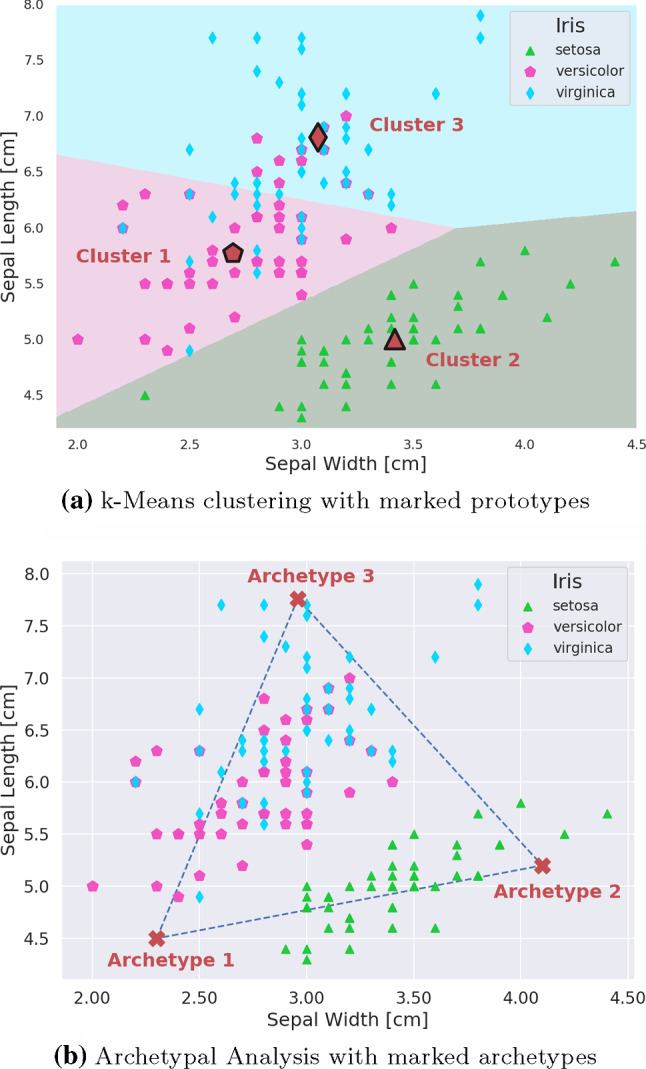
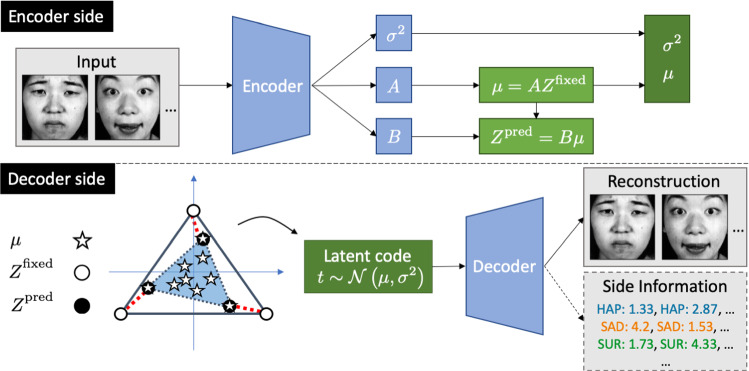
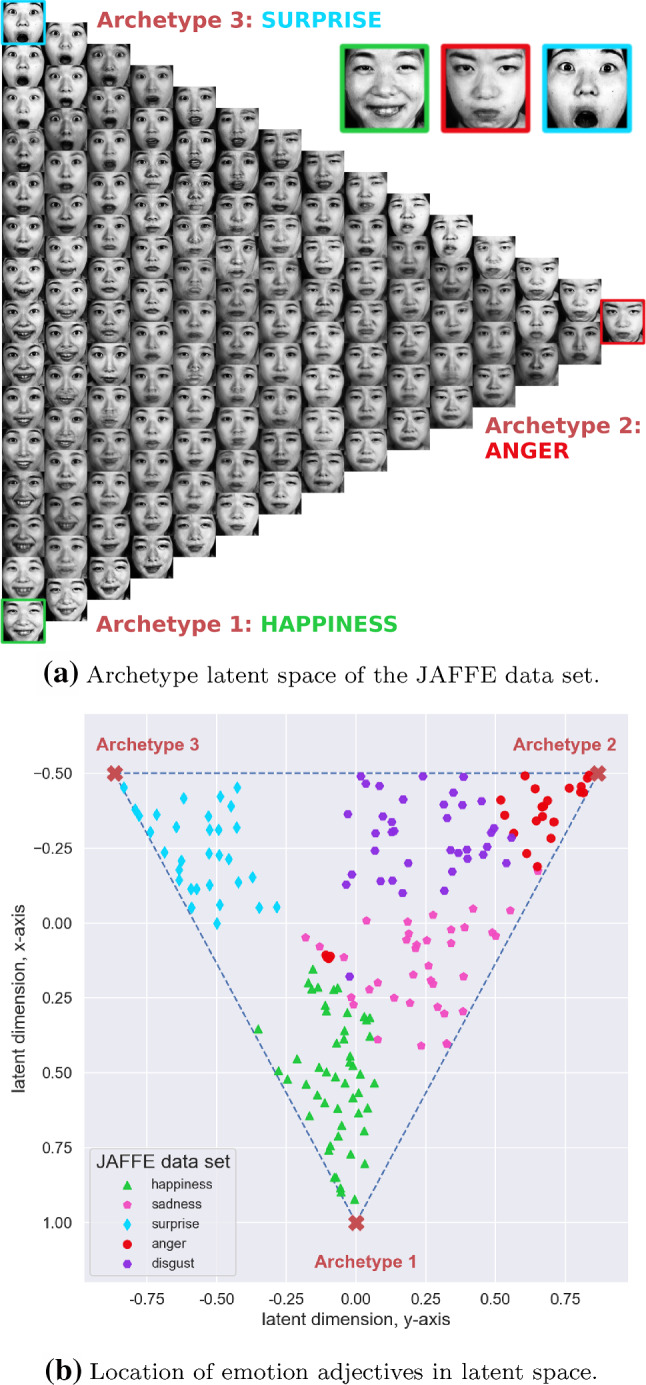
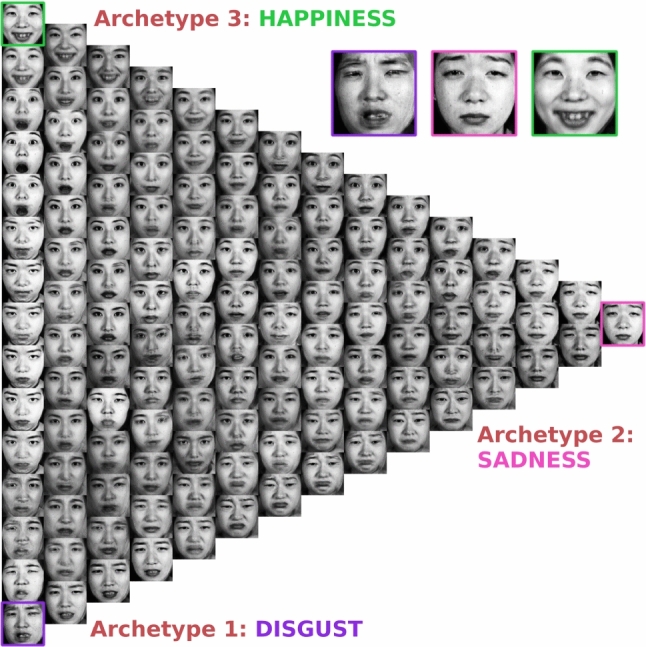
Archetypes represent extreme manifestations of a population with respect to specific characteristic traits or features. In linear feature space, archetypes approximate the data convex hull allowing all data points to be expressed as convex mixtures of archetypes. As mixing of archetypes is performed directly on the input data, linear Archetypal Analysis requires additivity of the input, which is a strong assumption unlikely to hold e.g. in case of image data. To address this problem, we propose learning an appropriate feature space while simultaneously identifying suitable archetypes. We thus introduce a generative formulation of the linear archetype model, parameterized by neural networks. By introducing the distance-dependent archetype loss, the linear archetype model can be integrated into the latent space of a deep variational information bottleneck and an optimal representation, together with the archetypes, can be learned end-to-end. Moreover, the information bottleneck framework allows for a natural incorporation of arbitrarily complex side information during training. As a consequence, learned archetypes become easily interpretable as they derive their meaning directly from the included side information. Applicability of the proposed method is demonstrated by exploring archetypes of female facial expressions while using multi-rater based emotion scores of these expressions as side information. A second application illustrates the exploration of the chemical space of small organic molecules. By using different kinds of side information we demonstrate how identified archetypes, along with their interpretation, largely depend on the side information provided.
The online version contains supplementary material available at 10.1007/s11263-020-01390-3.
原型表示在特定特征或特性方面群体的极端表现。在线性特征空间中,原型近似于数据凸包,从而允许所有数据点表示为原型的凸组合。由于原型的混合是直接在输入数据上进行的,线性原型分析要求输入具有可加性,这是一个很强的假设,例如在图像数据的情况下不太可能成立。为了解决这个问题,我们建议学习一个合适的特征空间,同时识别合适的原型。因此,我们引入了由神经网络参数化的线性原型模型的生成式公式。通过引入距离相关的原型损失,线性原型模型可以集成到深度变分信息瓶颈的潜在空间中,并且可以端到端地学习最优表示以及原型。此外,信息瓶颈框架允许在训练期间自然地纳入任意复杂的辅助信息。因此,学习到的原型很容易解释,因为它们直接从包含的辅助信息中获得其含义。通过使用基于多评分者的女性面部表情情感得分作为辅助信息来探索女性面部表情的原型,证明了所提出方法的适用性。第二个应用说明了对小有机分子化学空间的探索。通过使用不同类型的辅助信息,我们展示了所识别的原型及其解释在很大程度上如何依赖于所提供的辅助信息。
在线版本包含可在10.1007/s11263-020-01390-3获取的补充材料。