Gaur Anupama, Sharma Meenakshi, Sharma Rajesh, Marwah Nikhil
Department of Public Health Dentistry, Government Dental College, Jaipur, Rajasthan, India.
Department of Pedodontics and Preventive Dentistry, Government Dental College, Jaipur, Rajasthan, India.
Int J Clin Pediatr Dent. 2021 May-Jun;14(3):376-382. doi: 10.5005/jp-journals-10005-1975.
Most dentists are concerned that their patients are consuming a record number of sugar-filled sodas, sweetened fruit drinks, and other stuff that affect their oral environment. Children are invariably the victims of these foodstuffs. These items generally have very little nutritional value, albeit their commercial value. Thus, dietary habits and the choice of food among children and teens are important factors that determine how quickly they may develop oral diseases. Thus, to design good intervention programs and preventive strategies, information on food habits and dietary intake of the target population is very important.
To determine dietary diversity using food group score (FGS) among 12-15 years schoolchildren of urban and rural areas of Jaipur.
Jaipur district is divided into 13 Tehsils. Based on a simple random number table, Bhanpur (Rural) and Central Jaipur (Urban) were selected for the present study. Food group scores were calculated from the 5-day diet diary of the study subjects.
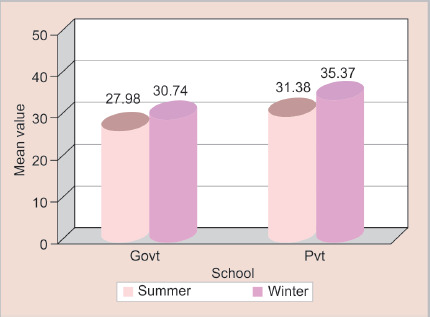
Scores were found to be higher in winters as compared to the summer season and this difference is observed to be highly statistically significant. Scores were found to be higher in urban schoolchildren as compared to rural and the difference was highly statistically significant among urban schoolchildren in winters. Scores were found to be higher among private schoolchildren as compared to government and this difference was highly statistically significant among schoolchildren belonging to urban areas.
There is a need for nutritional counseling and basic oral health care in the study area irrespective of the season. The dietary diversity of children is determined by social, psychological, and economic factors. Thus, counseling should be given accordingly in conjunction with a team of health professionals including physicians, dieticians, and dentists under the supervision of parents, guardians, and schoolteachers and management.
Gaur A, Sharma M, Sharma R. Quantifying Dietary Diversity by Using Food Group Scores among Schoolchildren of Jaipur: A Seasonal Longitudinal Study. Int J Clin Pediatr Dent 2021;14(3):376-382.
大多数牙医担心他们的患者正在饮用创纪录数量的含糖汽水、甜味水果饮料以及其他影响口腔环境的饮品。儿童一直是这些食品的受害者。这些食品通常营养价值极低,尽管它们具有商业价值。因此,儿童和青少年的饮食习惯及食物选择是决定他们患口腔疾病速度的重要因素。所以,为了设计良好的干预项目和预防策略,关于目标人群饮食习惯和饮食摄入量的信息非常重要。
使用食物组评分(FGS)确定斋浦尔城乡地区12至15岁学童的饮食多样性。
斋浦尔区分为13个乡。基于简单随机数表,本研究选取了班布尔(农村)和斋浦尔市中心(城市)。食物组评分根据研究对象的5天饮食日记计算得出。
发现冬季的评分高于夏季,且这种差异具有高度统计学意义。城市学童的评分高于农村学童,并且冬季城市学童之间的差异具有高度统计学意义。私立学校学童的评分高于公立学校学童,且城市地区学童之间的这种差异具有高度统计学意义。
无论季节如何,研究区域都需要营养咨询和基本口腔保健。儿童的饮食多样性由社会、心理和经济因素决定。因此,应在家长、监护人、学校教师和管理人员的监督下,由包括医生、营养师和牙医在内的健康专业团队联合进行相应的咨询。
Gaur A, Sharma M, Sharma R. Quantifying Dietary Diversity by Using Food Group Scores among Schoolchildren of Jaipur: A Seasonal Longitudinal Study. Int J Clin Pediatr Dent 2021;14(3):376 - 382.