Termine Cristiano, Dui Linda Greta, Borzaga Laura, Galli Vera, Lipari Rossella, Vergani Marta, Berlusconi Valentina, Agosti Massimo, Lunardini Francesca, Ferrante Simona
Piazza Biroldi 19, 21100 Varese, Italy Child Neuropsychiatry Unit, Department of Medicine and Surgery, School of Medicine, University of Insubria.
Department of Maternal and Child Health, Del Ponte Hospital, Varese, Italy.
Curr Psychol. 2023;42(10):8615-8631. doi: 10.1007/s12144-021-02321-2. Epub 2021 Oct 25.
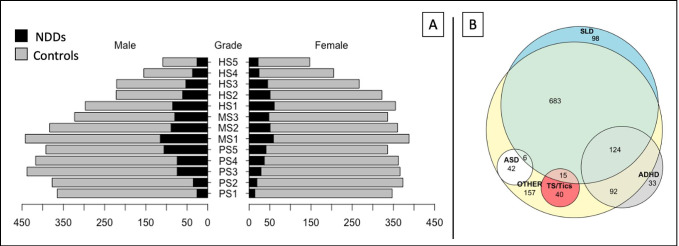
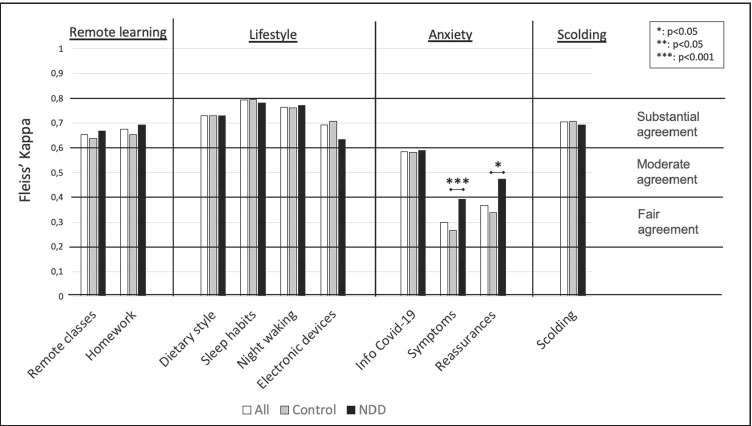
We conducted a cross-sectional study to compare the impact of social distancing and lifestyle changes that occurred during Corona Virus Disease 2019 (COVID-19) lockdown on children and adolescents with and without Neurodevelopmental Disorders (NDDs). An online questionnaire was administered in order to investigate the effects of NDD condition, socio-demographic status, familiar/home environment and COVID-19 exposure on their lives during a two months period of social isolation. We used logistic regression, focusing on five endpoints (remote learning, lifestyle, stress/anxiety, sociality, scolding) to define the extent of these effects. Most questions were paired up to parents and children, to verify the occurrence of agreement. 8305 questionnaires were analyzed, 1362 of which completed by NDDs and 6943 by controls. Results showed that the presence of a NDD, compared to controls, had a significant impact on: (i.e. subjects with NDDs experienced more difficulties in attending online classes and studying), (i.e. subjects with NDDs missed their schoolmates less), S (i.e. subjects with NDDs were scolded more often) and (i.e. subjects with NDDs were perceived by their parents as more anxious). Substantial agreement between parents and children arose from questions concerning , and . The current study actually points out that having a NDD gives account for a stronger influence on school performance and on behavioral and psychological aspects, during a two months lockdown. Such results may provide useful information to governments and school authorities on how carrying through supportive strategies for youth affected by NDDs.
The online version contains supplementary material available at 10.1007/s12144-021-02321-2.
我们进行了一项横断面研究,以比较2019年冠状病毒病(COVID-19)封锁期间社交距离和生活方式变化对患有和未患有神经发育障碍(NDDs)的儿童和青少年的影响。通过在线问卷来调查神经发育障碍状况、社会人口统计学状况、家庭环境以及COVID-19暴露在为期两个月的社会隔离期间对他们生活的影响。我们使用逻辑回归,重点关注五个终点(远程学习、生活方式、压力/焦虑、社交、责骂)来确定这些影响的程度。大多数问题是向父母和孩子成对提出的,以核实是否存在一致性。共分析了8305份问卷,其中1362份由患有神经发育障碍的人填写,6943份由对照组填写。结果表明,与对照组相比,患有神经发育障碍对以下方面有显著影响:(即患有神经发育障碍的受试者在参加在线课程和学习方面遇到更多困难)、(即患有神经发育障碍的受试者较少想念同学)、S(即患有神经发育障碍的受试者被责骂的频率更高)以及(即患有神经发育障碍的受试者被父母认为更焦虑)。父母和孩子在关于、和的问题上达成了实质性一致。当前研究实际上指出,在为期两个月的封锁期间,患有神经发育障碍对学业成绩以及行为和心理方面有更强的影响。这些结果可能会为政府和学校当局提供有用信息,以了解如何为受神经发育障碍影响的青少年实施支持策略。
在线版本包含可在10.1007/s12144-021-02321-2获取的补充材料。