Zia Niloufar, Ravanfar Parsa, Allahdadian Sepideh, Ghasemi Mehdi
Department of Psychology, Lesley University, Cambridge, MA 02138, USA.
Department of Psychiatry, University of Texas Southwestern, Dallas, TX 75390, USA.
J Clin Med. 2022 Sep 3;11(17):5213. doi: 10.3390/jcm11175213.
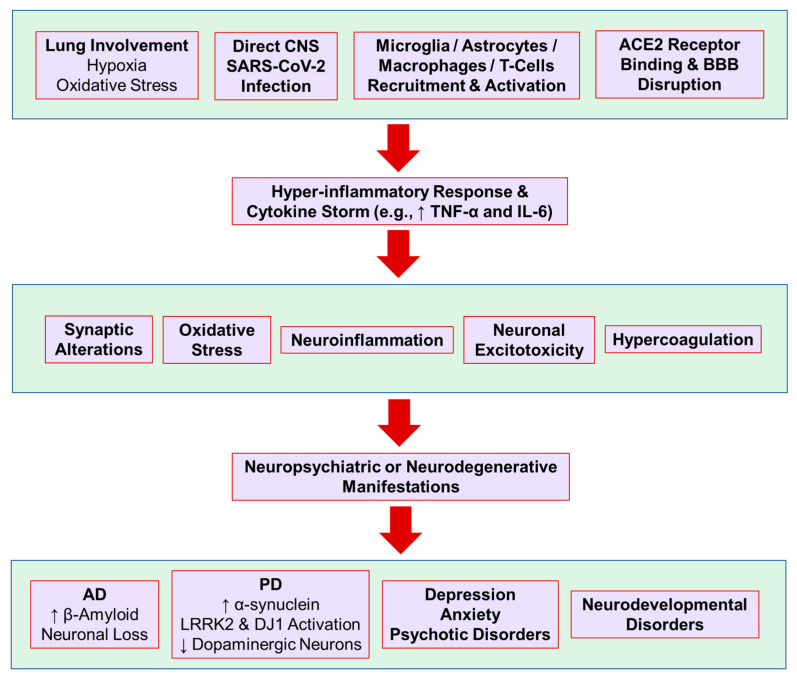
Since the Coronavirus disease 2019 (COVID-19) pandemic, caused by severe acute respiratory syndrome coronavirus 2 (SARS-CoV-2), many studies have shown that besides common COVID-19 symptoms, patients may develop various neuropsychiatric conditions including anxiety, mood disorders, psychosis, neurodegenerative diseases (e.g., dementia), insomnia, and even substance abuse disorders. COVID-19 can also worsen the patients underlying neuropsychiatric and neurodevelopmental conditions during or after the system phase of disease. In this review, we discuss the impact of SARS-CoV-2 infection on development or status of neuropsychiatric conditions during or following COVID-19.
自严重急性呼吸综合征冠状病毒2(SARS-CoV-2)引发2019年冠状病毒病(COVID-19)大流行以来,许多研究表明,除了常见的COVID-19症状外,患者还可能出现各种神经精神疾病,包括焦虑、情绪障碍、精神病、神经退行性疾病(如痴呆)、失眠,甚至物质使用障碍。COVID-19还可能在疾病的系统阶段期间或之后加重患者潜在的神经精神和神经发育疾病。在本综述中,我们讨论了SARS-CoV-2感染对COVID-19期间或之后神经精神疾病的发展或状态的影响。