Wu Qi, Wang Qin, Yang Jennifer, Martens Jacob Ws, Mills Elizabeth A, Saad Aiya, Chilukuri Pavani, Dowling Catherine A, Mao-Draayer Yang
Department of Neurology, University of Michigan Medical School, Ann Arbor, MI, USA.
Autoimmunity Center of Excellence, University of Michigan Medical School, Ann Arbor, MI, USA.
J Cent Nerv Syst Dis. 2021 Oct 25;13:11795735211050712. doi: 10.1177/11795735211050712. eCollection 2021.
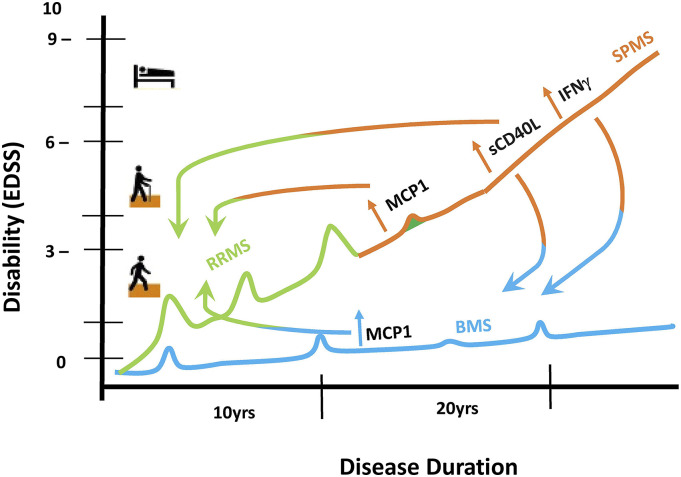
The long-term prognosis of relapsing-remitting multiple sclerosis (RRMS) is usually unfavorable as most patients transition to secondary progressive multiple sclerosis (SPMS) with accumulative disability. A rare form of non-progressive multiple sclerosis (MS) also exists, known as benign MS (BMS or NPMS), which lacks disease progression defined as Expanded Disability Status Scale (EDSS) ≤3 after 15 years of disease onset without treatment.
Our study aims to identify soluble plasma factors predicting disease progression in multiple sclerosis (MS).
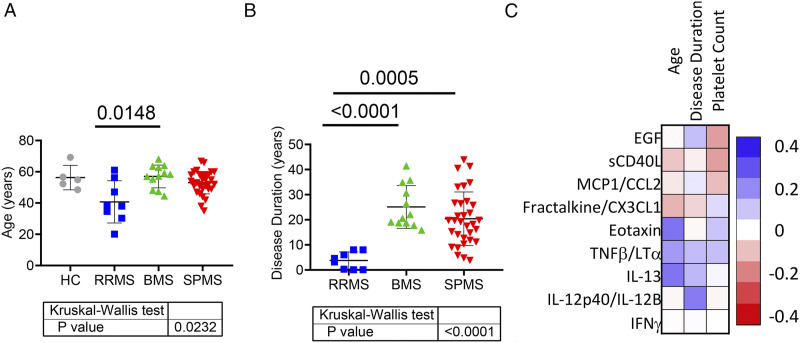
We utilized Luminex multiplex to analyze plasma levels of 33 soluble factors, comparing 32 SPMS patients to age-, sex-, and disease duration-matched non-progressive BMS patients, as well as to RRMS patients and healthy controls.
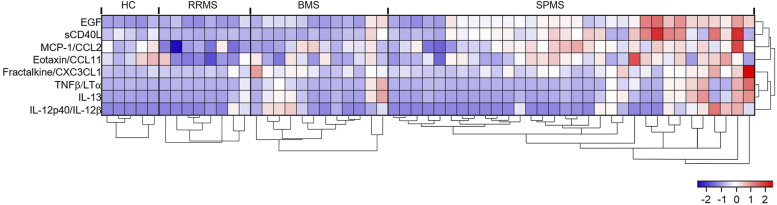
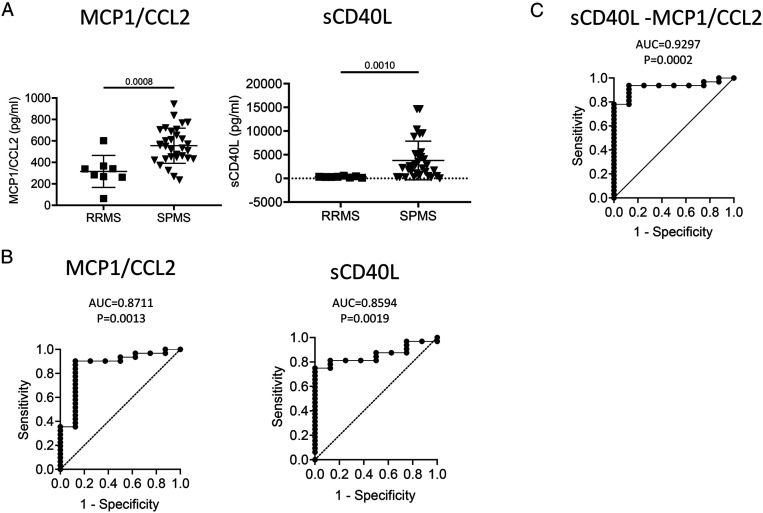
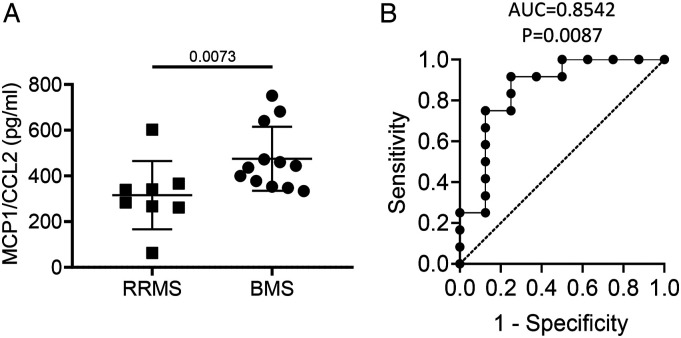
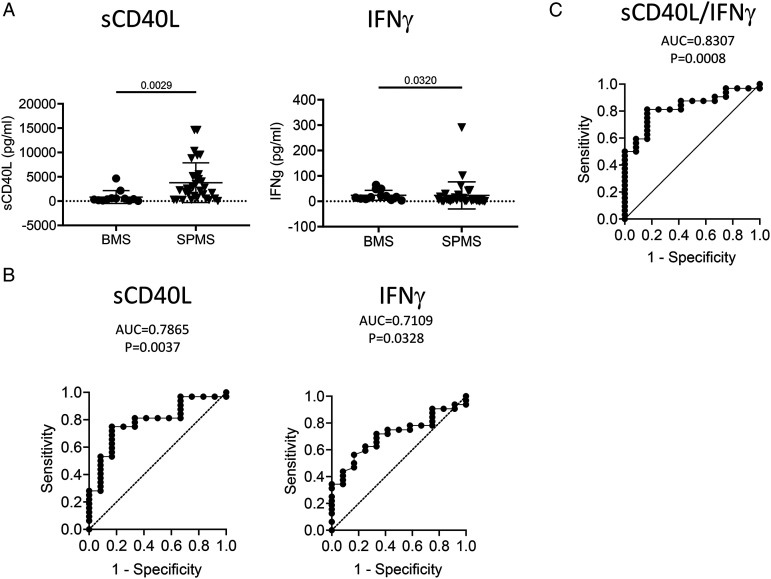
Plasma levels of EGF, sCD40L, MCP1/CCL2, fractalkine/CX3CL1, IL-13, Eotaxin, TNFβ/LTα, and IL-12p40 were significantly different between the various types of MS. Plasma sCD40L was significantly elevated in SPMS compared to BMS and RRMS. The combination of MCP1/CCL2 and sCD40L discriminated between RRMS and SPMS. MCP1/CCL2 was found to be the most effective classifier between BMS and RRMS, while BMS was most effectively distinguished from SPMS by the combination of sCD40L and IFNγ levels.
These differences may facilitate personalized precision medicine and aid in the discovery of new therapeutic targets for disease progression through the improvement of patient stratification.
复发缓解型多发性硬化症(RRMS)的长期预后通常不佳,因为大多数患者会随着残疾的累积转变为继发进展型多发性硬化症(SPMS)。还存在一种罕见的非进展型多发性硬化症(MS),称为良性MS(BMS或NPMS),其定义为在疾病发作15年后未经治疗的情况下扩展残疾状态量表(EDSS)≤3,即无疾病进展。
我们的研究旨在确定预测多发性硬化症(MS)疾病进展的可溶性血浆因子。
我们利用Luminex多重检测法分析33种可溶性因子的血浆水平,将32例SPMS患者与年龄、性别和病程匹配的非进展型BMS患者、RRMS患者以及健康对照进行比较。
不同类型的MS之间,表皮生长因子(EGF)、可溶性CD40配体(sCD40L)、单核细胞趋化蛋白1/CC趋化因子配体2(MCP1/CCL2)、 fractalkine/CX3CL1、白细胞介素13(IL-13)、嗜酸性粒细胞趋化因子、肿瘤坏死因子β/LTα和白细胞介素12p40的血浆水平存在显著差异。与BMS和RRMS相比,SPMS患者的血浆sCD40L显著升高。MCP1/CCL2和sCD40L的组合可区分RRMS和SPMS。发现MCP1/CCL2是BMS和RRMS之间最有效的分类指标,而sCD40L和干扰素γ(IFNγ)水平的组合最有效地将BMS与SPMS区分开来。
这些差异可能有助于个性化精准医疗,并通过改善患者分层来帮助发现疾病进展的新治疗靶点。