Agostini M, Araujo G, Bakalyarov A M, Balata M, Barabanov I, Baudis L, Bauer C, Bellotti E, Belogurov S, Bettini A, Bezrukov L, Biancacci V, Bossio E, Bothe V, Brudanin V, Brugnera R, Caldwell A, Cattadori C, Chernogorov A, Comellato T, D'Andrea V, Demidova E V, Marco N Di, Doroshkevich E, Fischer F, Fomina M, Gangapshev A, Garfagnini A, Gooch C, Grabmayr P, Gurentsov V, Gusev K, Hakenmüller J, Hemmer S, Hofmann W, Huang J, Hult M, Inzhechik L V, Janicskó Csáthy J, Jochum J, Junker M, Kazalov V, Kermaïdic Y, Khushbakht H, Kihm T, Kirpichnikov I V, Klimenko A, Kneißl R, Knöpfle K T, Kochetov O, Kornoukhov V N, Krause P, Kuzminov V V, Laubenstein M, Lindner M, Lippi I, Lubashevskiy A, Lubsandorzhiev B, Lutter G, Macolino C, Majorovits B, Maneschg W, Manzanillas L, Miloradovic M, Mingazheva R, Misiaszek M, Moseev P, Müller Y, Nemchenok I, Pandola L, Pelczar K, Pertoldi L, Piseri P, Pullia A, Ransom C, Rauscher L, Riboldi S, Rumyantseva N, Sada C, Salamida F, Schönert S, Schreiner J, Schütt M, Schütz A-K, Schulz O, Schwarz M, Schwingenheuer B, Selivanenko O, Shevchik E, Shirchenko M, Shtembari L, Simgen H, Smolnikov A, Stukov D, Vasenko A A, Veresnikova A, Vignoli C, von Sturm K, Wester T, Wiesinger C, Wojcik M, Yanovich E, Zatschler B, Zhitnikov I, Zhukov S V, Zinatulina D, Zschocke A, Zsigmond A J, Zuber K, Zuzel G
Department of Physics and Astronomy, University College London, London, UK.
Physik Department, Technische Universität München, Munich, Germany.
Eur Phys J C Part Fields. 2021;81(6):505. doi: 10.1140/epjc/s10052-021-09184-8. Epub 2021 Jun 7.
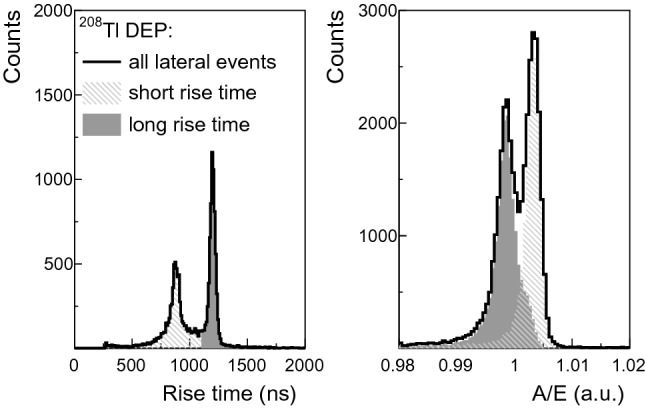
Neutrinoless double- decay of Ge is searched for with germanium detectors where source and detector of the decay are identical. For the success of future experiments it is important to increase the mass of the detectors. We report here on the characterization and testing of five prototype detectors manufactured in inverted coaxial (IC) geometry from material enriched to 88% in Ge. IC detectors combine the large mass of the traditional semi-coaxial Ge detectors with the superior resolution and pulse shape discrimination power of point contact detectors which exhibited so far much lower mass. Their performance has been found to be satisfactory both when operated in vacuum cryostat and bare in liquid argon within the Gerda setup. The measured resolutions at the -value for double- decay of Ge ( = 2039 keV) are about 2.1 keV full width at half maximum in vacuum cryostat. After 18 months of operation within the ultra-low background environment of the GERmanium Detector Array (Gerda) experiment and an accumulated exposure of 8.5 kg year, the background index after analysis cuts is measured to be around . This work confirms the feasibility of IC detectors for the next-generation experiment Legend.
利用锗探测器寻找锗的无中微子双β衰变,其中衰变的源和探测器是相同的。对于未来实验的成功而言,增加探测器的质量很重要。我们在此报告五个原型探测器的特性和测试情况,这些探测器采用反同轴(IC)几何结构制造,由富集到88%的锗材料制成。IC探测器将传统半同轴锗探测器的大质量与点接触探测器的卓越分辨率和脉冲形状鉴别能力结合起来,而点接触探测器迄今为止质量要低得多。已发现它们在真空低温恒温器中运行以及在Gerda装置中裸置于液氩中时性能都令人满意。在真空低温恒温器中,对于锗的双β衰变((Q_{\beta\beta}=2039)keV),测量得到的(Q)值处的分辨率约为半高宽2.1keV。在锗探测器阵列(Gerda)实验的超低本底环境中运行18个月且累积曝光量为8.5kg·年之后,经分析切割后的本底指数测量值约为 。这项工作证实了IC探测器用于下一代Legend实验的可行性。