Agostini M, Araujo G, Bakalyarov A M, Balata M, Barabanov I, Baudis L, Bauer C, Bellotti E, Belogurov S, Bettini A, Bezrukov L, Biancacci V, Bossio E, Bothe V, Brudanin V, Brugnera R, Caldwell A, Cattadori C, Chernogorov A, Comellato T, D'Andrea V, Demidova E V, Marco N Di, Doroshkevich E, Fischer F, Fomina M, Gangapshev A, Garfagnini A, Gooch C, Grabmayr P, Gurentsov V, Gusev K, Hakenmüller J, Hemmer S, Hiller R, Hofmann W, Huang J, Hult M, Inzhechik L V, Csáthy J Janicskó, Jochum J, Junker M, Kazalov V, Kermaïdic Y, Khushbakht H, Kihm T, Kirpichnikov I V, Klimenko A, Kneißl R, Knöpfle K T, Kochetov O, Kornoukhov V N, Krause P, Kuzminov V V, Laubenstein M, Lindner M, Lippi I, Lubashevskiy A, Lubsandorzhiev B, Lutter G, Macolino C, Majorovits B, Maneschg W, Manzanillas L, Miloradovic M, Mingazheva R, Misiaszek M, Moseev P, Müller Y, Nemchenok I, Pandola L, Pelczar K, Pertoldi L, Piseri P, Pullia A, Ransom C, Rauscher L, Riboldi S, Rumyantseva N, Sada C, Salamida F, Schönert S, Schreiner J, Schütt M, Schütz A-K, Schulz O, Schwarz M, Schwingenheuer B, Selivanenko O, Shevchik E, Shirchenko M, Shtembari L, Simgen H, Smolnikov A, Stukov D, Vasenko A A, Veresnikova A, Vignoli C, von Sturm K, Wester T, Wiesinger C, Wojcik M, Yanovich E, Zatschler B, Zhitnikov I, Zhukov S V, Zinatulina D, Zschocke A, Zsigmond A J, Zuber K, Zuzel G
Department of Physics and Astronomy, University College London, London, UK.
Physik Department, Technische Universität München, Munich, Germany.
Eur Phys J C Part Fields. 2021;81(8):682. doi: 10.1140/epjc/s10052-021-09403-2. Epub 2021 Aug 2.
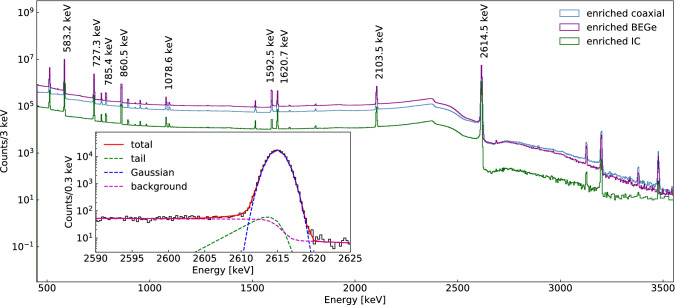
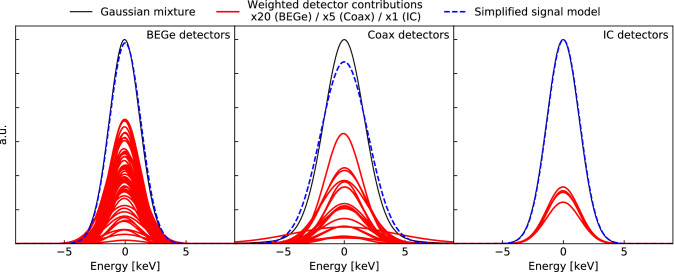
The GERmanium Detector Array (Gerda) collaboration searched for neutrinoless double- decay in Ge with an array of about 40 high-purity isotopically-enriched germanium detectors. The experimental signature of the decay is a monoenergetic signal at keV in the measured summed energy spectrum of the two emitted electrons. Both the energy reconstruction and resolution of the germanium detectors are crucial to separate a potential signal from various backgrounds, such as neutrino-accompanied double- decays allowed by the Standard Model. The energy resolution and stability were determined and monitored as a function of time using data from regular Th calibrations. In this work, we describe the calibration process and associated data analysis of the full Gerda dataset, tailored to preserve the excellent resolution of the individual germanium detectors when combining data over several years.
锗探测器阵列(Gerda)合作组使用约40个高纯度同位素富集锗探测器阵列在锗中寻找无中微子双β衰变。该衰变的实验特征是在两个发射电子的测量总能量谱中,在keV处有一个单能信号。锗探测器的能量重建和分辨率对于从各种背景(如标准模型允许的中微子伴随双β衰变)中分离潜在信号至关重要。利用来自常规钍校准的数据,确定并监测了能量分辨率和稳定性随时间的变化。在这项工作中,我们描述了完整Gerda数据集的校准过程及相关数据分析,其经过调整以在合并多年数据时保持单个锗探测器的出色分辨率。