Agostini M, Alexander A, Araujo G, Bakalyarov A M, Balata M, Barabanov I, Baudis L, Bauer C, Belogurov S, Bettini A, Bezrukov L, Biancacci V, Bossio E, Bothe V, Brugnera R, Caldwell A, Calgaro S, Cattadori C, Chernogorov A, Chiu P-J, Comellato T, D'Andrea V, Demidova E V, Di Giacinto A, Di Marco N, Doroshkevich E, Fischer F, Fomina M, Gangapshev A, Garfagnini A, Gooch C, Grabmayr P, Gurentsov V, Gusev K, Hakenmüller J, Hemmer S, Hofmann W, Hult M, Inzhechik L V, Janicskó Csáthy J, Jochum J, Junker M, Kazalov V, Kermaïdic Y, Khushbakht H, Kihm T, Kilgus K, Kirpichnikov I V, Klimenko A, Knöpfle K T, Kochetov O, Kornoukhov V N, Krause P, Kuzminov V V, Laubenstein M, Lindner M, Lippi I, Lubashevskiy A, Lubsandorzhiev B, Lutter G, Macolino C, Majorovits B, Maneschg W, Manzanillas L, Marshall G, Misiaszek M, Morella M, Müller Y, Nemchenok I, Neuberger M, Pandola L, Pelczar K, Pertoldi L, Piseri P, Pullia A, Rauscher L, Redchuk M, Riboldi S, Rumyantseva N, Sada C, Sailer S, Salamida F, Schönert S, Schreiner J, Schütt M, Schütz A-K, Schulz O, Schwarz M, Schwingenheuer B, Selivanenko O, Shevchik E, Shirchenko M, Shtembari L, Simgen H, Smolnikov A, Stukov D, Sullivan S, Vasenko A A, Veresnikova A, Vignoli C, von Sturm K, Wester T, Wiesinger C, Wojcik M, Yanovich E, Zatschler B, Zhitnikov I, Zhukov S V, Zinatulina D, Zschocke A, Zsigmond A J, Zuber K, Zuzel G
Department of Physics and Astronomy, University College London, London, UK.
Physik-Institut, Universität Zürich, Zurich, Switzerland.
Eur Phys J C Part Fields. 2023;83(9):778. doi: 10.1140/epjc/s10052-023-11862-8. Epub 2023 Sep 4.
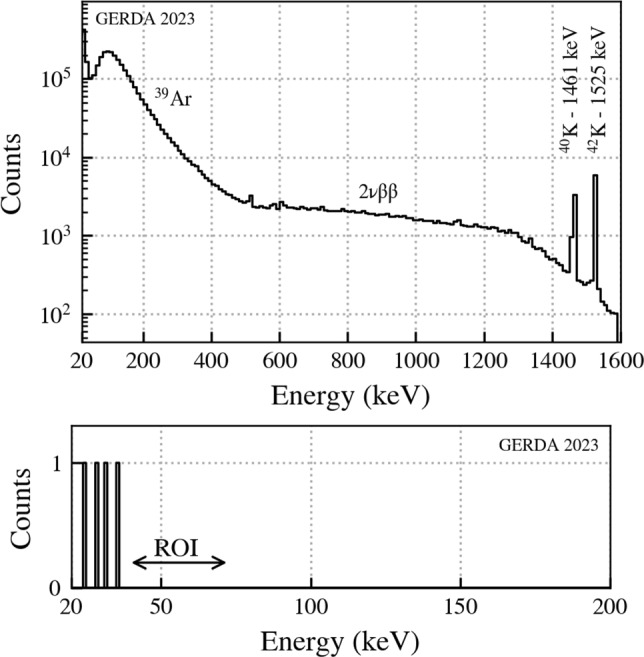
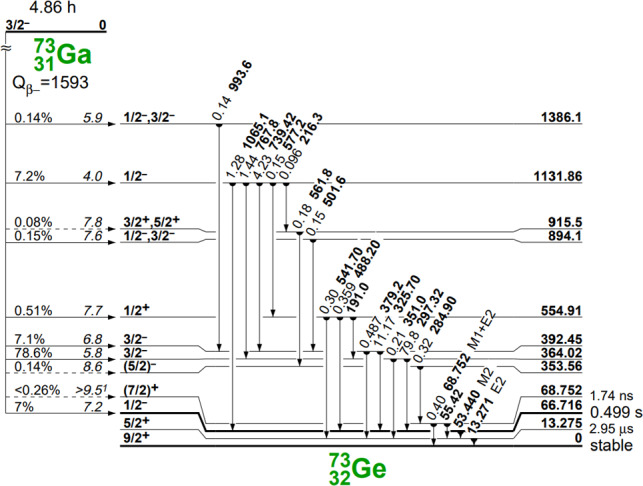
We search for tri-nucleon decays of Ge in the dataset from the GERmanium Detector Array (GERDA) experiment. Decays that populate excited levels of the daughter nucleus above the threshold for particle emission lead to disintegration and are not considered. The ppp-, ppn-, and pnn-decays lead to Cu, Zn, and Ga nuclei, respectively. These nuclei are unstable and eventually proceed by the beta decay of Ga to Ge (stable). We search for the Ga decay exploiting the fact that it dominantly populates the 66.7 keV Ga state with half-life of 0.5 s. The nnn-decays of Ge that proceed via Ge are also included in our analysis. We find no signal candidate and place a limit on the sum of the decay widths of the inclusive tri-nucleon decays that corresponds to a lower lifetime limit of 1.210 yr (90% credible interval). This result improves previous limits for tri-nucleon decays by one to three orders of magnitude.
我们在锗探测器阵列(GERDA)实验的数据集中寻找锗的三核子衰变。那些使子核激发态的能量高于粒子发射阈值的衰变会导致原子核解体,因此不予考虑。质子 - 质子 - 质子(ppp)衰变、质子 - 质子 - 中子(ppn)衰变和质子 - 中子 - 中子(pnn)衰变分别产生铜、锌和镓原子核。这些原子核不稳定,最终通过镓的β衰变转变为稳定的锗。我们利用镓主要衰变为半衰期为0.5秒的66.7keV激发态这一事实来寻找镓的衰变。通过锗进行的锗的中子 - 中子 - 中子(nnn)衰变也包含在我们的分析中。我们未找到信号候选事例,并对包含性三核子衰变的衰变宽度总和设定了一个限制,这对应于1.2×10¹⁰年的更低寿命限制(90%可信区间)。该结果将之前对三核子衰变的限制提高了一到三个数量级。