Chen Chen, Li Xueqin, Lv Yuebin, Yin Zhaoxue, Zhao Feng, Liu Yingchun, Li Chengcheng, Ji Saisai, Zhou Jinhui, Wei Yuan, Cao Xingqi, Wang Jiaonan, Gu Heng, Lu Feng, Liu Zuyun, Shi Xiaoming
China CDC Key Laboratory of Environment and Population Health, National Institute of Environmental Health, Chinese Center for Disease Control and Prevention, Beijing, China.
Department of Big Data in Health Science, School of Public Health, Zhejiang University School of Medicine, Hangzhou, China.
Front Aging Neurosci. 2021 Oct 14;13:747686. doi: 10.3389/fnagi.2021.747686. eCollection 2021.
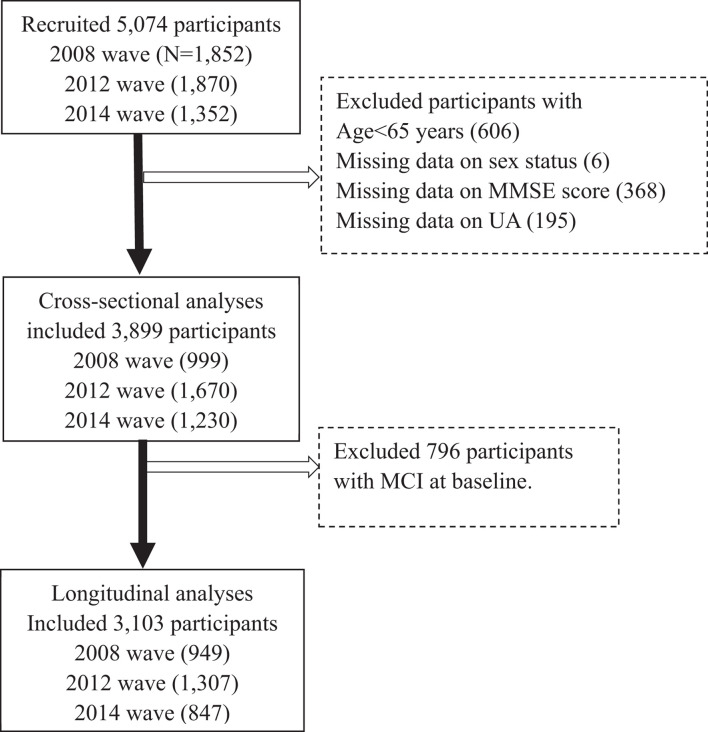
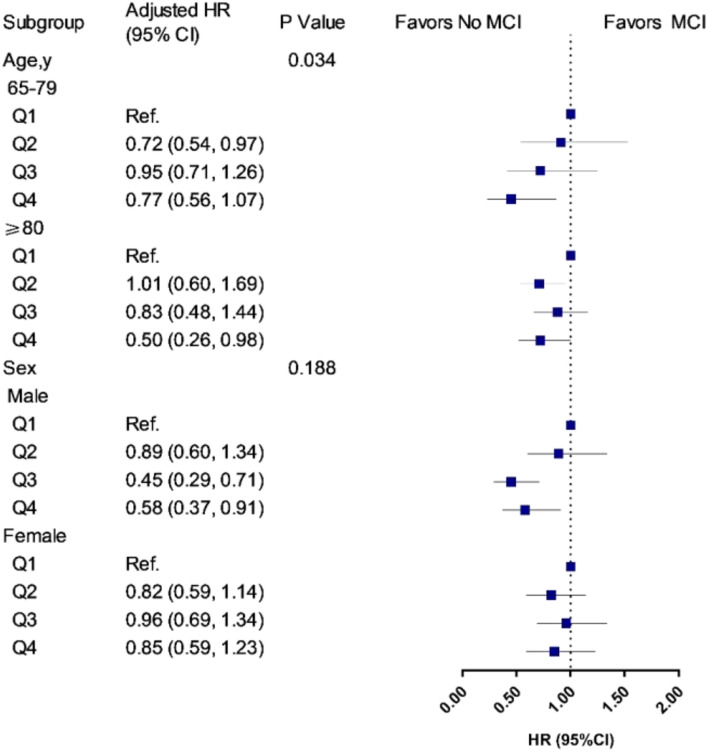
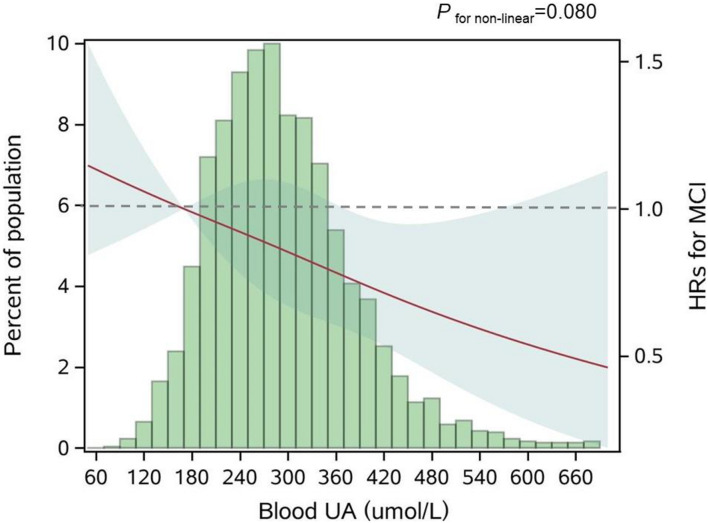
It remains unsolved that whether blood uric acid (UA) is a neuroprotective or neurotoxic agent. This study aimed to evaluate the longitudinal association of blood UA with mild cognitive impairment (MCI) among older adults in China. A total of 3,103 older adults (aged 65+ years) free of MCI at baseline were included from the Healthy Aging and Biomarkers Cohort Study (HABCS). Blood UA level was determined by the uricase colorimetry assay and analyzed as both continuous and categorical (by quartile) variables. Global cognition was assessed using the Mini-Mental State Examination four times between 2008 and 2017, with a score below 24 being considered as MCI. Cox proportional hazards models were used to examine the associations. During a 9-year follow-up, 486 (15.7%) participants developed MCI. After adjustment for all covariates, higher UA had a dose-response association with a lower risk of MCI (all < 0.05). Participants in the highest UA quartile group had a reduced risk [hazard ratio (HR), 0.73; 95% (CI): 0.55-0.96] of MCI, compared with those in the lowest quartile group. The associations were still robust even when considering death as a competing risk. Subgroup analyses revealed that these associations were statistically significant in younger older adults (65-79 years) and those without hyperuricemia. Similar significant associations were observed when treating UA as a continuous variable. High blood UA level is associated with reduced risks of MCI among Chinese older adults, highlighting the potential of managing UA in daily life for maintaining late-life cognition.
血尿酸(UA)究竟是一种神经保护剂还是神经毒性剂,这一问题仍未得到解决。本研究旨在评估中国老年人中血尿酸与轻度认知障碍(MCI)之间的纵向关联。健康老龄化与生物标志物队列研究(HABCS)纳入了3103名基线时无MCI的老年人(年龄65岁及以上)。采用尿酸酶比色法测定血尿酸水平,并将其作为连续变量和分类变量(按四分位数)进行分析。在2008年至2017年期间,使用简易精神状态检查表对整体认知进行了4次评估,得分低于24分被视为MCI。采用Cox比例风险模型来检验这种关联。在9年的随访期间,486名(15.7%)参与者发生了MCI。在对所有协变量进行调整后,较高的血尿酸与较低的MCI风险呈剂量反应关联(所有P<0.05)。与最低四分位数组的参与者相比,血尿酸最高四分位数组的参与者发生MCI的风险降低[风险比(HR),0.73;95%置信区间(CI):0.55 - 0.96]。即使将死亡视为竞争风险,这种关联仍然很强劲。亚组分析显示,这些关联在较年轻的老年人(65 - 79岁)和无高尿酸血症的人群中具有统计学意义。将血尿酸作为连续变量处理时,也观察到了类似的显著关联。高血尿酸水平与中国老年人中MCI风险降低相关,这凸显了在日常生活中控制血尿酸以维持晚年认知的潜力。