Šarabon Nejc, Kozinc Žiga, Perman Mihael
Faculty of Health Sciences, University of Primorska, Izola, Slovenia.
Andrej Marušič Institute, University of Primorska, Koper, Slovenia.
Front Physiol. 2021 Oct 15;12:767941. doi: 10.3389/fphys.2021.767941. eCollection 2021.
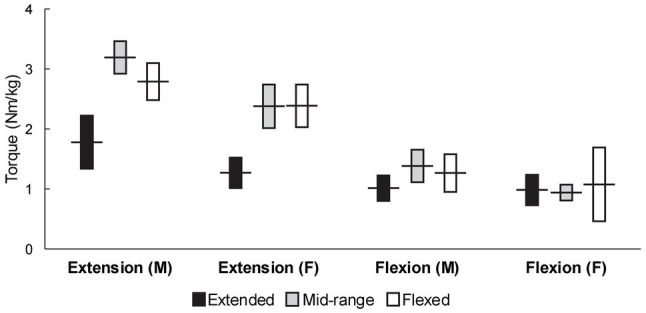
Single-joint isometric and isokinetic knee strength assessment plays an important role in strength and conditioning, physical therapy, and rehabilitation. The literature, however, lacks absolute reference values. We systematically reviewed the available studies that assessed isometric knee strength. Two scientific databases (PubMed and PEDro) were searched for the papers that are published from the inception of the field to the end of 2019. We included studies that involved participants of both genders and different age groups, regardless of the study design, that involved isometric knee extension and/or flexion measurement. The extracted data were converted to body-mass-normalized values. Moreover, the data were grouped according to the knee angle condition (extended, mid-range, and flexed). A meta-analysis was performed on 13,893 participants from 411 studies. In adult healthy males, the pooled 95% confidence intervals (CI) for knee extension were 1.34-2.23Nm/kg for extended knee angle, 2.92-3.45Nm/kg for mid-range knee angle, and 2.50-3.06Nm/kg for flexed knee angle, while the CIs for flexion were 0.85-1.20, 1.15-1.62, and 0.96-1.54Nm/kg, respectively. Adult females consistently showed lower strength than adult male subgroups (e.g., the CIs for knee extension were 1.01-1.50, 2.08-2.74, and 2.04-2.71Nm/kg for extended, mid-range, and flexed knee angle condition). Older adults consistently showed lower values than adults (e.g., pooled CIs for mid-range knee angle were 1.74-2.16Nm/kg (male) and 1.40-1.64Nm/kg (female) for extension, and 0.69-0.89Nm/kg (male) and 0.46-0.81Nm/kg (female) for flexion). Reliable normative for athletes could not be calculated due to limited number of studies for individual sports.
单关节等长和等速膝关节力量评估在力量与体能训练、物理治疗及康复中发挥着重要作用。然而,文献中缺乏绝对参考值。我们系统回顾了评估等长膝关节力量的现有研究。检索了两个科学数据库(PubMed和PEDro),查找从该领域创立至2019年底发表的论文。我们纳入了涉及不同性别和年龄组参与者的研究,无论研究设计如何,只要涉及等长膝关节伸展和/或屈曲测量。提取的数据被转换为体重标准化值。此外,数据根据膝关节角度情况(伸展、中间范围和屈曲)进行分组。对来自411项研究的13,893名参与者进行了荟萃分析。在成年健康男性中,膝关节伸展的合并95%置信区间(CI)为:膝关节伸展角度时为1.34 - 2.23Nm/kg,膝关节中间范围角度时为2.92 - 3.45Nm/kg,膝关节屈曲角度时为2.50 - 3.06Nm/kg,而屈曲的CI分别为0.85 - 1.20、1.15 - 1.62和0.96 - 1.