Sun Lei, Rogiers Gil, Courtin Pascal, Chapot-Chartier Marie-Pierre, Bierne Hélène, Michiels Chris W
Laboratory of Food Microbiology, Department of Microbial and Molecular Systems (M2S) and Leuven Food Science and Nutrition Research Center (LFoRCe), KU Leuven, Leuven, Belgium.
INRAE, AgroParisTech, Micalis Institute, Université Paris-Saclay, Jouy-en-Josas, France.
Front Microbiol. 2021 Oct 15;12:760253. doi: 10.3389/fmicb.2021.760253. eCollection 2021.
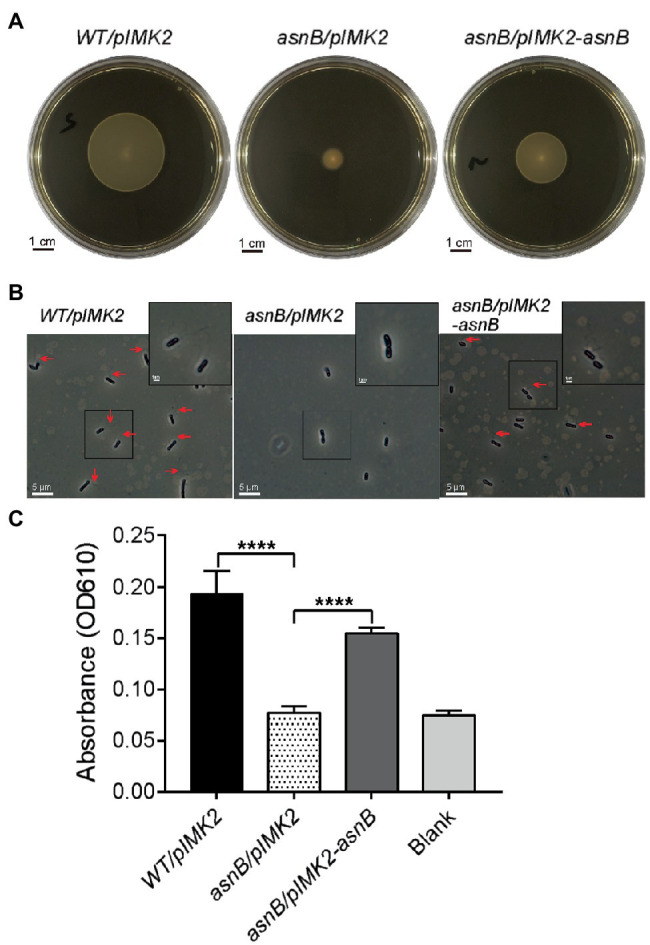
A mutant of ScottA with a transposon in the 5' untranslated region of the gene was identified to be hypersensitive to the antimicrobial -cinnamaldehyde. Here, we report the functional characterization of AsnB in peptidoglycan (PG) modification and intracellular infection. While AsnB of is annotated as a glutamine-dependent asparagine synthase, sequence alignment showed that this protein is closely related to a subset of homologs that catalyze the amidation of -diaminopimelic acid (DAP) residues in the peptidoglycan of other bacterial species. Structural analysis of peptidoglycan from an mutant, compared to that of isogenic wild-type (WT) and complemented mutant strains, confirmed that AsnB mediates DAP amidation in . Deficiency in DAP amidation caused several peptidoglycan- and cell surface-related phenotypes in the mutant, including formation of shorter but thicker cells, susceptibility to lysozyme, loss of flagellation and motility, and a strong reduction in biofilm formation. In addition, the mutant showed reduced invasion of human epithelial JEG-3 and Caco-2 cells. Analysis by immunofluorescence microscopy revealed that inactivation abrogated the proper display at the listerial surface of the invasion protein InlA, which normally gets cross-linked to DAP its LPXTG motif. Together, this work shows that AsnB of , like several of its homologs in related Gram-positive bacteria, mediates the amidation of DAP residues in the peptidoglycan and, in this way, affects several cell wall and cell surface-related properties. It also for the first time implicates the amidation of peptidoglycan DAP residues in cell wall anchoring of InlA and in bacterial virulence.
一个在基因5'非翻译区带有转座子的ScottA突变体被鉴定为对抗菌剂肉桂醛高度敏感。在此,我们报告了AsnB在肽聚糖(PG)修饰和细胞内感染中的功能特性。虽然的AsnB被注释为谷氨酰胺依赖性天冬酰胺合成酶,但序列比对表明该蛋白与其他细菌物种肽聚糖中催化二氨基庚二酸(DAP)残基酰胺化的一组同源物密切相关。与同基因野生型(WT)和互补突变体菌株相比,对突变体的肽聚糖进行结构分析证实,AsnB介导中的DAP酰胺化。DAP酰胺化缺陷在突变体中导致了几种与肽聚糖和细胞表面相关的表型,包括形成更短但更厚的细胞、对溶菌酶敏感、失去鞭毛和运动性以及生物膜形成大幅减少。此外,该突变体对人上皮JEG - 3和Caco - 2细胞的侵袭减少。免疫荧光显微镜分析显示,失活消除了侵袭蛋白InlA在李斯特菌表面的正确展示,InlA通常通过其LPXTG基序与DAP交联。总之,这项工作表明,的AsnB与其在相关革兰氏阳性细菌中的几个同源物一样,介导肽聚糖中DAP残基的酰胺化,并以此方式影响几种细胞壁和细胞表面相关特性。它还首次表明肽聚糖DAP残基的酰胺化与InlA的细胞壁锚定和细菌毒力有关。