Kotha Sreelakshmi, Lawendy Bishoy, Asim Saira, Gomes Charlene, Yu Jeffrey, Orchanian-Cheff Ani, Tomlinson George, Bhat Mamatha
Department of Gastroenterology, Guy's and St Thomas' Hospital, London SE1 7JD, United Kingdom.
Department of Multi-Organ Transplantation, Toronto General Hospital, Toronto M5G 2C4, Canada.
World J Transplant. 2021 Oct 18;11(10):432-442. doi: 10.5500/wjt.v11.i10.432.
Solid organ transplantation is a life-saving intervention for end-stage organ disease. Post-transplant diabetes mellitus (PTDM) is a common complication in solid organ transplant recipients, and significantly compromises long-term survival beyond a year.
To perform a systematic review and meta-analysis to estimate incidence of PTDM and compare the effects of the 3 major immunosuppressants on incidence of PTDM.
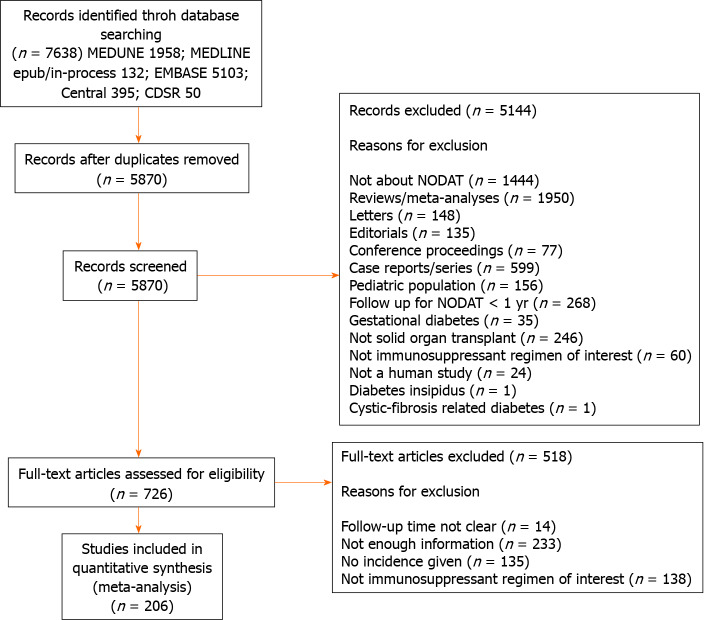
Two hundred and six eligible studies identified 75595 patients on Tacrolimus, 51242 on Cyclosporine and 3020 on Sirolimus. Random effects meta-analyses was used to calculate incidence.
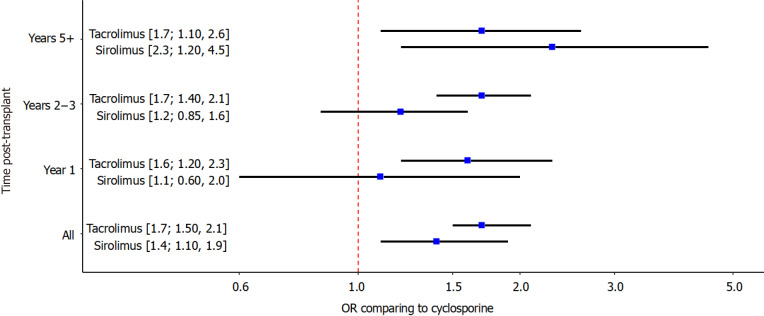
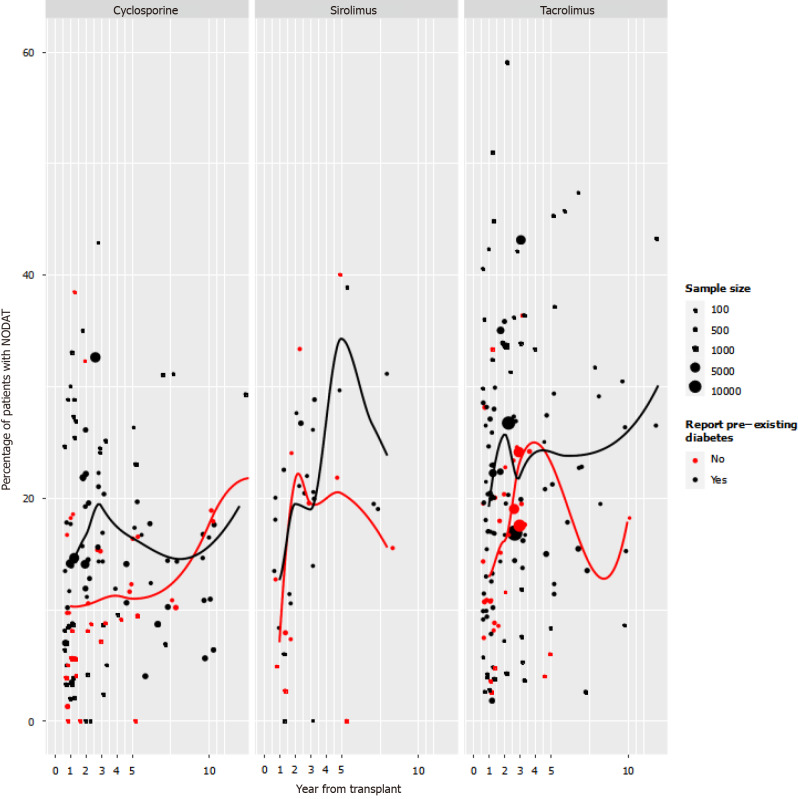
Network meta-analysis estimated the overall risk of developing PTDM was higher with tacrolimus (OR = 1.4 95%CI: 1.0-2.0) and sirolimus (OR = 1.8; 95%CI: 1.5-2.2) than with Cyclosporine. The overall incidence of PTDM at years 2-3 was 17% for kidney, 19% for liver and 22% for heart. The risk factors for PTDM most frequently identified in the primary studies were age, body mass index, hepatitis C, and African American descent.
Tacrolimus tends to exhibit higher diabetogenicity in the short-term (2-3 years post-transplant), whereas sirolimus exhibits higher diabetogenicity in the long-term (5-10 years post-transplant). This study will aid clinicians in recognition of risk factors for PTDM and encourage careful evaluation of the risk/benefit of different immunosuppressant regimens in transplant recipients.
实体器官移植是终末期器官疾病的一种挽救生命的干预措施。移植后糖尿病(PTDM)是实体器官移植受者常见的并发症,并且严重影响一年后的长期生存率。
进行一项系统评价和荟萃分析,以估计PTDM的发病率,并比较3种主要免疫抑制剂对PTDM发病率的影响。
206项符合条件的研究纳入了75595例使用他克莫司的患者、51242例使用环孢素的患者和3020例使用西罗莫司的患者。采用随机效应荟萃分析计算发病率。
网状荟萃分析估计,与环孢素相比,使用他克莫司(OR = 1.4;95%CI:1.0 - 2.0)和西罗莫司(OR = 1.8;95%CI:1.5 - 2.2)发生PTDM的总体风险更高。2 - 3年时,肾脏移植受者PTDM的总体发病率为17%,肝脏移植受者为19%,心脏移植受者为22%。在原始研究中最常确定的PTDM危险因素是年龄、体重指数、丙型肝炎和非裔美国人血统。
他克莫司在短期(移植后2 - 3年)往往表现出较高的致糖尿病性,而西罗莫司在长期(移植后5 - 10年)表现出较高的致糖尿病性。本研究将有助于临床医生识别PTDM的危险因素,并鼓励仔细评估移植受者不同免疫抑制方案的风险/益处。