Microbiology, Immunology and Parasitology Department, Escola Paulista de Medicina, Federal University of São Paulo, São Paulo, Brazil.
Biochemistry Department, Escola Paulista de Medicina, Federal University of São Paulo, São Paulo, Brazil.
Front Cell Infect Microbiol. 2021 Oct 15;11:756521. doi: 10.3389/fcimb.2021.756521. eCollection 2021.
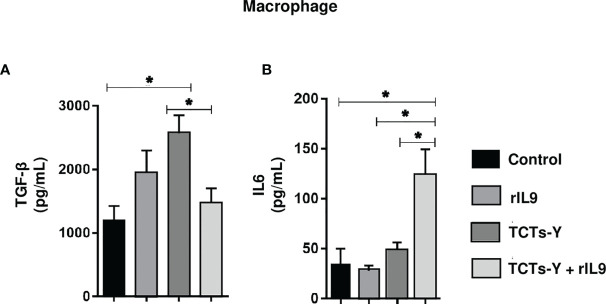
Chagas' disease is a parasitosis caused by , which affects approximately 8 million people worldwide. The balance between pro- and anti-inflammatory cytokines produced during immunological responses contributes to disease prognosis and progression. Parasite tissue persistence can induce chronic inflammatory stimuli, which can cause long-term tissue injury and fibrosis. Chronic Chagas' patients exhibit increased levels of interleukin (IL)-9, an important cytokine in the regulation of inflammatory and fibrogenic processes. Data on the role of IL-9 in other pathologies are sometimes contradictory, and few studies have explored this cytokine's influence in Chagas' disease pathology. Hence, the aim of this study was to evaluate the role of IL-9 in the progression of infection and . infection demonstrated that IL-9 reduced the number of infected cells and decreased the multiplication of intracellular amastigotes in both C2C12 myoblasts and bone marrow-derived macrophages. In myoblasts, the increased production of nitric oxide (NO) was essential for reduced parasite multiplication, whereas macrophage responses resulted in increased IL-6 and reduced TGF-β levels, indicating that parasite growth restriction mechanisms induced by IL-9 were cell-type specific. Experimental infection of BALB/c mice with trypomastigotes of the Y strain implicated a major role of IL-9 during the chronic phase, as increased Th9 and Tc9 cells were detected among splenocytes; higher levels of IL-9 in these cell populations and increased cardiac IL-9 levels were detected compared to those of uninfected mice. Moreover, rIL9 treatment decreased serum IL-12, IL-6, and IL-10 levels and cardiac TNF-α levels, possibly attempting to control the inflammatory response. IL-9 neutralization increased cardiac fibrosis, synthesis of collagens I and III, and mastocyte recruitment in BALB/c heart tissue during the chronic phase. In conclusion, our data showed that IL-9 reduced the invasion and multiplication of , in both myoblasts and macrophages, favoring disease control through cell-specific mechanisms. , IL-9 was elevated during experimental chronic infection in BALB/c mice, and this cytokine played a protective role in the immunopathological response during this phase by controlling cardiac fibrosis and proinflammatory cytokine production.
恰加斯病是一种由 引起的寄生虫病,全球约有 800 万人受到影响。免疫反应过程中产生的促炎和抗炎细胞因子之间的平衡有助于疾病的预后和进展。寄生虫组织的持续存在会引发慢性炎症刺激,从而导致长期的组织损伤和纤维化。慢性恰加斯病患者的白细胞介素(IL)-9 水平升高,IL-9 是调节炎症和纤维发生过程的重要细胞因子。关于 IL-9 在其他病理中的作用的数据有时存在矛盾,并且很少有研究探讨该细胞因子在恰加斯病病理学中的影响。因此,本研究旨在评估 IL-9 在 感染 和 进展中的作用。 在体外和体内实验中,IL-9 减少了感染细胞的数量,并降低了 C2C12 成肌细胞和骨髓来源的巨噬细胞内的内阿米巴增殖。在成肌细胞中,增加一氧化氮(NO)的产生对于减少寄生虫增殖至关重要,而巨噬细胞反应导致 IL-6 增加和 TGF-β 水平降低,表明 IL-9 诱导的寄生虫生长限制机制具有细胞类型特异性。用 Y 株 锥虫的 实验感染 BALB/c 小鼠表明,IL-9 在慢性期起主要作用,因为在脾细胞中检测到 Th9 和 Tc9 细胞增加;与未感染的小鼠相比,这些细胞群中的 IL-9 水平升高,并且心脏中的 IL-9 水平升高。此外,rIL9 治疗降低了血清 IL-12、IL-6 和 IL-10 水平以及心脏 TNF-α 水平,可能试图控制炎症反应。IL-9 中和增加了 BALB/c 心脏组织在慢性期的心脏纤维化、胶原 I 和 III 的合成和肥大细胞募集。总之,我们的数据表明,IL-9 减少了 在成肌细胞和巨噬细胞中的侵袭和增殖,通过细胞特异性机制有利于疾病的控制。在 BALB/c 小鼠的实验性慢性感染中,IL-9 升高,并且该细胞因子通过控制心脏纤维化和促炎细胞因子的产生,在该阶段的免疫病理反应中发挥保护作用。