Borghi-Silva Audrey, Garcia-Araújo Adriana S, Winkermann Eliane, Caruso Flavia R, Bassi-Dibai Daniela, Goulart Cássia da Luz, Dixit Snehil, Back Guilherme Dionir, Mendes Renata G
Cardiopulmonary Physiotherapy Laboratory, Physiotherapy Department, Federal University of Sao Carlos, Sao Carlos, Brazil.
Graduate Program in Comprehensive Health Care, Universidade de Cruz Alta/Universidade Regional do Noroeste do Estado do Rio Grande do Sul, Ijuí, Brazil.
Front Cardiovasc Med. 2021 Oct 13;8:729073. doi: 10.3389/fcvm.2021.729073. eCollection 2021.
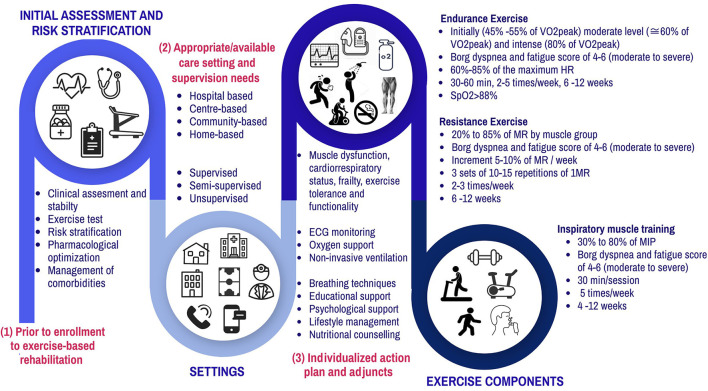
Among the most prevalent multimorbidities that accompany the aging process, chronic obstructive pulmonary disease (COPD) and chronic heart failure (CHF) stand out, representing the main causes of hospital admissions in the world. The prevalence of COPD coexistence in patients with CHF is higher than in control subjects, given the common risk factors associated with a complex process of chronic diseases developing in the aging process. COPD-CHF coexistence confers a marked negative impact on mechanical-ventilatory, cardiocirculatory, autonomic, gas exchange, muscular, ventilatory, and cerebral blood flow, further impairing the reduced exercise capacity and health status of either condition alone. In this context, integrated approach to the cardiopulmonary based on pharmacological optimization and non-pharmacological treatment (i.e., exercise-based cardiopulmonary and metabolic rehabilitation) can be emphatically encouraged by health professionals as they are safe and well-tolerated, reducing hospital readmissions, morbidity, and mortality. This review aims to explore aerobic exercise, the cornerstone of cardiopulmonary and metabolic rehabilitation, resistance and inspiratory muscle training and exercise-based rehabilitation delivery models in patients with COPD-CHF multimorbidities across the continuum of the disease. In addition, the review address the importance of adjuncts to enhance exercise capacity in these patients, which may be used to optimize the gains obtained in these programs.
在伴随衰老过程的最常见的多种疾病中,慢性阻塞性肺疾病(COPD)和慢性心力衰竭(CHF)最为突出,是全球住院的主要原因。鉴于与衰老过程中慢性疾病发展的复杂过程相关的常见风险因素,CHF患者中COPD共存的患病率高于对照组。COPD-CHF共存对机械通气、心脏循环、自主神经、气体交换、肌肉、通气和脑血流有显著的负面影响,进一步损害了单独任何一种疾病所导致的运动能力和健康状况的下降。在这种情况下,基于药物优化和非药物治疗(即基于运动的心肺和代谢康复)的心肺综合治疗方法,因其安全且耐受性良好、可减少再入院率、发病率和死亡率,可得到卫生专业人员的大力鼓励。本综述旨在探讨有氧运动(心肺和代谢康复的基石)、阻力训练和吸气肌训练以及基于运动的康复治疗模式,用于患有COPD-CHF多种疾病的患者在疾病全过程中的治疗。此外,本综述还阐述了辅助手段对提高这些患者运动能力的重要性,这些辅助手段可用于优化这些项目所取得的成效。