Liu Fuwei, Yang Yunyao, Cheng Winglam, Ma Jianyong, Zhu Wengen
Department of Cardiology, The Affiliated Ganzhou Hospital of Nanchang University, Ganzhou, China.
Department of Cardiology, The First Affiliated Hospital of Sun Yat-Sen University, Guangzhou, China.
Front Cardiovasc Med. 2021 Oct 15;8:757188. doi: 10.3389/fcvm.2021.757188. eCollection 2021.
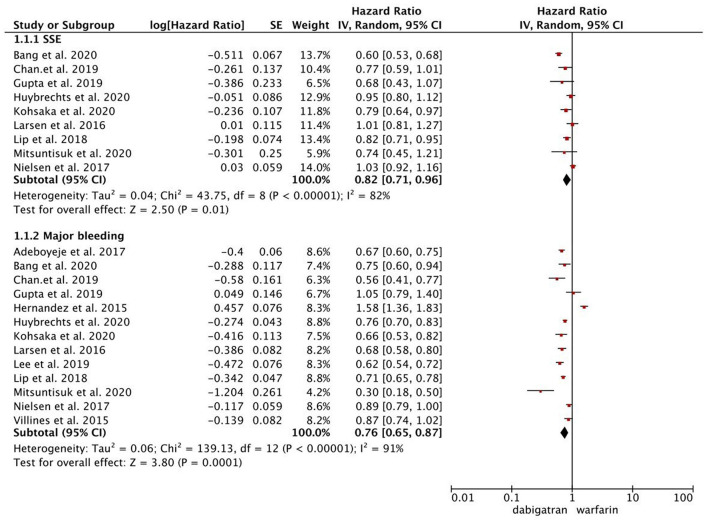
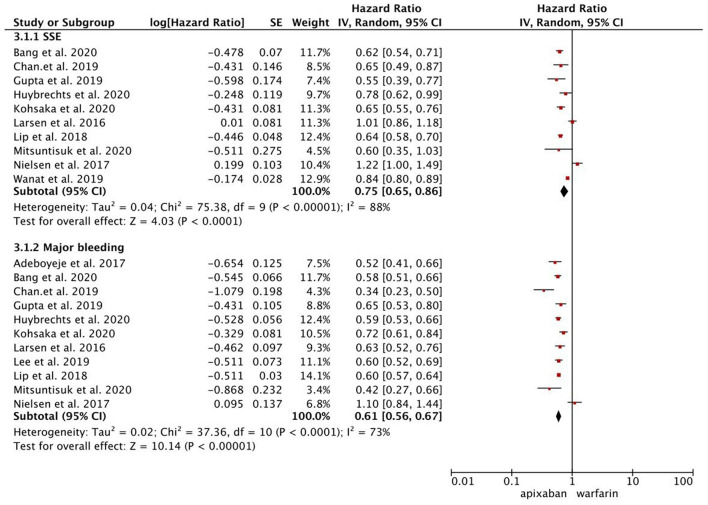
Recent observational studies have compared effectiveness and safety profiles between non-vitamin K antagonist oral anticoagulants (NOACs) and warfarin in patients with atrial fibrillation (AF). Nevertheless, the confounders may exist due to the nature of clinical practice-based data, thus potentially influencing the reliability of results. This systematic review and meta-analysis were conducted to compare the effect of NOACs with warfarin based on the propensity score-based observational studies vs. randomized clinical trials (RCTs). Articles included were systematically searched from the PubMed and EMBASE databases until March 2021 to obtain relevant studies. The primary outcomes were stroke or systemic embolism (SSE) and major bleeding. Hazard ratios (HRs) and 95% confidence intervals (CIs) of the outcomes were extracted and then pooled by the random-effects model. A total of 20 propensity score-based observational studies and 4 RCTs were included. Compared with warfarin, dabigatran (HR, 0.82 [95% CI, 0.71-0.96]), rivaroxaban (HR, 0.80 [95% CI, 0.75-0.85]), apixaban (HR, 0.75 [95% CI, 0.65-0.86]), and edoxaban (HR, 0.71 [95% CI, 0.60-0.83]) were associated with a reduced risk of stroke or systemic embolism, whereas dabigatran (HR, 0.76 [95% CI, 0.65-0.87]), apixaban (HR, 0.61 [95% CI, 0.56-0.67]), and edoxaban (HR, 0.58 [95% CI, 0.45-0.74]) but not rivaroxaban (HR, 0.92 [95% CI, 0.84-1.00]) were significantly associated with a decreased risk of major bleeding based on the observational studies. Furthermore, the risk of major bleeding with dabigatran 150 mg was significantly lower in observational studies than that in the RE-LY trial, whereas the pooled results of observational studies were similar to the data from the corresponding RCTs in other comparisons. Data from propensity score-based observational studies and NOAC trials consistently suggest that the use of four individual NOACs is non-inferior to warfarin for stroke prevention in AF patients.
近期的观察性研究比较了非维生素K拮抗剂口服抗凝药(NOACs)与华法林在心房颤动(AF)患者中的有效性和安全性。然而,基于临床实践的数据本质上可能存在混杂因素,从而可能影响结果的可靠性。本系统评价和荟萃分析旨在基于倾向评分观察性研究与随机临床试验(RCTs)比较NOACs与华法林的效果。从PubMed和EMBASE数据库系统检索截至2021年3月的文章以获取相关研究。主要结局为卒中或全身性栓塞(SSE)和大出血。提取结局的风险比(HRs)和95%置信区间(CIs),然后采用随机效应模型进行汇总。共纳入20项基于倾向评分的观察性研究和4项RCTs。与华法林相比,达比加群(HR,0.82 [95% CI,0.71 - 0.96])、利伐沙班(HR,0.80 [95% CI,0.75 - 0.85])、阿哌沙班(HR,0.75 [95% CI,0.65 - 0.86])和依度沙班(HR,0.71 [95% CI,0.60 - 0.83])与卒中或全身性栓塞风险降低相关,而基于观察性研究,达比加群(HR,0.76 [95% CI,0.65 - 0.87])、阿哌沙班(HR,0.61 [95% CI,0.56 - 0.67])和依度沙班(HR,0.58 [95% CI,0.45 - 0.74])而非利伐沙班(HR,0.92 [95% CI, 0.84 - 1.00])与大出血风险降低显著相关。此外,观察性研究中达比加群150 mg的大出血风险显著低于RE-LY试验,而观察性研究的汇总结果在其他比较中与相应RCTs的数据相似。基于倾向评分观察性研究和NOAC试验的数据一致表明,在AF患者中使用四种单独的NOACs预防卒中不劣于华法林。