Suomalainen Olli Pekka, Martinez-Majander Nicolas, Broman Jenna, Mannismäki Laura, Aro Aapo, Curtze Sami, Pakarinen Sami, Lehto Mika, Putaala Jukka
Departments of Neurology, Helsinki University Hospital, University of Helsinki, Haartmaninkatu 4, P.O. Box 340, 00290 Helsinki, Finland.
Departments of Cardiology, Helsinki University Hospital, University of Helsinki, 00290 Helsinki, Finland.
J Clin Med. 2023 Dec 20;13(1):30. doi: 10.3390/jcm13010030.
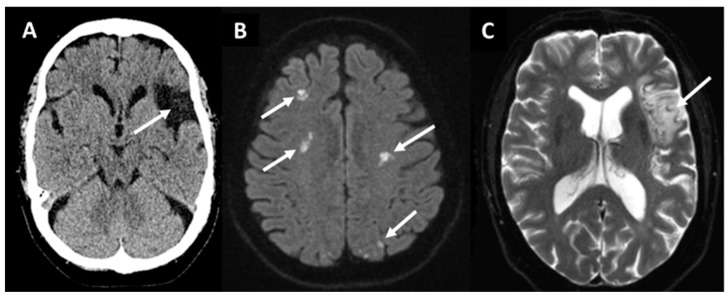
Atrial fibrillation (AF) is the most common sustained arrythmia and one of the strongest risk factors and causal mechanisms of ischemic stroke (IS). Acute IS due to AF tends to be more severe than with other etiology of IS and patients with treated AF have reported to experience worse outcomes after endovascular treatment compared with patients without AF. As cardioembolism accounts for more than a fifth of ISs and the risk of future stroke can be mitigated with effective anticoagulation, which has been shown to be effective and safe in patients with paroxysmal or sustained AF, the screening of patients with cryptogenic IS (CIS) for AF is paramount. Embolic stroke of undetermined source (ESUS) is a subtype of CIS with a high likelihood of cardioembolism. The European Stroke Organization and European Society of Cardiology guidelines recommend at least 72 h of screening when AF is suspected. The longer the screening and the earlier the time point after acute IS, the more likely the AF paroxysm is found. Several methods are available for short-term screening of AF, including in-hospital monitoring and wearable electrocardiogram recorders for home monitoring. Implantable loop monitors provide an effective long-term method to screen patients with high risk of AF after IS and artificial intelligence and convolutional neural networks may enhance the efficacy of AF screening in the future. Direct oral anticoagulants (DOACs) are preferred over vitamin K antagonists in both primary and secondary prevention of IS in AF patients. Recent data from the randomized controlled trials (RCT) also suggest that early initiation of DOAC treatment after acute IS is safe compared to later initiation. Anticoagulation treatment may still predispose for intracranial bleeding, particularly among patients with prior cerebrovascular events. Left atrial appendix closure offers an optional treatment choice for patients with prior intracranial hemorrhage and may offer an alternative to oral anticoagulation even for patients with IS, but these indications await validation in ongoing RCTs. There are still controversies related to the association of found AF paroxysms in CIS patients with prolonged screening, pertaining to the optimal duration of screening and screening strategies with prolonged monitoring techniques in patients with ESUS. In this review, we summarize the current knowledge of epidemiology, screening, and prognosis in AF patients with stroke.
心房颤动(AF)是最常见的持续性心律失常,也是缺血性卒中(IS)最强的危险因素和病因机制之一。由AF引起的急性IS往往比其他IS病因更为严重,并且据报道,接受治疗的AF患者与未患AF的患者相比,血管内治疗后的预后更差。由于心源性栓塞占IS的五分之一以上,且有效的抗凝治疗可降低未来卒中风险,已证明其在阵发性或持续性AF患者中有效且安全,因此对不明原因IS(CIS)患者进行AF筛查至关重要。不明来源栓塞性卒中(ESUS)是CIS的一种亚型,心源性栓塞可能性很高。欧洲卒中组织和欧洲心脏病学会指南建议,怀疑AF时至少进行72小时筛查。筛查时间越长,急性IS后时间点越早,发现AF发作的可能性就越大。有几种方法可用于AF的短期筛查,包括住院监测和用于家庭监测的可穿戴心电图记录仪。植入式循环记录仪为筛查IS后AF高危患者提供了一种有效的长期方法,人工智能和卷积神经网络可能会在未来提高AF筛查的效果。在AF患者IS的一级和二级预防中,直接口服抗凝剂(DOACs)优于维生素K拮抗剂。随机对照试验(RCT)的最新数据还表明,与延迟启动相比,急性IS后早期启动DOAC治疗是安全的。抗凝治疗仍可能导致颅内出血,尤其是在既往有脑血管事件的患者中。左心耳封堵为既往有颅内出血的患者提供了一种可选的治疗选择,甚至对于IS患者也可能是口服抗凝治疗的替代方法,但这些适应证有待正在进行的RCT验证。关于CIS患者中发现的AF发作与延长筛查之间的关联仍存在争议,涉及ESUS患者延长监测技术的最佳筛查持续时间和筛查策略。在本综述中,我们总结了AF合并卒中患者的流行病学、筛查和预后的当前知识。