Mamnoon Babak, Feng Li, Froberg Jamie, Choi Yongki, Sathish Venkatachalem, Taratula Oleh, Taratula Olena, Mallik Sanku
Department of Pharmaceutical Sciences, North Dakota State University, Fargo, North Dakota 58102, United States.
Department of Physics, North Dakota State University, Fargo, North Dakota 58102, United States.
ACS Omega. 2021 Oct 11;6(42):27654-27667. doi: 10.1021/acsomega.1c02250. eCollection 2021 Oct 26.
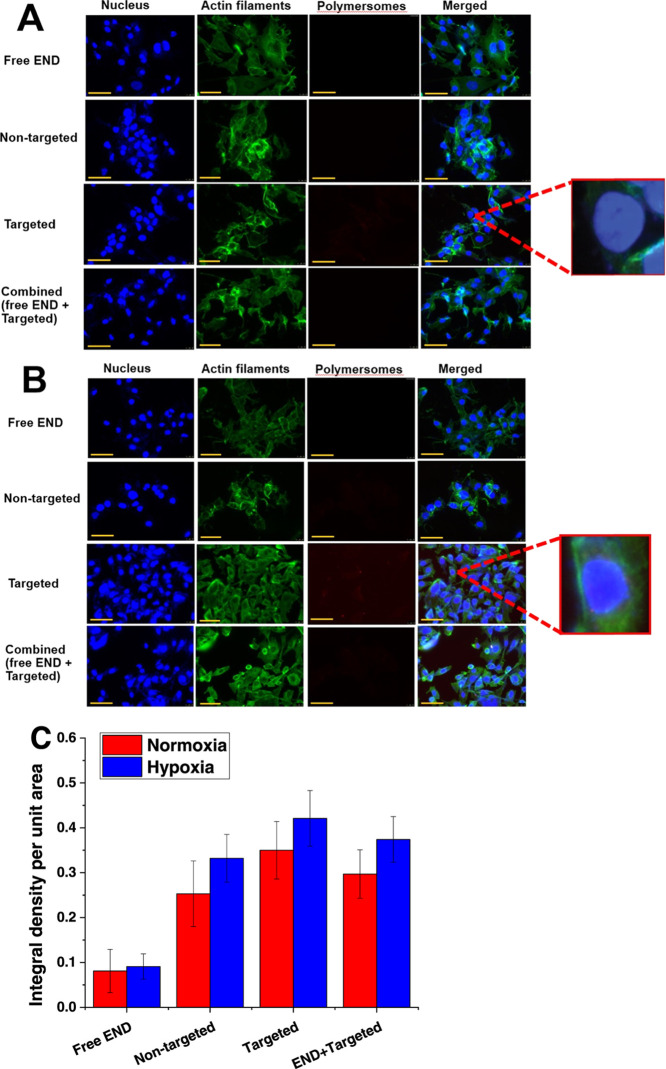
Endoxifen is the primary active metabolite of tamoxifen, a nonsteroidal-selective estrogen receptor modulator (SERM) and widely used medication to treat estrogen receptor-positive (ER+) breast cancer. In this study, endoxifen was conjugated to the surface of polymeric nanoparticles (polymersomes) for targeted delivery of doxorubicin (DOX) to estrogen receptor-positive breast cancer cells (MCF7). Rapid cell growth and insufficient blood supply result in low oxygen concentration (hypoxia) within the solid breast tumors. The polymersomes developed here are prepared from amphiphilic copolymers of polylactic acid (PLA) and poly(ethylene glycol) (PEG) containing diazobenzene as the hypoxia-responsive linker. We prepared two nanoparticle formulations: DOX-encapsulated hypoxia-responsive polymersomes (DOX-HRPs) and endoxifen-conjugated, DOX-encapsulated hypoxia-responsive polymersomes (END-DOX-HRPs). Cellular internalization studies demonstrated eight times higher cytosolic and nuclear localization after incubating breast cancer cells with END-DOX-HRPs (targeted polymersomes) in contrast to DOX-HRPs (nontargeted polymersomes). Cytotoxicity studies on monolayer cell cultures exhibited that END-DOX-HRPs were three times more toxic to ER+ MCF7 cells than DOX-HRPs and free DOX in hypoxia. The cell viability studies on three-dimensional hypoxic cultures also demonstrated twice as much toxicity when the spheroids were treated with targeted polymersomes instead of nontargeted counterparts. This is the first report of surface-decorated polymeric nanoparticles with endoxifen ligands for targeted drug delivery to ER+ breast cancer microtumors. The newly designed endoxifen-conjugated, hypoxia-responsive polymersomes might have translational potential for ER+ breast cancer treatment.
4-羟基他莫昔芬是他莫昔芬的主要活性代谢产物,他莫昔芬是一种非甾体选择性雌激素受体调节剂(SERM),是治疗雌激素受体阳性(ER+)乳腺癌的广泛使用的药物。在本研究中,4-羟基他莫昔芬与聚合物纳米颗粒(聚合物囊泡)表面偶联,用于将阿霉素(DOX)靶向递送至雌激素受体阳性乳腺癌细胞(MCF7)。快速的细胞生长和血液供应不足导致实体乳腺肿瘤内的氧浓度较低(缺氧)。这里开发的聚合物囊泡由聚乳酸(PLA)和聚乙二醇(PEG)的两亲共聚物制备而成,其中含有重氮苯作为缺氧响应连接体。我们制备了两种纳米颗粒制剂:包封DOX的缺氧响应聚合物囊泡(DOX-HRPs)和4-羟基他莫昔芬偶联、包封DOX的缺氧响应聚合物囊泡(END-DOX-HRPs)。细胞内化研究表明,与DOX-HRPs(非靶向聚合物囊泡)相比,用END-DOX-HRPs(靶向聚合物囊泡)孵育乳腺癌细胞后,细胞溶质和细胞核定位高出八倍。单层细胞培养的细胞毒性研究表明,在缺氧条件下,END-DOX-HRPs对ER+ MCF7细胞的毒性是DOX-HRPs和游离DOX的三倍。三维缺氧培养的细胞活力研究还表明,用靶向聚合物囊泡而非非靶向聚合物囊泡处理球体时,毒性增加两倍。这是关于用4-羟基他莫昔芬配体对聚合物纳米颗粒进行表面修饰以将药物靶向递送至ER+乳腺微肿瘤的首次报道。新设计的4-羟基他莫昔芬偶联、缺氧响应聚合物囊泡可能对ER+乳腺癌治疗具有转化潜力。