IGF, University of Montpellier, CNRS, INSERM, 34094 Montpellier, France.
European Molecular Biology Laboratory, 71 Avenue des Martyrs, 38000 Grenoble, France.
Cell Rep Methods. 2021 Oct 25;1(6):None. doi: 10.1016/j.crmeth.2021.100102.
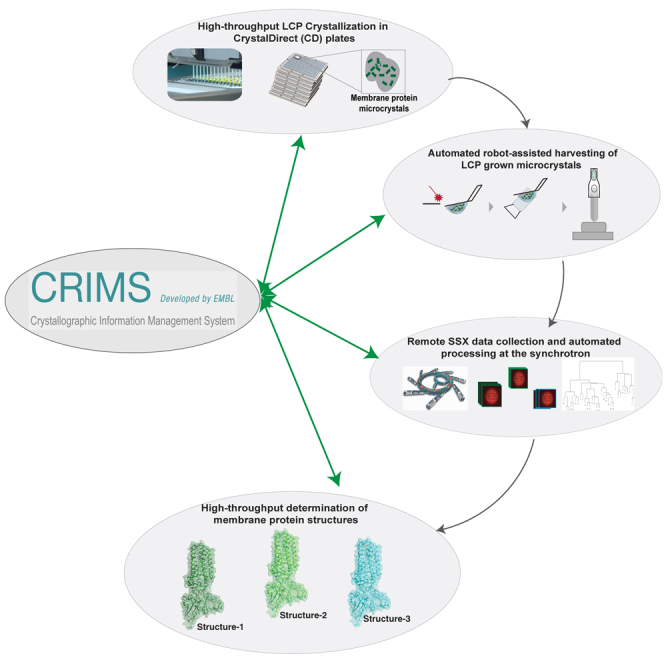
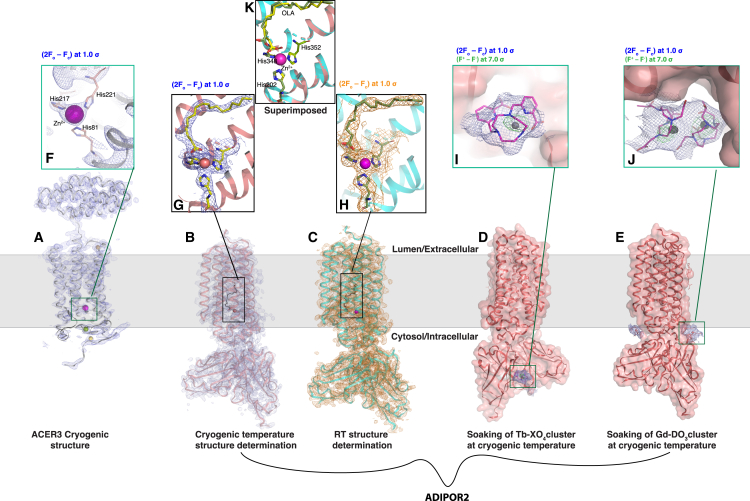
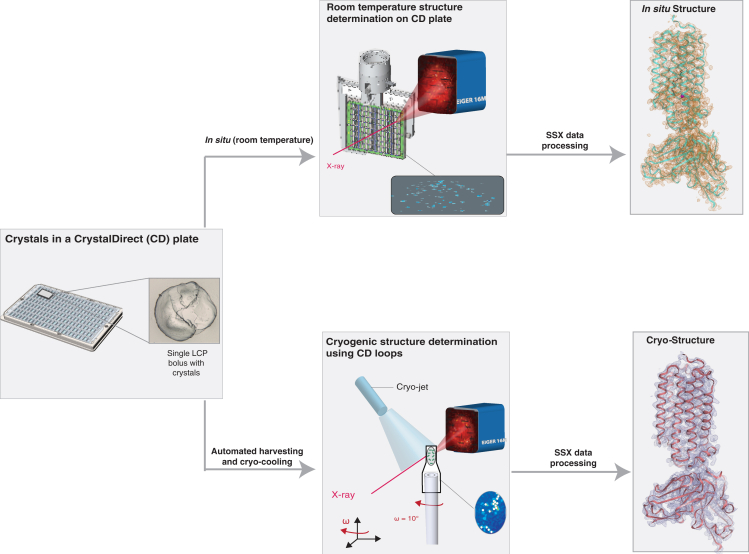
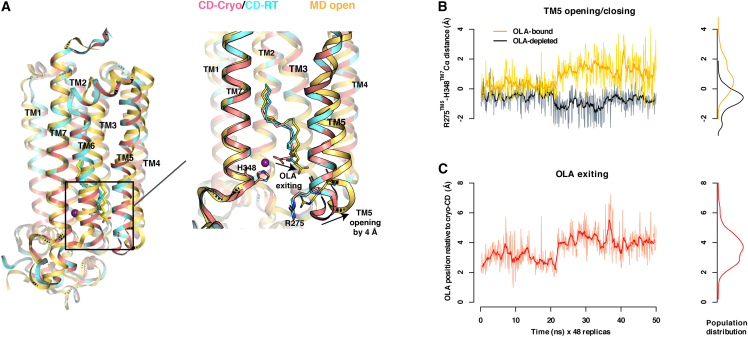
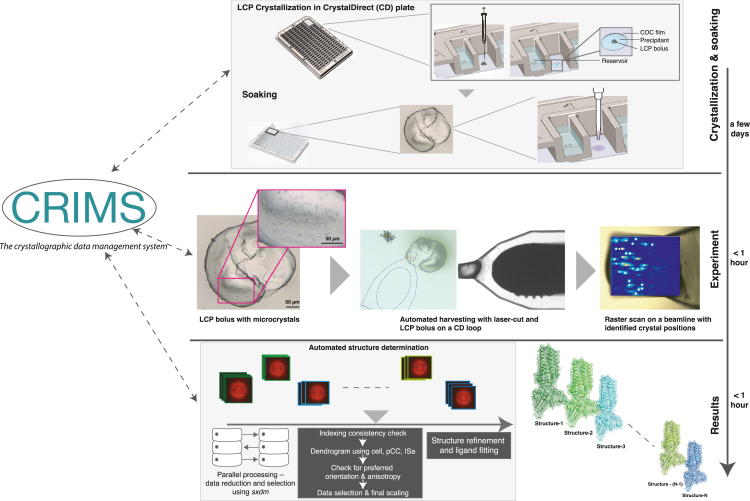
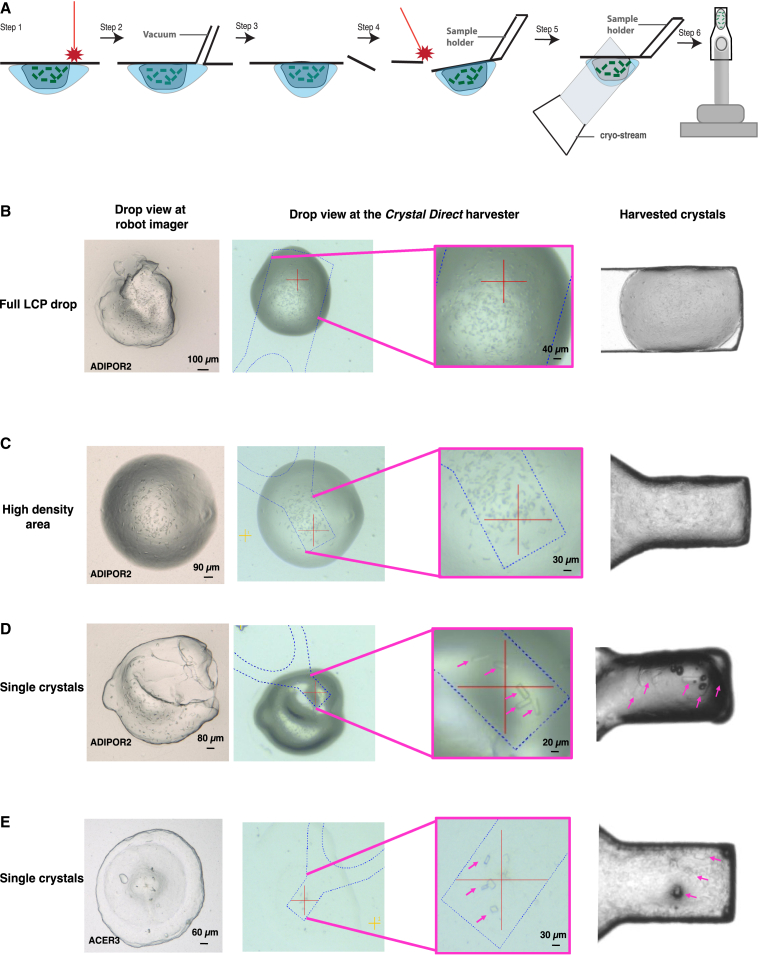
Membrane proteins are central to many pathophysiological processes, yet remain very difficult to analyze structurally. Moreover, high-throughput structure-based drug discovery has not yet been exploited for membrane proteins because of lack of automation. Here, we present a facile and versatile platform for membrane protein crystallization, enabling rapid atomic structure determination at both cryogenic and room temperatures. We apply this approach to human integral membrane proteins, which allowed us to identify different conformational states of intramembrane enzyme-product complexes and analyze by molecular dynamics simulations the structural dynamics of the ADIPOR2 integral membrane protein. Finally, we demonstrate an automated pipeline combining high-throughput microcrystal soaking, automated laser-based harvesting, and serial crystallography, enabling screening of small-molecule libraries with membrane protein crystals grown . This approach brings needed automation to this important class of drug targets and enables high-throughput structure-based ligand discovery with membrane proteins.
膜蛋白在许多病理生理过程中起着核心作用,但它们的结构仍然非常难以分析。此外,由于缺乏自动化,高通量基于结构的药物发现尚未应用于膜蛋白。在这里,我们提出了一个简单而通用的膜蛋白结晶平台,能够在低温和室温下快速确定原子结构。我们将这种方法应用于人类完整的膜蛋白,使我们能够识别跨膜酶-产物复合物的不同构象状态,并通过分子动力学模拟分析 ADIPOR2 完整膜蛋白的结构动力学。最后,我们展示了一个自动化的管道,结合高通量微晶体浸泡、基于激光的自动收获和连续晶体学,能够用生长的膜蛋白晶体筛选小分子文库。这种方法为这一重要的药物靶点类带来了急需的自动化,并能够实现基于结构的配体与膜蛋白的高通量发现。