Department of Public Health Science, Faculty of Landscape and Society, Norwegian University of Life Sciences, Ås, Norway.
Faculty of Science and Technology, Norwegian University of Life Sciences, Ås, Norway.
PLoS Negl Trop Dis. 2021 Nov 1;15(11):e0009239. doi: 10.1371/journal.pntd.0009239. eCollection 2021 Nov.
Nudging, a strategy that uses subtle stimuli to direct people's behavior, has recently been included as an effective and low-cost behavior change strategy in low- and middle- income countries (LMIC), targeting behavior-based prevention and control of neglected tropical diseases (NTDs). The present scoping review aims to provide a timely overview of how nudge interventions have been applied within this field. In addition, the review proposes a framework for the ethical consideration of nudges for NTD prevention and control, or more broadly global health promotion.
A comprehensive search was performed in several databases: MEDLINE, PsycINFO, and Embase (Ovid), Web of Science Core Collection, CINAHL, ERIC and Econ.Lit (EBSCO), as well as registered trials and reviews in CENTRAL and PROSPERO to identify ongoing or unpublished studies. Additionally, studies were included through a handpicked search on websites of governmental nudge units and global health or development organizations.
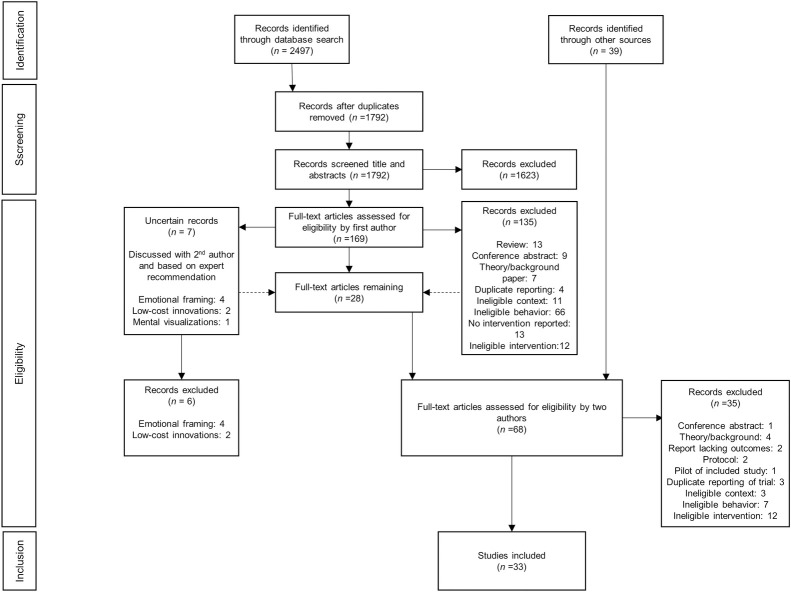
This scoping review identified 33 relevant studies, with only two studies targeting NTDs in particular, resulting in a total of 67 nudge strategies. Most nudges targeted handwashing behavior and were focused on general health practices rather than targeting a specific disease. The most common nudge strategies were those targeting decision assistance, such as facilitating commitment and reminder actions. The majority of nudges were of moderate to high ethical standards, with the highest standards being those that had the most immediate and significant health benefits, and those implemented by agents in a trust relationship with the target audience.
Three key recommendations should inform research investigating nudge strategies in global health promotion in general. Firstly, future efforts should investigate the different opportunities that nudges present for targeting NTDs in particular, rather than relying solely on integrated health promotion approaches. Secondly, to apply robust study designs including rigorous process and impact evaluation which allow for a better understanding of 'what works' and 'how it works'. Finally, to consider the ethical implications of implementing nudge strategies, specifically in LMIC.
推动,一种利用微妙刺激来引导人们行为的策略,最近被纳入中低收入国家(LMIC)中一种有效且低成本的行为改变策略,旨在针对基于行为的预防和控制被忽视的热带病(NTD)。本范围综述旨在及时概述推动干预措施在该领域的应用情况。此外,该综述提出了一个框架,用于考虑推动预防和控制 NTD 或更广泛的全球健康促进的伦理问题。
在几个数据库中进行了全面搜索:MEDLINE、PsycINFO 和 Embase(Ovid)、Web of Science 核心合集、CINAHL、ERIC 和 Econ.Lit(EBSCO),以及 CENTRAL 和 PROSPERO 中注册的试验和综述,以确定正在进行或未发表的研究。此外,还通过在政府推动单位和全球卫生或发展组织的网站上进行精选搜索来纳入研究。
本范围综述确定了 33 项相关研究,其中只有两项专门针对 NTD,共涉及 67 项推动策略。大多数推动策略针对洗手行为,重点关注一般健康实践,而不是针对特定疾病。最常见的推动策略是那些针对决策辅助的策略,例如促进承诺和提醒行动。大多数推动策略具有中等至高标准,最高标准是那些具有最直接和显著健康益处的策略,以及那些由与目标受众具有信任关系的代理人实施的策略。
有三个关键建议应该为一般全球健康促进中推动策略的研究提供信息。首先,未来的努力应该调查推动策略为特定目标 NTD 带来的不同机会,而不仅仅依赖于综合健康促进方法。其次,应用稳健的研究设计,包括严格的过程和影响评估,以更好地理解“什么有效”和“如何有效”。最后,要考虑在 LMIC 实施推动策略的伦理影响。