Sidney Kimmel Comprehensive Cancer Center, Johns Hopkins Hospital, Baltimore, MD.
Hospital of the University of Pennsylvania, Philadelphia, PA.
Blood. 2022 Mar 10;139(10):1452-1468. doi: 10.1182/blood.2021013443.
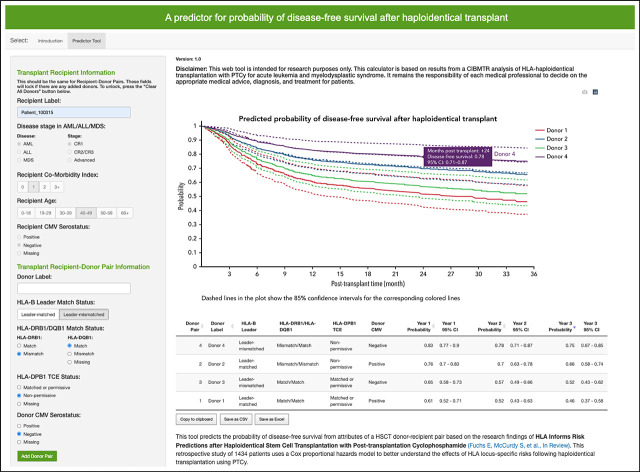
Hematopoietic cell transplantation from HLA-haploidentical related donors is increasingly used to treat hematologic cancers; however, characteristics of the optimal haploidentical donor have not been established. We studied the role of donor HLA mismatching in graft-versus-host disease (GVHD), disease recurrence, and survival after haploidentical donor transplantation with posttransplantation cyclophosphamide (PTCy) for 1434 acute leukemia or myelodysplastic syndrome patients reported to the Center for International Blood and Marrow Transplant Research. The impact of mismatching in the graft-versus-host vector for HLA-A, -B, -C, -DRB1, and -DQB1 alleles, the HLA-B leader, and HLA-DPB1 T-cell epitope (TCE) were studied using multivariable regression methods. Outcome was associated with HLA (mis)matches at individual loci rather than the total number of HLA mismatches. HLA-DRB1 mismatches were associated with lower risk of disease recurrence. HLA-DRB1 mismatching with HLA-DQB1 matching correlated with improved disease-free survival. HLA-B leader matching and HLA-DPB1 TCE-nonpermissive mismatching were each associated with improved overall survival. HLA-C matching lowered chronic GVHD risk, and the level of HLA-C expression correlated with transplant-related mortality. Matching status at the HLA-B leader and HLA-DRB1, -DQB1, and -DPB1 predicted disease-free survival, as did patient and donor cytomegalovirus serostatus, patient age, and comorbidity index. A web-based tool was developed to facilitate selection of the best haploidentical-related donor by calculating disease-free survival based on these characteristics. In conclusion, HLA factors influence the success of haploidentical transplantation with PTCy. HLA-DRB1 and -DPB1 mismatching and HLA-C, -B leader, and -DQB1 matching are favorable. Consideration of HLA factors may help to optimize the selection of haploidentical related donors.
HLA 单倍体相关供者的造血细胞移植越来越多地用于治疗血液系统恶性肿瘤;然而,尚未确定最佳单倍体供者的特征。我们研究了供者 HLA 错配在移植后环磷酰胺(PTCy)治疗的 1434 例急性白血病或骨髓增生异常综合征患者的移植物抗宿主病(GVHD)、疾病复发和生存中的作用,这些患者向国际血液和骨髓移植研究中心报告。使用多变量回归方法研究了 HLA-A、-B、-C、-DRB1 和 -DQB1 等位基因、HLA-B 前导序列和 HLA-DPB1 T 细胞表位(TCE)的移植物抗宿主载体错配的影响。结果与个体基因座上的 HLA(错)配而非 HLA 错配总数相关。HLA-DRB1 错配与较低的疾病复发风险相关。HLA-DRB1 错配与 HLA-DQB1 匹配相关,与无病生存改善相关。HLA-B 前导序列匹配和 HLA-DPB1 TCE 非允许性错配均与总生存改善相关。HLA-C 匹配降低慢性 GVHD 风险,HLA-C 表达水平与移植相关死亡率相关。HLA-B 前导序列、HLA-DRB1、-DQB1 和 -DPB1 的匹配状态预测无病生存,患者和供者巨细胞病毒血清状态、患者年龄和合并症指数也是如此。开发了一个基于网络的工具,通过根据这些特征计算无病生存来促进最佳单倍体相关供者的选择。总之,HLA 因素影响 PTCy 治疗的单倍体移植的成功。HLA-DRB1 和 -DPB1 错配以及 HLA-C、-B 前导序列和 -DQB1 匹配是有利的。考虑 HLA 因素可能有助于优化单倍体相关供者的选择。