Division of Neurology Department of Medicine University of Toronto Canada.
Li Ka Shing Knowledge InstituteSt. Michael's Hospital-Unity Health Toronto Toronto Canada.
J Am Heart Assoc. 2021 Nov 16;10(22):e022635. doi: 10.1161/JAHA.121.022635. Epub 2021 Nov 2.
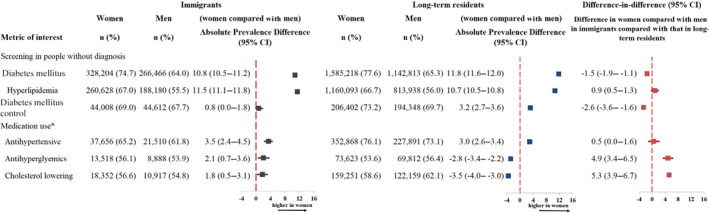
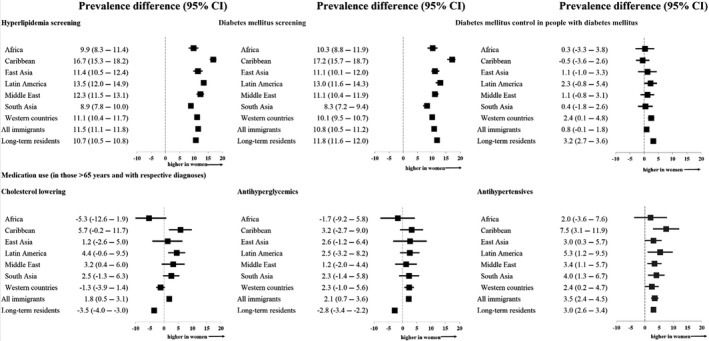
Background We evaluated whether immigration status modified the association between sex and the quality of primary cardiovascular disease prevention in Ontario, Canada. Methods and Results We used a population-based administrative database-derived cohort of community-dwelling adults (aged ≥40 years) without prior cardiovascular disease residing in Ontario on January 1, 2011. In the preceding 3 years, we evaluated screening for hyperlipidemia and diabetes in those not previously diagnosed; diabetes control (HbA <7%); and medication use to control hypertension, hyperlipidemia, or diabetes in those with previous diagnosis. We calculated the absolute prevalence difference (APD) between women and men for each metric stratified by immigration status and then determined the difference-in-differences for immigrants compared with long-term residents. Our sample included 5.3 million adults (19% immigrants), with receipt of each metric ranging from 55% to 90%. Among immigrants, women were more likely than men to be screened for hyperlipidemia (APD, 10.8%; 95% CI, 10.5-11.2) and diabetes (APD, 11.5%; 95% CI, 11.1-11.8) and to be treated with medications for hypertension (APD, 3.5%; 95% CI, 2.4-4.5), diabetes (APD, 2.1%; 95% CI, 0.7-3.6) and hyperlipidemia (APD, 1.8%; 95% CI, 0.5-3.1). Among long-term residents, findings were similar except poorer medication use for diabetes (APD, -2.8%; 95% CI, -3.4 to -2.2) and hyperlipidemia (APD, -3.5%; 95% CI, -4.0 to -3.0]) in women compared with men. Conclusions The overall quality of primary preventive care can be improved for all adults, and future research should evaluate the impact of observed equal or better care in women than men, irrespective of immigration status, on cardiovascular disease incidence.
背景 我们评估了移民身份是否改变了性别的关联与加拿大安大略省心血管疾病一级预防的质量。
方法和结果 我们使用了一个基于人群的行政数据库,其中包含了 2011 年 1 月 1 日居住在安大略省、年龄≥40 岁的社区成年居民(既往无心血管疾病)。在过去 3 年中,我们评估了既往无诊断者的血脂异常和糖尿病筛查、糖尿病控制(HbA <7%)以及既往诊断者的高血压、血脂异常或糖尿病的药物治疗情况。我们按移民身份对每个指标的女性和男性之间的绝对差异(APD)进行分层,然后确定与长期居民相比,移民的差异。我们的样本包括 530 万成年人(19%的移民),每个指标的接受率从 55%到 90%不等。在移民中,女性比男性更有可能接受血脂异常(APD,10.8%;95%CI,10.5-11.2)和糖尿病(APD,11.5%;95%CI,11.1-11.8)筛查,并且更有可能接受高血压(APD,3.5%;95%CI,2.4-4.5)、糖尿病(APD,2.1%;95%CI,0.7-3.6)和血脂异常(APD,1.8%;95%CI,0.5-3.1)药物治疗。在长期居民中,结果相似,除了女性的糖尿病(APD,-2.8%;95%CI,-3.4 至-2.2)和血脂异常(APD,-3.5%;95%CI,-4.0 至-3.0)药物治疗较差。
结论 所有成年人的一级预防保健的总体质量都可以提高,未来的研究应该评估无论移民身份如何,观察到的女性比男性更好或同等的护理对心血管疾病发病率的影响。