Department of Laboratory Medicine.
Helen Diller Family Comprehensive Cancer Center, and.
Blood Adv. 2022 Jan 8;6(3):854-865. doi: 10.1182/bloodadvances.2021005522.
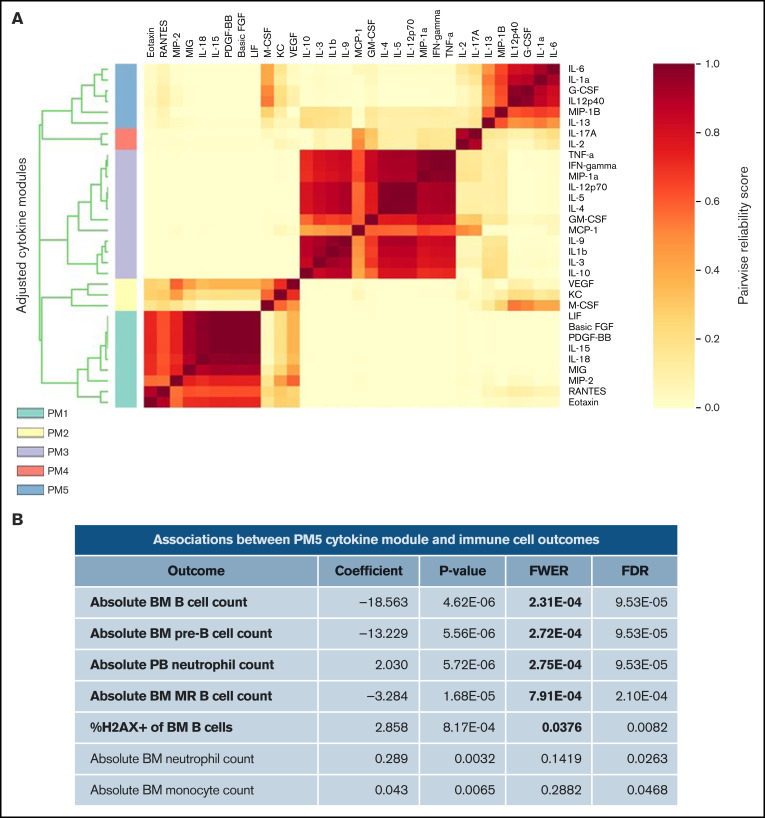
Exposures to a wide repertoire of common childhood infections and strong inflammatory responses to those infections are associated with the risk of pediatric B-cell acute lymphoblastic leukemia (B-ALL) in opposing directions. Neonatal inflammatory markers are also related to risk by unknown mechanism(s). Here, we demonstrate that interleukin-10 (IL-10) deficiency, which is associated with childhood B-ALL, indirectly impairs B lymphopoiesis and increases B-cell DNA damage in association with a module of 6 proinflammatory/myeloid-associated cytokines (IL-1α, IL-6, IL-12p40, IL-13, macrophage inflammatory protein-1β/CCL4, and granulocyte colony-stimulating factor). Importantly, antibiotics attenuated inflammation and B-cell defects in preleukemic Cdkn2a-/-Il10-/- mice. In an ETV6-RUNX1+ (E6R1+) Cdkn2a-/- mouse model of B-ALL, decreased levels of IL-10 accelerated B-cell neoplasms in a dose-dependent manner and altered the mutational profile of these neoplasms. Our results illuminate a mechanism through which a low level of IL-10 can create a risk for leukemic transformation and support developing evidence that microbial dysbiosis contributes to pediatric B-ALL.
接触广泛的常见儿童感染和对这些感染的强烈炎症反应与儿科 B 细胞急性淋巴细胞白血病 (B-ALL) 的风险呈相反方向相关。新生儿炎症标志物的风险机制也未知。在这里,我们证明与儿童 B-ALL 相关的白细胞介素-10 (IL-10) 缺乏症间接损害 B 淋巴生成,并增加与 6 个促炎/髓样相关细胞因子(IL-1α、IL-6、IL-12p40、IL-13、巨噬细胞炎症蛋白-1β/CCL4 和粒细胞集落刺激因子)模块相关的 B 细胞 DNA 损伤。重要的是,抗生素减轻了前白血病 Cdkn2a-/-Il10-/-小鼠的炎症和 B 细胞缺陷。在 ETV6-RUNX1+ (E6R1+) Cdkn2a-/-B-ALL 小鼠模型中,IL-10 水平降低以剂量依赖的方式加速 B 细胞肿瘤的发生,并改变这些肿瘤的突变谱。我们的研究结果阐明了低水平的 IL-10 如何为白血病转化创造风险的机制,并支持微生物失调导致儿科 B-ALL 的证据。