Bosnyak Dan, McDonald Alison C, Gasperin Haaz Israel, Qi Weikai, Crowley David C, Guthrie Najla, Evans Malkanthi
Zentrela Inc. Suite B21, 175 Longwood Rd S, Hamilton, ON, L8P 0A1, Canada.
KGK Science Inc., 255 Queens Ave, London, ON, N6A 5R8, Canada.
Neurol Ther. 2022 Mar;11(1):51-72. doi: 10.1007/s40120-021-00293-w. Epub 2021 Nov 2.
Current methods to detect recent delta-9-tetrahydrocannabinol (THC) use cannot objectively quantify its psychoactive effects (PE). The Cognalyzer, an electroencephalography (EEG)-based method, detects and quantifies the strength of THC-induced PE on a scale from 0 to 100%. This study assesses the relationship between the magnitude of Cognalyzer PE predictions and reported subjective drug effects for 4-h post-cannabis inhalation.
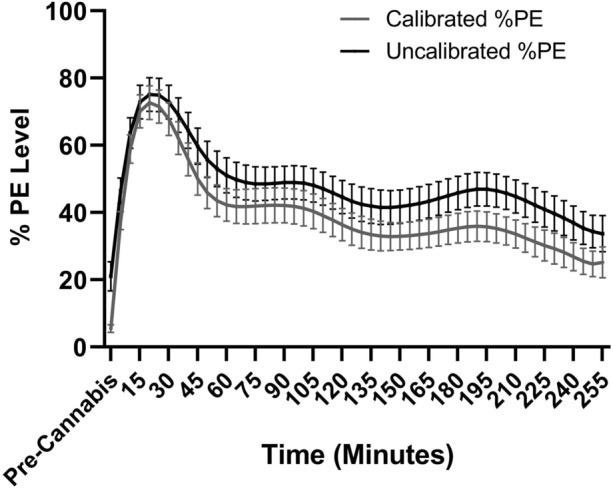
Seventy-five participants were enrolled in the study. Prior to ad libitum cannabis inhalation, an EEG recording episode was completed. Immediately after inhalation, the Drug Effects Questionnaire (DEQ) was administered and another EEG recording performed. For 25 participants, the study ended. For 50 participants, assessments were repeated at 30-min intervals for 4 h. EEG files were blinded and analyzed using two versions of the Cognalyzer algorithm. The relationship between the Cognalyzer PE level results and the DEQ was assessed using generalized linear models and multiple regression.
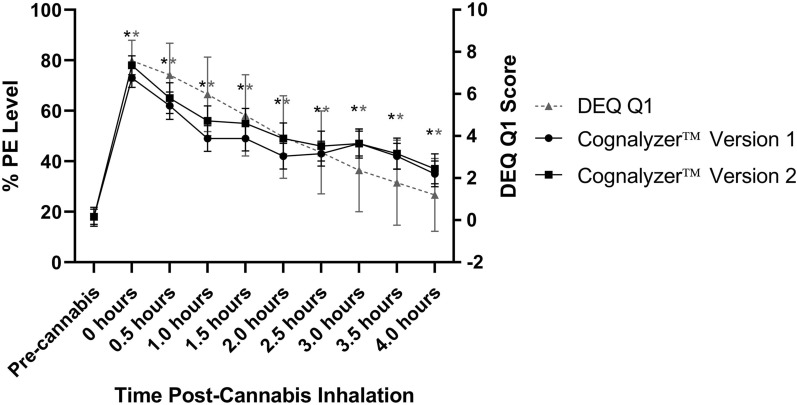
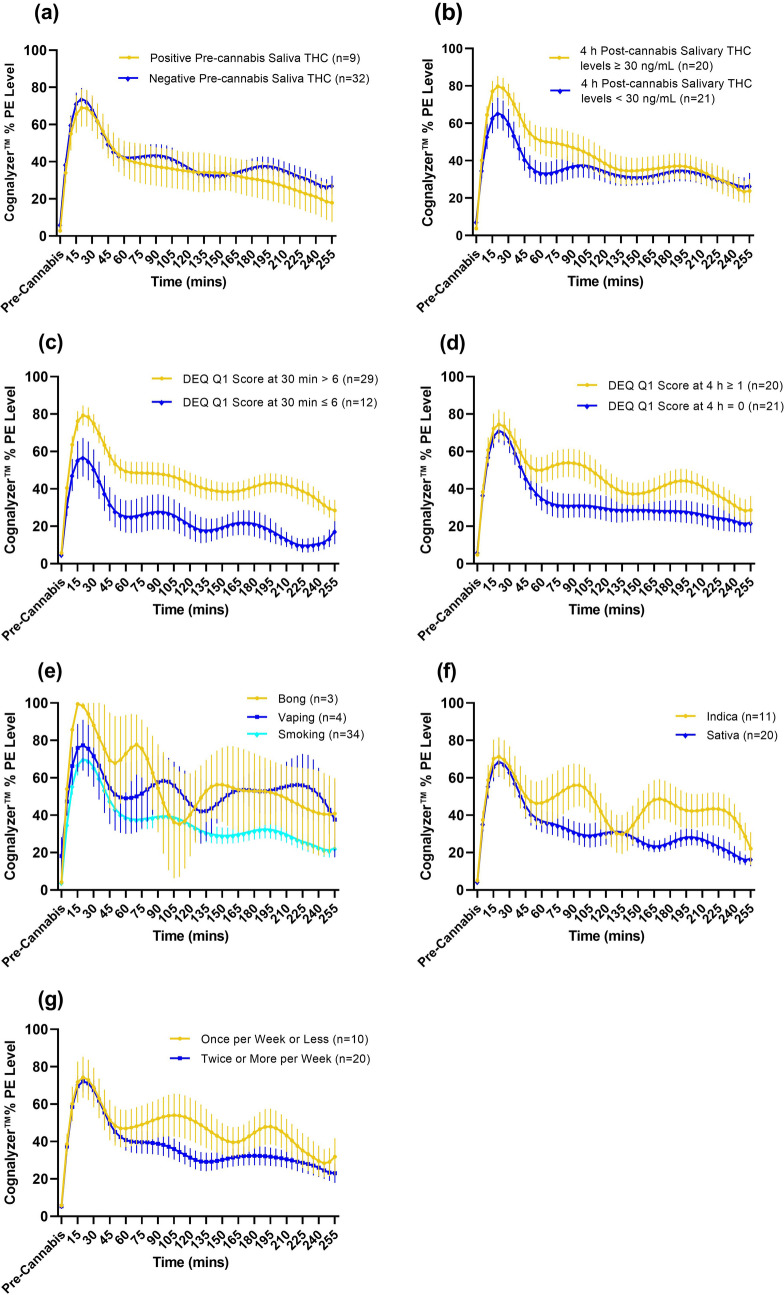
There were significant PE increases from pre-cannabis for up to 3.5 h. Mean reports of feeling drug effects were > 0 at all post-inhalation time points (p ≤ 0.024). Furthermore, there were significant relationships between the Cognalyzer PE and self-reported perception of drug effects (p ≤ 0.001). Subgroup analysis showed that Cognalyzer PE levels were impacted by cannabis use history, subjective ratings of drug effects, oral fluid THC concentration and the cannabis product inhaled.
The findings show that the Cognalyzer can be used to objectively determine the strength of cannabis psychoactive effects that cannabis products create on consumers and how it changes depending on their experience with cannabis. The Cognalyzer can be used to conduct scientific consumer research to generate trustworthy informational material about the psychoactive experience of cannabis products. For clinical research, the Cognalyzer can be used to study the pharmacodynamics of cannabinoids or delivery systems, such as nano-emulsifications.
目前检测近期 Δ⁹-四氢大麻酚(THC)使用情况的方法无法客观量化其精神活性作用(PE)。Cognalyzer 是一种基于脑电图(EEG)的方法,可在 0%至 100%的范围内检测并量化 THC 诱导的精神活性作用的强度。本研究评估了 Cognalyzer 精神活性作用预测强度与吸入大麻后 4 小时内报告的主观药物效应之间的关系。
75 名参与者被纳入该研究。在随意吸入大麻之前,完成一次脑电图记录。吸入后立即发放药物效应问卷(DEQ)并进行另一次脑电图记录。对于 25 名参与者,研究结束。对于 50 名参与者,在 4 小时内每隔 30 分钟重复进行评估。脑电图文件进行了盲法处理,并使用两个版本的 Cognalyzer 算法进行分析。使用广义线性模型和多元回归评估 Cognalyzer 精神活性作用水平结果与 DEQ 之间的关系。
从吸大麻前到长达 3.5 小时,精神活性作用显著增加。在所有吸入后时间点,感觉有药物效应的平均报告均大于 0(p≤0.024)。此外,Cognalyzer 精神活性作用与自我报告的药物效应感知之间存在显著关系(p≤0.001)。亚组分析表明,Cognalyzer 精神活性作用水平受大麻使用史、药物效应主观评分、口腔液 THC 浓度以及吸入的大麻产品影响。
研究结果表明,Cognalyzer 可用于客观确定大麻产品对消费者产生的精神活性作用的强度,以及其如何根据消费者的大麻使用经验而变化。Cognalyzer 可用于开展科学的消费者研究,以生成有关大麻产品精神活性体验的可靠信息材料。对于临床研究,Cognalyzer 可用于研究大麻素或给药系统(如纳米乳化剂)的药效学。