Centre for Chromosome Biology, Biomedical Sciences, National University of Ireland Galway, Galway H91 TK33, Ireland.
Open Biol. 2021 Nov;11(11):210107. doi: 10.1098/rsob.210107. Epub 2021 Nov 3.
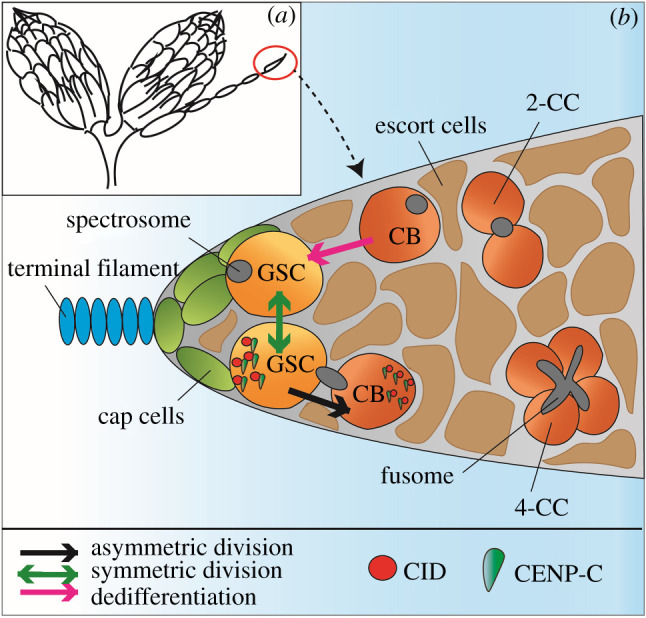
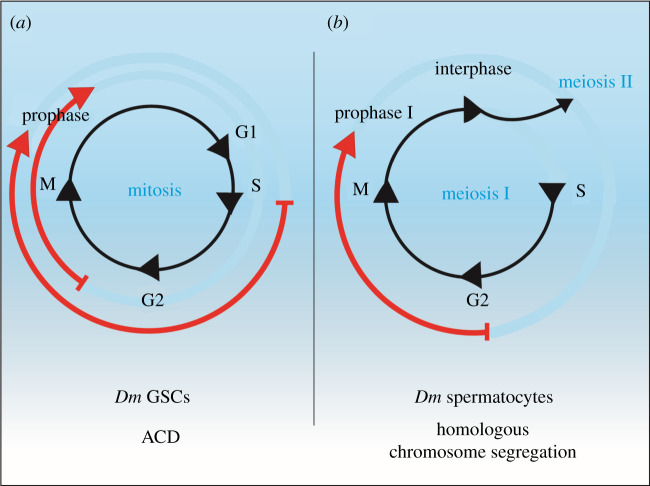
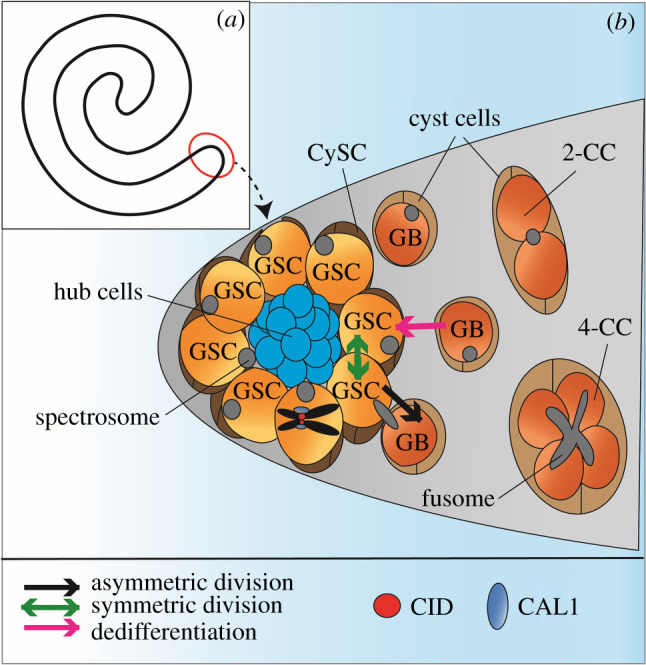
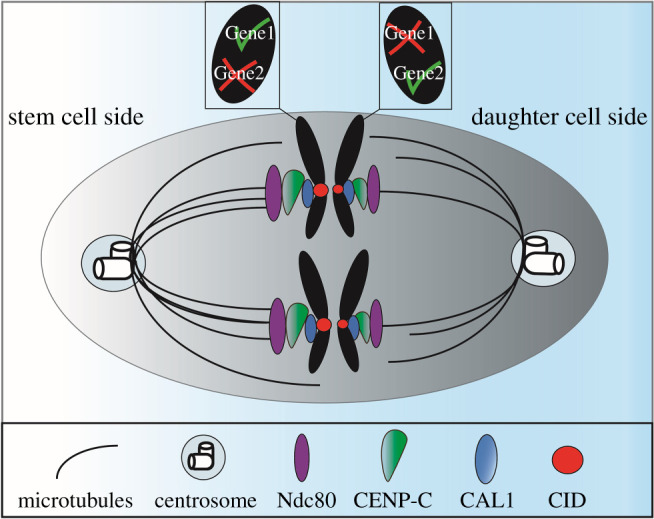
The centromere is the constricted chromosomal region required for the correct separation of the genetic material at cell division. The kinetochore protein complex assembles at the centromere and captures microtubules emanating from the centrosome to orchestrate chromosome segregation in mitosis and meiosis. Asymmetric cell division (ACD) is a special type of mitosis that generates two daughter cells with different fates. Epigenetic mechanisms operating at the centromere have been proposed to contribute to ACD. Recent studies have shown that an asymmetric distribution of CENP-A-the centromere-specific histone H3 variant-between sister chromatids can bias chromosome segregation in ACD. In stem cells, this leads to non-random sister chromatid segregation, which can affect cell fate. These findings support the 'silent sister' hypothesis, according to which the mechanisms of ACD are epigenetically regulated through centromeres. Here, we review the recent data implicating centromeres in ACDs and cell fate in female and male germline stem cells.
着丝粒是细胞分裂时正确分离遗传物质所需的紧缩染色体区域。动粒蛋白复合物在着丝粒处组装,并捕获来自中心体的微管,以协调有丝分裂和减数分裂中的染色体分离。不对称细胞分裂 (ACD) 是一种特殊的有丝分裂,它产生具有不同命运的两个子细胞。在着丝粒处的表观遗传机制被认为有助于 ACD。最近的研究表明,姐妹染色单体之间着丝粒特异性组蛋白 H3 变体 CENP-A 的不对称分布可以使 ACD 中的染色体分离产生偏差。在干细胞中,这导致姐妹染色单体的非随机分离,这可能会影响细胞命运。这些发现支持“沉默姐妹”假说,根据该假说,ACD 的机制通过着丝粒被表观遗传调控。在这里,我们回顾了最近的数据,这些数据表明着丝粒在雌性和雄性生殖干细胞中的 ACD 和细胞命运中起作用。