Fogante M, Cavagna E, Rinaldi G
Azienda Ospedaliera "Ospedali Riuniti", Ancona, Italy.
Ospedale "Infermi", Rimini, Italy.
Radiography (Lond). 2022 May;28(2):531-536. doi: 10.1016/j.radi.2021.10.012. Epub 2021 Oct 22.
To evaluate the radiological sequelae of coronavirus disease (COVID-19) in a mid-term follow-up and investigate their relationship with clinical-radiological findings.
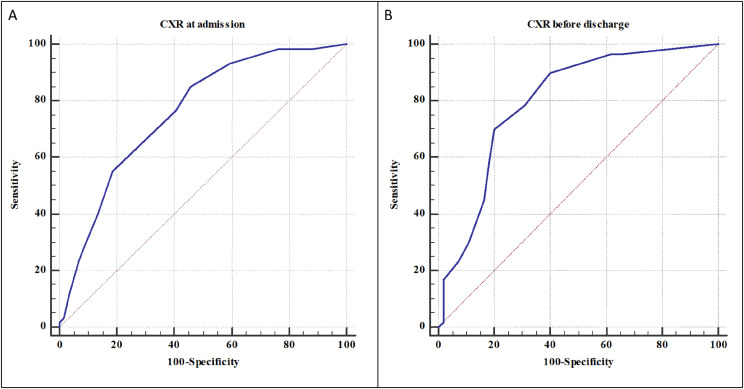
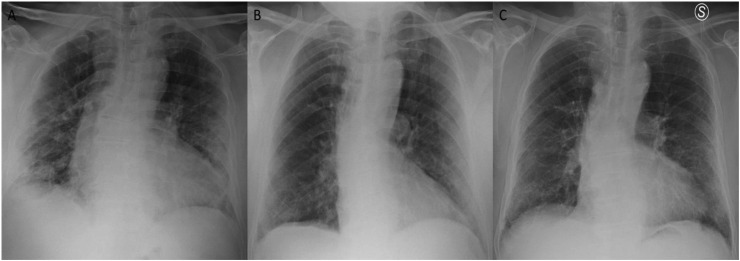
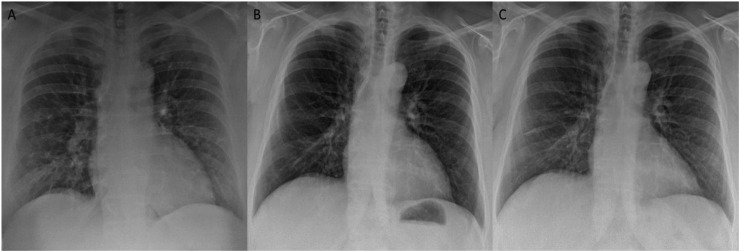
This prospective study included COVID-19 patients who underwent a CXR three months after discharge. The relationship between CXR score at three months after discharge and clinical findings and previous CXR scores, at admission and before the discharge, were evaluated. Then, based on mid-term follow-up CXR score, patients were divided in Group A (score = 0) and Group B (score≥1), and clinical-radiological findings were compared between two Groups. Finally, we calculated the CXR scores at admission and before the discharge with the highest sensitivity and specificity to predict normal and abnormal CXR score at mid-term follow-up.
The study included 119 patients, mean age 65.9 ± 14.6 years. The oxygen saturation (Sa) (p = 0.0006), the days of hospitalization (p < 0.0001) and the CXR score before the discharge (p = 0.0091) were independent factors to predict the mid-term follow-up CXR score. The Group A, 59 (49.6%) patients, had CXR scores at admission and before the discharge lower than Group B. The CXR scores at admission and before the discharge with the highest sensitivity and specificity to predict normal and abnormal CXR score at mid-term follow-up were, respectively, 3 and 2 (p < 0.0001).
The radiological abnormalities were present in about half patients three months after discharge, which had higher age, previous CXR scores and longer hospitalization. The S, days of hospitalization and previous CXR scores were independent factors for predicting the CXR at three months.
The radiologist with CXR could play a central role in mid to long-term follow-up of COVID-19, assessing the radiological sequelae of patients and identifying those who might require a closer follow-up.
在中期随访中评估冠状病毒病(COVID-19)的放射学后遗症,并研究它们与临床放射学表现之间的关系。
这项前瞻性研究纳入了出院三个月后接受胸部X线检查(CXR)的COVID-19患者。评估出院三个月后的CXR评分与临床结果以及入院时和出院前的既往CXR评分之间的关系。然后,根据中期随访CXR评分,将患者分为A组(评分=0)和B组(评分≥1),并比较两组之间的临床放射学表现。最后,我们计算入院时和出院前具有最高敏感性和特异性的CXR评分,以预测中期随访时正常和异常的CXR评分。
该研究纳入了119例患者,平均年龄65.9±14.6岁。血氧饱和度(Sa)(p=0.0006)、住院天数(p<0.0001)和出院前的CXR评分(p=0.0091)是预测中期随访CXR评分的独立因素。A组有59例(49.6%)患者,其入院时和出院前的CXR评分低于B组。在预测中期随访时正常和异常CXR评分方面,入院时和出院前具有最高敏感性和特异性的CXR评分分别为3分和2分(p<0.0001)。
出院三个月后,约一半患者存在放射学异常,这些患者年龄较大、既往CXR评分较高且住院时间较长。Sa、住院天数和既往CXR评分是预测三个月时CXR的独立因素。
进行CXR检查的放射科医生在COVID-19的中长期随访中可发挥核心作用,评估患者的放射学后遗症,并识别那些可能需要密切随访的患者。