Department of Integrated Traditional Chinese and Western Medicine, Sichuan University West China Hospital, Chengdu, Sichuan, China.
Department of Gastrointestinal Surgery, Sichuan University West China Hospital, Chengdu, Sichuan, China.
BMJ Open. 2021 Nov 2;11(11):e053309. doi: 10.1136/bmjopen-2021-053309.
Abdominal surgery is associated with common complications, including decreased or poor appetite, abdominal distension, abdominal pain caused by decreased or absent gastrointestinal motility, anal arrest with flatus and defecation, and nausea and vomiting resulting from the use of anaesthetics and opioid analgesics. These complications seriously affect postoperative recovery, prolong hospital stay and aggravate patient burden. This study aims to investigate for the first time the efficacy of transcutaneous electrical acupoint stimulation (TEAS) combined with electroacupuncture (EA) therapy for rapid recovery after laparotomy for gastrointestinal surgery. There have been no clinical studies of this combination therapy.
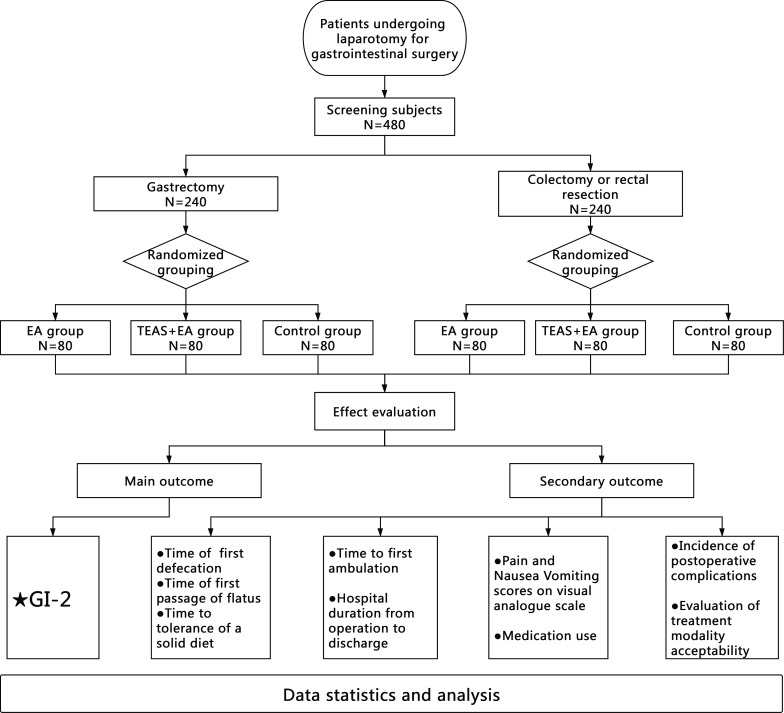
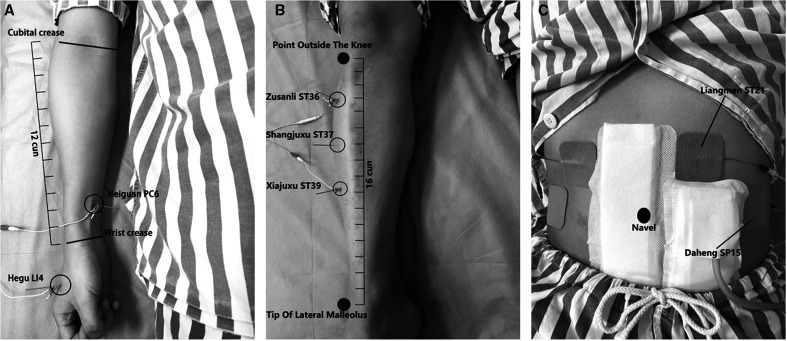
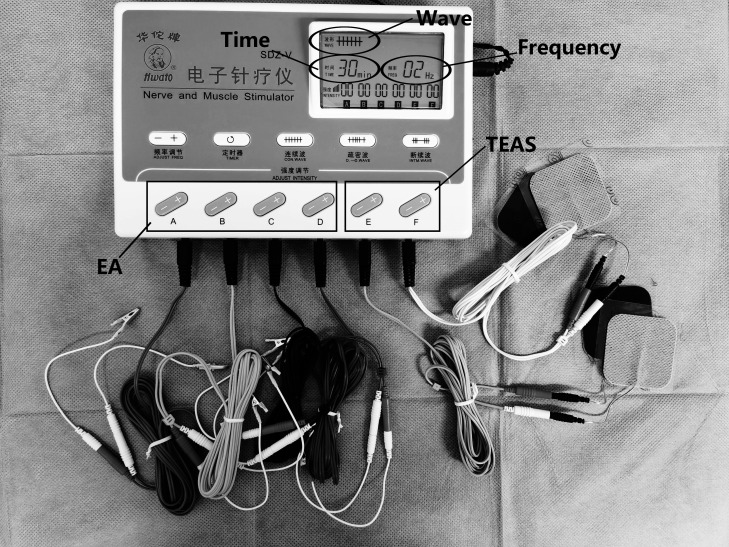
This will be a prospective, single-centre, three-arm, randomised controlled trial. A total of 480 patients undergoing abdominal surgery will be stratified according to surgery type (ie, gastric or colorectal procedure) and randomised into three groups; namely, the EA, TEAS +EA and control groups. The control group will receive enhanced recovery after surgery (ERAS)-standardised perioperative management, including preoperative education, optimising the anaesthesia scheme, avoiding intraoperative hypothermia, restrictive fluid infusion and reducing surgical trauma. The EA group will receive EA stimulation at LI4, PC6, ST36, ST37 and ST39 based on the ERAS-standardised perioperative management. Moreover, the TEAS +EA group will receive ERAS-standardised perioperative management; EA stimulation at the LI4, PC6, ST36, ST37 and ST39; and TEAS stimulation at ST21 and SP15. The primary outcome will be the GI-2 (composite outcome of time to first defaecation and time to tolerance of a solid diet). Secondary outcomes will include the time of first passage of flatus, time to first defaecation, time to tolerance of a solid diet, time to first ambulation, hospital duration from operation to discharge, pain and nausea vomiting scores on the Visual Analogue Scale, medication use, incidence of postoperative complications and evaluation of treatment modality acceptability. All statistical analyses will be performed based on the intention-to-treat principle.
Ethics approval has been granted by the Ethics Committee on Biomedical Research, West China Hospital of Sichuan University (approval number: 2021; number 52). The results are expected to be published in peer-reviewed journals.
ChiCTR2100045646.
腹部手术常伴有一些常见并发症,包括食欲减退或不佳、腹胀、胃肠蠕动减弱或消失引起的腹痛、肛门停止排气排便、麻醉和阿片类镇痛药引起的恶心呕吐等。这些并发症严重影响术后恢复,延长住院时间,加重患者负担。本研究首次探讨经皮穴位电刺激(TEAS)联合电针对胃肠外科手术后快速康复的效果。目前尚无这种联合治疗的临床研究。
这将是一项前瞻性、单中心、三臂、随机对照试验。将根据手术类型(即胃或结直肠手术)对 480 名接受腹部手术的患者进行分层,并随机分为三组:即电针组、TEAS+电针组和对照组。对照组将接受加速康复外科(ERAS)标准化围手术期管理,包括术前教育、优化麻醉方案、避免术中低体温、限制液体输注和减少手术创伤。电针组将在 ERAS 标准化围手术期管理的基础上接受 LI4、PC6、ST36、ST37 和 ST39 的电针刺激。此外,TEAS+电针组将接受 ERAS 标准化围手术期管理;LI4、PC6、ST36、ST37 和 ST39 的电针刺激;以及 ST21 和 SP15 的 TEAS 刺激。主要结局将是 GI-2(首次排便时间和首次耐受固体饮食时间的复合结局)。次要结局包括首次排气时间、首次排便时间、首次耐受固体饮食时间、首次下床时间、从手术到出院的住院时间、视觉模拟量表的疼痛和恶心呕吐评分、药物使用、术后并发症发生率以及治疗方式可接受性评估。所有统计分析均将基于意向治疗原则进行。
已获得四川大学华西医院生物医学研究伦理委员会的伦理批准(批准号:2021;编号 52)。研究结果预计将发表在同行评议期刊上。
ChiCTR2100045646。